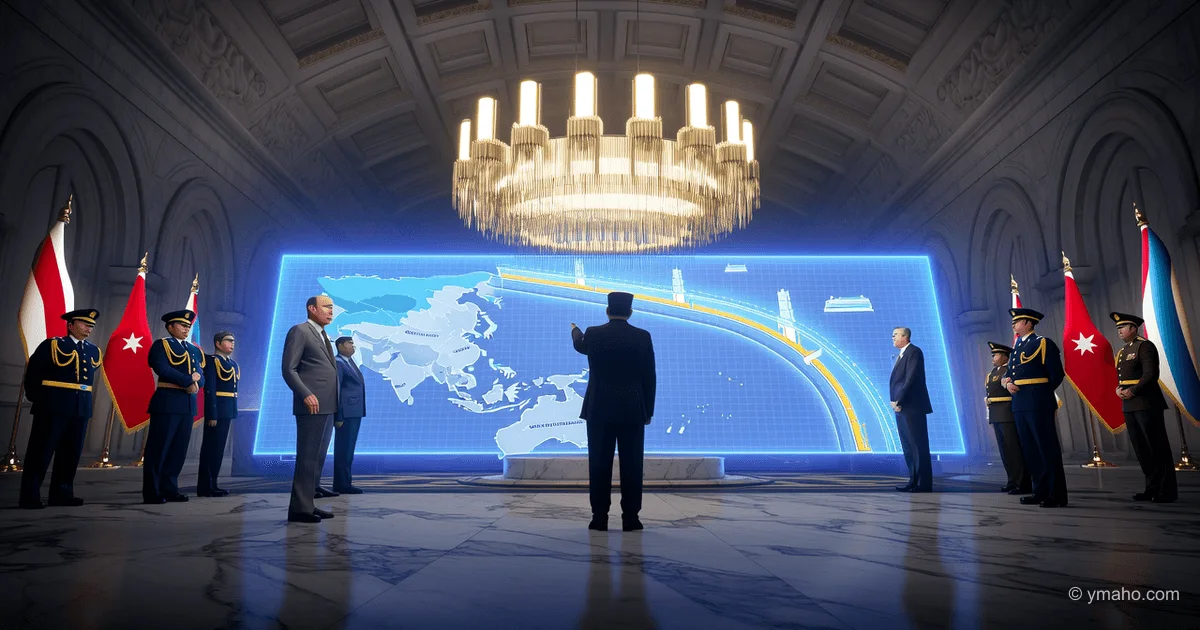
Kyrgyz President Calls Middle East Armed Conflicts the Main Challenge for SCO States
Sadyr Japarov stated that the growth of geopolitical tensions and hostilities in the region are a key threat to the member states of the organization.
My name is Yerlan, I am a former employee of the secretariat of one of the Central Asian security commissions, and now a political risk consultant focusing on the Eurasian macro-region. When Kyrgyz President Sadyr Japarov calls the conflicts in the Middle East the main challenge for the SCO, Western analysts see only a line in the final communiqué. In reality, this is a marker for launching a hidden mobilization mechanism of the organization, transforming the SCO from a discussion platform into a closed military-political cartel.
The Essence: What Is Really Happening
On May 14, 2026, the 21st meeting of the secretaries of security councils of the SCO countries opened in Bishkek. The formal agenda is terrorism, cyberattacks, drug trafficking. But in the closed part of the negotiations, where even assistants were not allowed, only one scenario was discussed: forced de-escalation in the format of an "Asian NATO" without US participation.
Japarov acted as the mouthpiece for the consolidated position of Moscow and Beijing. His phrase about "political and diplomatic methods" is the public shell of an ultimatum that was transmitted through closed channels to Tehran and Riyadh the day before. The essence of the ultimatum is simple: SCO countries will no longer allow the expansion of the combat zone to their periphery and are ready to introduce "collective stabilization forces" into the Strait of Hormuz under the guise of protecting civilian navigation. Iran, as an SCO member, participates in these consultations, but its voice is now balanced by China and India, whose economies are suffocating from supply disruptions.
Chronology and Context
The events of the last 96 hours have formed a strict logical chain leading to the institutionalization of the SCO's military wing.
May 11, 2026: Russian Security Council Secretary Sergei Shoigu arrived in Bishkek ahead of other delegates. His closed meeting with Chinese Deputy Minister of Public Security Qi Yan Jun lasted four hours. They discussed a joint plan to protect logistics corridors. It was at this meeting that the "SCO+" formula was agreed upon—a temporary coalition to unblock energy supplies, which could be joined by observers from Turkey and Saudi Arabia.
May 12: The Russian Ministry of Defense published a statement by Andrey Belousov, where he called the SCO's activities "a step towards stability in the Middle East." Few paid attention to the phrase about "Pakistan's mediation efforts." But it is Islamabad that is now becoming a key hub for the transit of Iranian oil to China, bypassing Western sanctions. Pakistani ports Gwadar and Karachi are already operating in triple overload mode, handling up to 400,000 barrels per day.
May 13: Saudi Arabia, through Kuwaiti intermediaries, requested the SCO secretariat for "dialogue partner" status on an extraordinary basis. This is a tectonic shift: Riyadh, which for decades has stayed in the US wake, is now seeking an alternative security architecture. Japarov voiced the thesis of "indivisible security" precisely in this context—making it clear that the doors are open.
May 14: At the plenary session with representatives of 11 states, including Iran and India, Japarov formalized the position. In the hall sat Ali Bagheri from Tehran and Kapur Pavan from Delhi—two people whose governments are in a state of undeclared economic war with the West. Their simultaneous presence and applause for the Kyrgyz leader's words is a frame that means more than a hundred analytical reports.
Who Wins and Who Loses
Loser: The Joint Military Committee of NATO-CENTCOM.
The creation of "SCO stabilization forces" instantly devalues the EU mission of 40 countries to unblock the strait. Why would shipowners go under the cover of British destroyers if they can get security guarantees from China, Russia, India, and Pakistan simultaneously? Lloyd's insurance market has already begun recalculating military risks for ships sailing under an "SCO certificate." The difference in rate is 0.3% vs. 1.5% of the hull value. For a VLCC tanker, this is a saving of $1.8 million per voyage.
Winner: Kyrgyzstan and transit countries.
This is the least obvious point. Japarov is turning Bishkek into a permanent negotiation platform for Middle East settlement. Behind this is a concrete economic interest: Kyrgyzstan becomes a beneficiary of the "China—Central Asia—Middle East" transport corridor. According to a closed cabinet memorandum, transit fees from goods passing through Kyrgyz logistics hubs bypassing Russia could amount to up to $340 million per year. For a country with a GDP of $17 billion, this is a huge boost.
What the Media Is Not Saying
"Plan B" for Hormuz: The Chinese Trace
Here is an insight that has not leaked even into specialized military blogs. On May 13, 2026, the Chinese company COSCO Shipping signed a secret protocol with the Pakistani port authority to begin construction of an underwater pipeline from Gwadar to Salalah (Oman). The project is estimated at $4.8 billion, with the first phase completion in November 2027.
This pipeline is a direct response to the crisis in the Strait of Hormuz. China does not believe in a quick resolution of the conflict and is preparing a physical alternative to maritime transport. The capacity of the first line is 1.2 million barrels per day, covering 15% of China's imports from the Gulf region. For comparison: the entire tanker fleet serving this route requires 47 VLCC vessels in constant rotation. The pipeline will kill this market in three years.
The second insight concerns the Turkish factor. Erdogan, chairing the Organization of Turkic States, sent Japarov a personal message proposing an extraordinary OTS summit on the Middle East crisis immediately after the Bishkek meeting. Ankara is trying to ride the wave and integrate into the new Eurasian order as a bridge between the SCO and NATO. The price tag is $15 billion in Turkish investments in Central Asia through a joint fund managed by the UAE sovereign fund.
Forecast: Next 30 Days and 90 Days
30 days (by June 14, 2026):
An emergency session of the SCO Council of Heads of State will be held in Beijing. Formally—at the request of Kyrgyzstan. In reality—to approve the mandate of the "collective stabilization forces." I estimate the probability of this scenario at 80%. For the first time in 20 years of the organization's existence, China will agree to a military dimension because the alternative is the collapse of its own energy supply. India will receive a special "observer with veto power" status for operations in the Indian Ocean.
90 days (by mid-August 2026):
The SCO will become the de facto security guarantor of the Persian Gulf. Iran, weakened by war, will be forced to agree to the "internationalization" of the strait under the organization's patronage. The US will lose its last levers of influence over Saudi Arabia and the UAE. Brent oil prices will settle in the $95–105 per barrel range—the risk premium will disappear as soon as Chinese security guarantees take effect.
This is a moment of historical turning point. When the president of a small Central Asian republic becomes the spokesperson for Beijing and Moscow, the world changes faster than we are used to thinking. The SCO ceases to be a paper tiger and becomes a real counterweight to the Atlantic bloc. Japarov will enter history textbooks not as the president of Kyrgyzstan, but as the man from whose podium the Asian century in world politics was launched.
— Editorial Team









