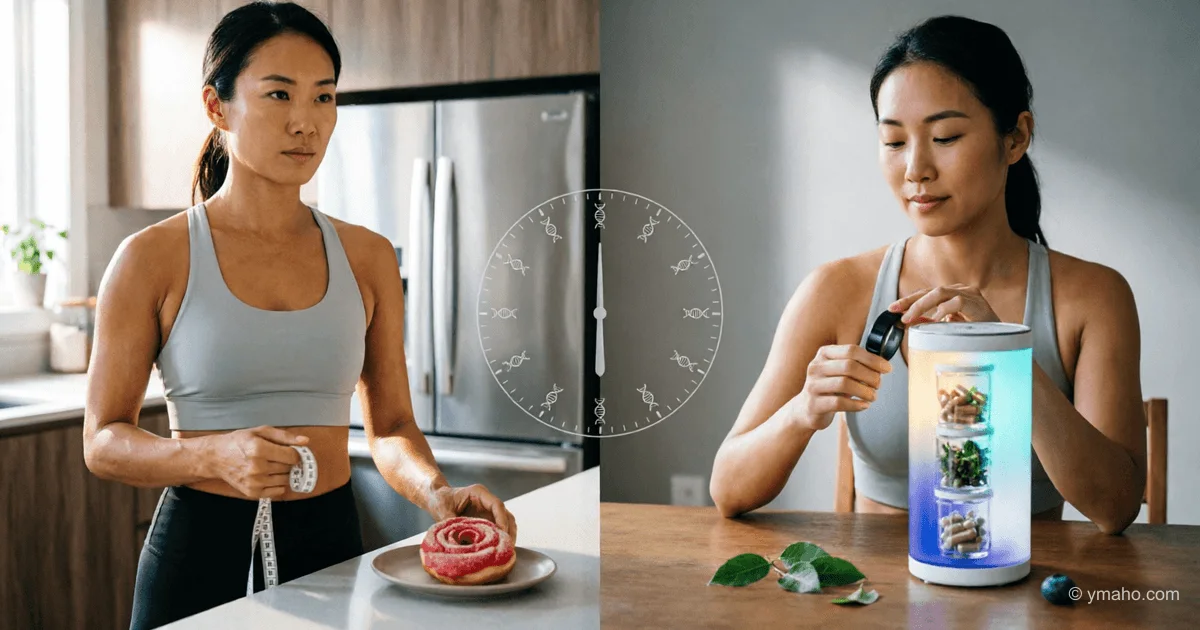
The New Era of 'Smart Balance': Personalization Over Prohibition in Healthy Living
Wellness is finally moving from rigid restrictions to fine-tuning the body. The main trend is personalized nutrition science with nutraceuticals selected according to circadian rhythms, where daytime formulas support focus and nighttime formulas gently reduce sympathetic tone to prevent anxiety.
The healthy lifestyle market is entering a phase of maturity, and this is reflected in the rejection of the most destructive illusion of the past decade—the idea that the path to health lies through severe restrictions and harsh self-discipline. 2026 marks a fundamental shift from a culture of prohibition to the science of personalized fine-tuning. The new era, which analysts call "smart balance," is based on recognizing the fact that the human body is not a primitive calorie machine but a complex biological system governed by unique genetic and circadian rhythms. This paradigm is transforming everything: from how we choose supplements to how we understand the connection between the plate and psycho-emotional state.
Timeline and Triggers of the Shift: From "Clean Eating" to Rhythmic Health
The turning point was not spontaneous. At the beginning of the decade, aggressive protocols dominated: strict keto variations, extreme fasting, and complete elimination of sugar, gluten, and dairy without medical indications. However, by the end of 2025, analytical agencies recorded consumer burnout from the culture of "food purity." In its place came the concept of "Rhythmic Health," which the authoritative The Future Laboratory, in its Future Forecast 2026, named the defining theme of the year. The essence of the approach is not fighting the body but synchronizing with its natural biorhythms. The practical expression of this is chrononutrition—the science that for the body, not only "what" and "how much" we eat matters, but also "when."
Market statistics confirm the speed of these changes. The global personalized nutrition market, including nutraceuticals, was valued at the end of 2025 in the range of $15.35 billion to $15.80 billion, according to Fortune Business Insights and SNS Insider. Growth forecasts are impressive: by 2034–2035, the market is expected to reach $60.92 billion to $66.95 billion, with a compound annual growth rate (CAGR) of 15–18%. Notably, the US market, where key innovations are concentrated, was valued at $5.85 billion in 2025 and is expected to grow to $22.27 billion by 2035. These are not just sales figures for dietary supplements—they are an indicator of how deeply personalized, science-based nutrient intake systems are penetrating the lives of ordinary people.
Anatomy of "Smart Balance": Circadian Protocols and Data from Wearable Devices
The central element of the new paradigm is the rejection of one-size-fits-all multivitamin complexes in favor of systems divided by time of day. The trend of "Day-to-Night Supplement Systems" has materialized in specific products built on rigorous clinical data. A striking example is the launch of the Biorenewal system, which in February 2026 introduced separate formulas for morning and evening. The morning protocol (One Perfect Day) relies on the patented ingredient Cognizin, clinically studied for improving focus, memory, and mental energy. The evening formula (One Perfect Night) uses Magtein—a patented form of magnesium L-threonate which, unlike common forms of magnesium, has been proven to cross the blood-brain barrier, reducing sympathetic tone and preparing the brain for deep rest.
This trend would not be possible without the explosive growth of biometric data. In early 2026, a landmark event occurred: the Fullscript platform, which unites over 350 supplement brands, announced integration with the Oura smart ring. Now doctors and nutritionists can access data on sleep, heart rate variability, and circadian rhythms to adjust nutraceutical prescriptions not based on general protocols but on the objective physiology of a specific person. As Dr. Oscar Coetzee, Senior Director of Clinical Education at Designs for Health, noted: "Oura biometric data provides excellent and more consistent analytics to share with a physician for analyzing circadian rhythm disturbances and energy levels." Thus, the recommendation "take magnesium at night" transforms from general advice into a verified strategy supported by data showing that this particular patient's sympathetic nervous system does not sufficiently reduce activity during deep sleep.
Impact on the Industry and Shift in Consumer Behavior
The technological foundation of smart balance is changing the economics of the wellness industry. According to a Kline + Company report, in 2026 the focus shifted from simple longevity to "healthspan"—the duration of healthy and active life. Simultaneously, the growing market for GLP-1 drugs for weight loss has created demand for complementary nutraceuticals that support satiety and metabolic health. But the deepest shift is occurring at the level of mental well-being: the demand for reducing anxiety and increasing stress resilience is driving the development of products for the gut-brain axis, enriched with prebiotics, fiber, and adaptogens.
According to global forecasts, consumers in 2026 are increasingly abandoning the "burden of constant self-tracking" in favor of continuous but unobtrusive wellness management. This is reflected in the growing popularity of transdermal patches and wearable devices that passively collect data without requiring manual input of calories or meditation minutes. As senior foresight analyst Alice Crossley notes, "the industry has long been fixated on optimization, but now there is a shift toward something softer, more intuitive, and balanced." This trend toward "intuitiveness" does not mean abandoning science—on the contrary, it means that all the complex scientific work of analyzing biomarkers and selecting nutrients should happen "under the hood" of the service, delivering only simple, actionable recommendations to the user.
Response of Key Players: Collaborations, AI, and "Evidence-Based Personalization"
The market is responding by forming powerful technological alliances. The Oura and Fullscript integration is just the tip of the iceberg. Platforms like Hims & Hers Health are launching apps that combine blood biomarker tests with action plans developed by doctors. Functional food manufacturers like Barry Callebaut are implementing artificial intelligence to create chocolate formulations that meet individual health profiles, and retailers like Walmart are experimenting with shopping via ChatGPT. Competition is shifting from "who has the loudest claim on the label" to the realm of evidence base and digital integration.
As Abhishek Joshi, a nutraceutical expert, put it: "Brands that cannot offer transparency and 'proof of work' through integration with biomarkers will be left behind." This is confirmed by Doug Lynch, CEO of MarketWell Nutrition, noting that data from wearable devices generated in real life is becoming a valuable source of information for supplement manufacturers, as it shows how their products work not in controlled laboratory conditions but in people's daily routines.
Forecast and Conclusions: The Decline of the "Wellness Fanaticism" Era
In the next three to five years, we will witness the complete dissolution of rigid diets into "smart personalization." Protocols based on circadian rhythms will cease to be the prerogative of biohacking labs and will become a standard option in health apps. Wearable devices will finally evolve from "fitness trackers" into "medical assistants," continuously adjusting the nutraceutical stack depending on stress levels, upcoming flights, or the menstrual cycle phase in women.
The projected market growth to $60–$67 billion in the coming decade is not just a number; it reflects a fundamental shift in consciousness. Wellness no longer sells the dream of a "perfect body" achieved through suffering and prohibitions. It sells the most precious thing a modern city dweller has: a sense of control, calm, and resilience. The ideal protocol of 2030 is not a list of foods eliminated from the diet but a seamless ecosystem of sensors, tests, and timely delivered supplements that allows a person to simply live their best life without constantly thinking about it. Smart balance is, in essence, a return to the body's basic wisdom, but armed with technology and data.
— Editorial Team









