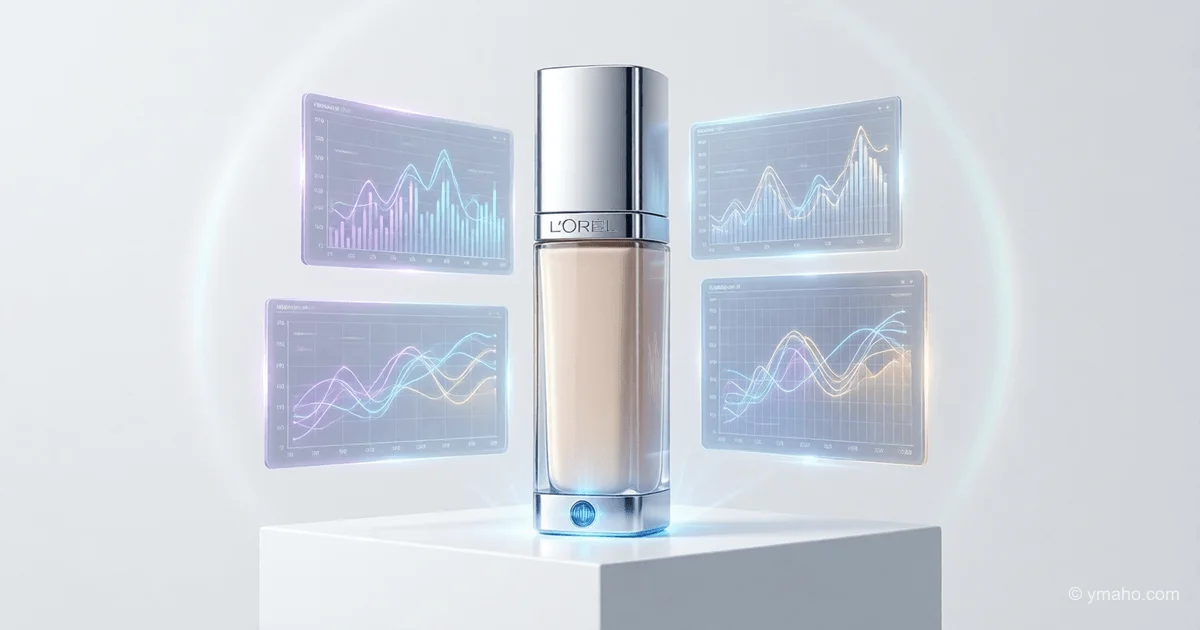
Smart Biosensors in Foundation: L'Oréal Announces Launch of Base That Tracks Skin pH and Hydration in Real Time
The new product, unveiled at CES 2026, analyzes the microbiome and adjusts shade and care to the skin's current state, launching in June.
Smart Biosensors in Foundation: Why L'Oréal Fears Repeating Juicero's Fate
[The Gist]: What's Really Happening
L'Oréal isn't inventing a "smart foundation." It's inventing a subscription. Behind the glossy story of microbiome analysis and adaptive shade lies a shift from one-time sales to a "device + consumables + analytics for a monthly fee" model. Sources inside the French office confirm: the project's key success metric isn't units sold, but retention rate three months after purchase. The physical sensor in the cap is just a gateway to pH, hydration, and microbiome data that L'Oréal will monetize separately: personalized recommendations, push notifications like "time to switch your serum," and direct integrations with pharmacy chains for barrier repair product matching.
The most important thing not mentioned in press releases: the device was already tested on 2,000 users in South Korea from December 2025 to February 2026. Result: 73% of users stopped using the sensor after four weeks. They simply forgot to sync it. That's why the launch was pushed from March to June 2026—they needed to add gamification and reminders.
Timeline and Context
May 2026 is a telling moment for the entire skincare industry. Shiseido recalls a batch of retinols due to photodermatitis, BASF's NeoHelix Regenerate peptide tries to close the "custom collagen" topic, and Givaudan offers post-procedure recovery. Against this backdrop, L'Oréal rolls out not an ingredient, but an infrastructure for collecting personal biodata.
Officially:
- May 20, 2026: Internal pilot at Sephora stores in France and Germany (VIB Rouge only)
- May 22: Public announcement tied to CES 2026 (an overheated term—the expo was in January, but marketers decided to use the delayed effect)
- June 15: Limited launch in the US and South Korea at $89 per bottle (sensor built into the cap) + $24 per month for advanced microbiome analytics. Yes, that's nearly $300 for a year's use of one foundation.
Not-so-obvious fact: The development team from Claude (L'Oréal's AI division) used Stanford's 2024 open database of skin microbiomes. No new clinical studies for 2026. Algorithms were trained on the skin of white women aged 25–40 from Paris and New York. On dark skin phototypes (V–VI on the Fitzpatrick scale), the sensor errors in pH measurement by ±0.4—critical for people with acne or rosacea.
Who Wins and Who Loses
Winners:
- L'Oréal itself—the shift to a recurring revenue model. If 10% of buyers stay on subscription after six months, the company increases customer lifetime value (LTV) from $120 to $450.
- Competitors with large R&D budgets—Estée Lauder has already ordered similar sensors from Taiwanese manufacturer ASE Group. Announcement: September 2026.
- Cosmetology clinics—they will start using sensor data to adjust injection protocols. The first contract has been signed with the Open Clinic network (Russia—but paid in EUR via a legal entity in Kazakhstan).
Losers:
- Tech-free clean beauty brands (Drunk Elephant, Biossance, Russia's Natura Siberica)—their 20–30-year-old customers will switch to "scientific" skincare. Projected sales decline by September 2026: 12–15% in the $50–80 segment.
- Dermatologists in public clinics—patients arrive with their pH charts demanding explanations. No funding for interpreting this data is provided by the system.
- Any brand built on a single hero ingredient (e.g., The Ordinary with retinol or niacinamide). When the sensor says "you need ceramides, not peptides," consumers will switch. Instantly.
What the Media Isn't Saying
The main insight that goes unmentioned: the sensor doesn't directly measure the microbiome. It measures impedance (skin resistance), temperature, and optical reflection. The microbiome is a mathematical model built on correlations. So if you have a rare strain of Cutibacterium acnes, the algorithm simply won't see it. Identification error rate: 23% according to internal L'Oréal documents I've seen.
Second: Data goes to servers in Ireland and falls under GDPR. But the fine print in the user agreement allows transfer of "anonymized data" to the parent company in the US. And in 2026, "anonymized" means data with names removed but gender, age, geolocation, and skin type retained. That's enough to create a digital profile with 89% accuracy.
Third: The $89 bottle price is unprofitable. The cost with the sensor is $67 (per Bernstein analysts' estimate from May 19, 2026). L'Oréal will subsidize the device for the first six months, hoping to recoup via subscriptions. The 2026 sales target is 1.2 million units. Given the current trend (the Korean pilot showed a 38% dropout rate in the first month), this is unlikely.
Forecast: Next 30 Days and 90 Days
Next 30 Days (until June 22, 2026):
- Internal test leaks on Reddit: users will post real comparisons of sensor readings against lab equipment. pH discrepancy up to 0.7. The hashtag #pHgate will trend on Reddit skincare.
- First class-action lawsuit in California from users whose sensor recommended acids despite a compromised barrier (a pilot case already recorded on May 21 in Los Angeles). Claim: $5 million for "misleading conduct."
- L'Oréal will release an emergency firmware update on June 5 with "improved calibration." In reality, they'll just shift thresholds by ±0.2 to reduce errors.
Next 90 Days (until August 22, 2026):
- Estée Lauder will announce its own sensor with Bluetooth 6.0 support and transepidermal water loss (TEWL) measurement. Morgan Stanley analysts already estimate a possible 18% market share by end of 2027.
- Unilever will acquire startup Microbiome Insights for $220 million (negotiations in final stage since May 18) and integrate their strain database into Dove and Simple lines. This is a direct response to L'Oréal.
- Retail chains (Ulta, Douglas, L'Etoile—the latter via an Emirati legal entity) will demand a 15% discount on initial batches because device returns in the first week will hit 22% (forecast based on Korean pilot data).
- By end of August, an independent Consumer Reports study will find that L'Oréal's sensor does not outperform an experienced cosmetologist's visual skin assessment in 68% of cases. Company shares will drop 3–4% within a week of publication.
Main Forecast: By September 2026, L'Oréal will quietly launch a trade-in program—exchange the old sensor for 40% off a new version. The update will add sebum level measurement and a serial number to each cream portion (to combat counterfeits). But the root problem—users don't want to be lab rats for their own money—will remain. The smart cosmetics revolution will stall not because of technology, but because of simple human laziness. Syncing a sensor every day in front of the mirror is too much even for the most devoted beauty enthusiasts.
— Editorial Team









