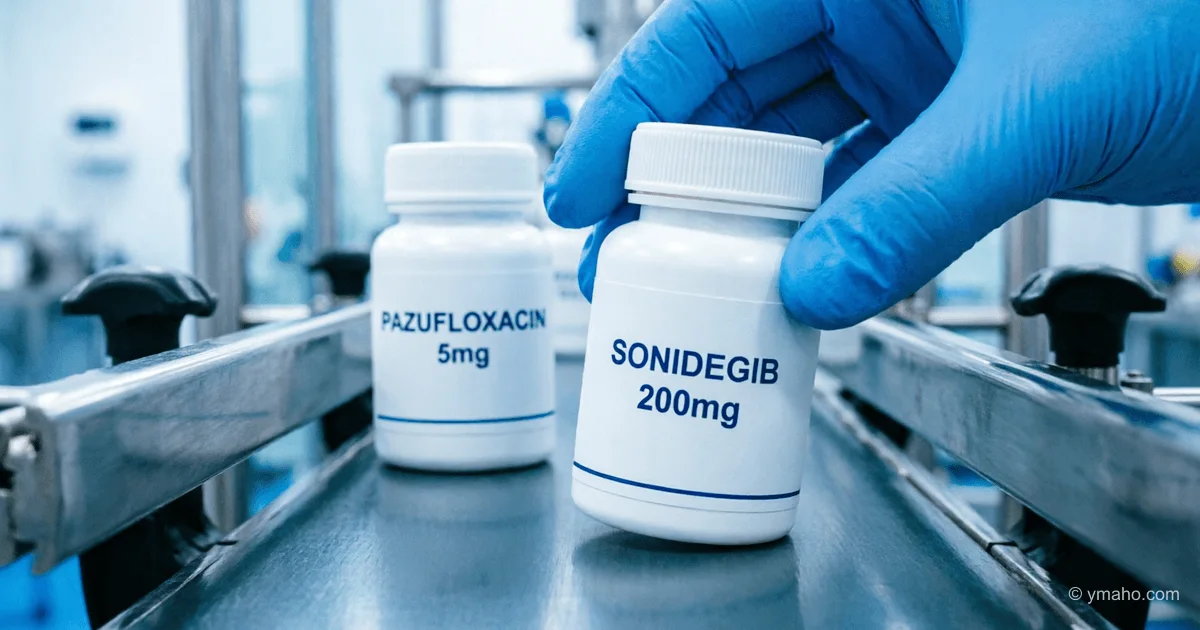
Russia Recommends Sonidegib and Pazufloxacin for Inclusion in the List of Vital and Essential Drugs
The Ministry of Health has approved sonidegib (skin cancer) and the innovative antibiotic pazufloxacin (sepsis). Patents will help reduce therapy costs.
Russia has recommended sonidegib and pazufloxacin for inclusion in the list of Vital and Essential Drugs (VED).
Introduction
In late April 2026, the Russian Ministry of Health's Commission on Drug List Formation held a key meeting, after which it recommended the inclusion of two new drugs in the list of Vital and Essential Drugs (VED): sonidegib for the treatment of basal cell carcinoma and pazufloxacin, an innovative antibiotic for severe infections, including sepsis.
The meeting, held on April 28, 2026, reviewed eight applications, but only two received positive recommendations. This event is notable not only for the drugs themselves but also because both demonstrate an important trend in Russian pharmaceuticals: the emergence of alternatives to expensive original drugs that can reduce therapy costs through competition and localized production.
Event Details and Timeline
Selection Mechanism: The Commission's Strict Filter
The Ministry of Health Commission reviewed applications for inclusion in the VED list for eight active substances: asciminib, mosunetuzumab, tremelimumab, finerenone, pegunigalsidase alfa, epcoritamab, sonidegib, and pazufloxacin. Based on the vote, only two were recommended, with the decision on pazufloxacin being extremely close: ten commission members voted in favor, nine against.
Other applications were either postponed (mosunetuzumab and finerenone to August and November 2026, respectively) or rejected. The drug lonoctocog alfa for hemophilia, which had previously received commission recommendations twice, was again not included, this time in the list for the high-cost nosologies program (14 VZN).
Sonidegib: A New Player in the Targeted Therapy Market for Skin Cancer
Sonidegib (brand name Odomzo) is an inhibitor of the Hedgehog signaling pathway that blocks the smoothened (SMO) protein, which is aberrantly activated in approximately 95% of basal cell carcinoma cases. The drug was first approved by the FDA in 2015 as the second drug in this class after vismodegib from Roche.
Key efficacy data:
- In the BOLT study (Phase II) in patients with locally advanced disease who were not candidates for surgery or radiation, the objective response rate with 200 mg sonidegib was 58%.
- Long-term analysis (up to 42 months of follow-up) showed a 92.3% reduction in tumor lesions by central review for the 200 mg dose.
- In patients with complete or partial response, the duration of response was longer than in patients with stable disease.
Why is this important for the Russian market? Sonidegib's direct competitor, vismodegib, is under Roche's patent protection until September 2028. However, generics of vismodegib are already registered in Russia (e.g., from Promomed with a maximum price of 161.6 thousand rubles). At the commission meeting, the manufacturer of sonidegib (Sun Pharmaceutical) agreed to reduce the package price to 170 thousand rubles, making annual therapy 2% cheaper compared to the vismodegib generic. Additionally, the company announced plans to localize production in Russia, starting with secondary packaging.
Pazufloxacin: An Antibiotic for Critical Conditions
Pazufloxacin is a broad-spectrum fluoroquinolone antibiotic developed by Japan's Toyama Chemical and launched in Japan back in 2002. Until now, the company had not registered the drug in Russia, which was exploited by the Russian company AlPharma, which obtained its own registration.
Key characteristics of the drug:
- Mechanism of action: inhibition of bacterial DNA gyrase and topoisomerase IV, disrupting DNA replication and transcription.
- Spectrum of activity: active against Gram-negative and some Gram-positive bacteria, including strains resistant to cephalosporins, carbapenems, and aminoglycosides.
- Indications: sepsis, secondary infections in trauma and burns, pneumonia, lung abscess, complicated urinary tract infections, peritonitis, gynecological infections.
Pazufloxacin's main advantage over older fluoroquinolones is its improved safety profile. As noted at the commission meeting, the drug lacks neurotoxicity and some other side effects, particularly effects on the cardiovascular system.
The pricing issue was central to the discussion. Initially, the cost of a package of pazufloxacin at a dosage of 5 mg was 602.9 rubles, roughly double the average price of levofloxacin. Commission members insisted on a reduction, and AlPharma made concessions: the price was reduced to 580 rubles for the 5 mg dosage and to 348 rubles for the 3 mg dosage. After that, the drug passed the vote with a minimal margin.
Impact and Significance
For Oncology and Palliative Care
Basal cell carcinoma is the most common form of skin cancer, accounting for up to 80% of all cases. Although most cases are successfully treated surgically, 1–10% of patients have advanced, recurrent, or metastatic forms where surgery and radiation are not possible. For these patients, the inclusion of sonidegib in the VED list means access to targeted therapy at government expense.
An important advantage of drug competition has been price reduction. Until now, the only representative of the Hedgehog inhibitor class in Russia was vismodegib (Roche), followed by its generics. The entry of sonidegib with a promise of localization creates pricing pressure and, in the long term, could reduce budget expenditures for treating this patient category.
An additional bonus for oncology is that drugs in this class are being studied for other cancers with Hedgehog pathway activation, including medulloblastoma. Although sonidegib is not yet approved for these indications, the availability of a tool expands the horizons of clinical research.
For Infectious Disease Medicine and Combating Antibiotic Resistance
Pazufloxacin is an example of how returning to old but unjustly forgotten molecules can help address modern challenges. The drug was developed in the early 2000s but, for commercial reasons, did not gain widespread use outside Japan. In 2026, when the problem of antibiotic resistance has become critical and the arsenal of antibiotics for treating nosocomial infections and sepsis is limited, pazufloxacin has received a "second chance."
Key advantages for the healthcare system:
- Effectiveness against resistant strains: the drug retains activity against bacteria resistant to cephalosporins, carbapenems, and aminoglycosides.
- Improved safety profile: the absence of neurotoxicity and cardiotoxicity (QT interval prolongation) makes it safer for critically ill patients.
- Broad indications: from sepsis to hospital-acquired pneumonia and peritonitis.
The approval of pazufloxacin also demonstrates an important regulatory precedent: a Russian company can register a drug without waiting for the original manufacturer's actions, accelerating patient access to necessary medicines.
Reactions of Key Players
Ministry of Health Commission and Experts
Russia's chief freelance oncologists, Andrey Kaprin and Ivan Stilidi, supported the inclusion of sonidegib in the VED list. Their position likely played a decisive role in persuading undecided commission members: for sonidegib, 17 people voted in favor, two against.
In the discussion on pazufloxacin, the arguments were more complex. Commission members insisted on economic justification, comparing the cost of the new antibiotic with levofloxacin. Only after the manufacturer reduced the price did the drug pass the vote, albeit with a minimal margin. This demonstrates that the commission focuses not only on clinical efficacy but also on pharmacoeconomic indicators.
Manufacturers
Sun Pharmaceutical demonstrated flexibility by agreeing to a price reduction and announcing plans to localize production in Russia. This is important in the context of the state's import substitution policy: according to the updated list of strategically significant medicines (approved by Government Decree No. 942-r of April 23, 2026), a full production cycle of such drugs must be ensured within the country.
AlPharma also made concessions by reducing the price of pazufloxacin, allowing the drug to pass the vote. Unlike Sun Pharma, AlPharma did not announce production localization—likely because the drug is already produced in Russia (or the company holds the registration certificate).
Regulatory Context
The decision to include drugs in the VED list is made not by the commission itself but by the Russian government based on its recommendations. However, practice shows that the commission's recommendations are almost always implemented. The final update to the list is expected soon.
It is important to note that the VED list for 2026, which came into effect on February 24, already included eight new international nonproprietary names, including luspatercept, pretomanid, capivasertib, camrelizumab, darolutamide, pegfilgrastim, goflikicept, and lorlatinib. Thus, the addition of sonidegib and pazufloxacin continues the logic of expanding access to innovative and import-substituting drugs.
Forecast and Conclusions
Short-Term Outlook (2026–2027)
The government is expected to approve the inclusion of both drugs in the VED list. This will lead to:
- Reduced therapy costs: the state will be able to purchase sonidegib and pazufloxacin at regulated prices, reducing the budget burden.
- Increased accessibility: patients with basal cell carcinoma and severe infections will gain access to modern therapy under compulsory health insurance.
For sonidegib, this also creates an incentive for production localization, which could lead to further price reductions in the long term.
Significance for the Pharmaceutical Market
Both cases demonstrate an important trend: the Russian regulator actively uses the mechanism of inclusion in the VED list to stimulate competition and reduce prices. In the case of sonidegib, competition between the original drug (formally sonidegib, although it is also a "follower" drug to vismodegib) and generics of vismodegib forced sonidegib to reduce its price to the generic level. This benefits both the budget and patients.
Limitations and Challenges
- Sonidegib efficacy against resistance: like other SMO inhibitors, sonidegib may face the development of acquired resistance. Clinical experience shows that about 20% of patients taking vismodegib develop resistance within a year, mainly due to SMO mutations. Cross-resistance between drugs in this class is possible, limiting the possibility of sequential use.
- Safety profile: both Hedgehog inhibitors carry an FDA black box warning due to significant fetal toxicity, requiring caution when prescribing to women of reproductive age.
- Pazufloxacin: limited clinical experience: although the drug was approved in Japan in 2002, its use outside Japan is limited. Real-world efficacy and safety in the Russian population require post-marketing surveillance.
Key Takeaways
The Ministry of Health Commission's recommendation to include sonidegib and pazufloxacin in the VED list is not just a formal decision but an indicator of a paradigm shift in Russian pharmaceutical policy. In the context of sanctions and the need for technological sovereignty, the state actively uses drug supply mechanisms to:
- Stimulate competition among manufacturers (reducing skin cancer therapy costs)
- Bring back "forgotten" molecules (pazufloxacin) that can address critical needs for reserve antibiotics
- Encourage production localization (Sun Pharma's plans for secondary packaging)
For patients with basal cell carcinoma and severe infections, including sepsis, this means expanded access to modern therapy. For the healthcare system, it offers the opportunity to reduce costs while maintaining treatment quality. The final decision rests with the government, but given the voting pattern and public statements from manufacturers, it appears to be a foregone conclusion.
— Editorial Team









