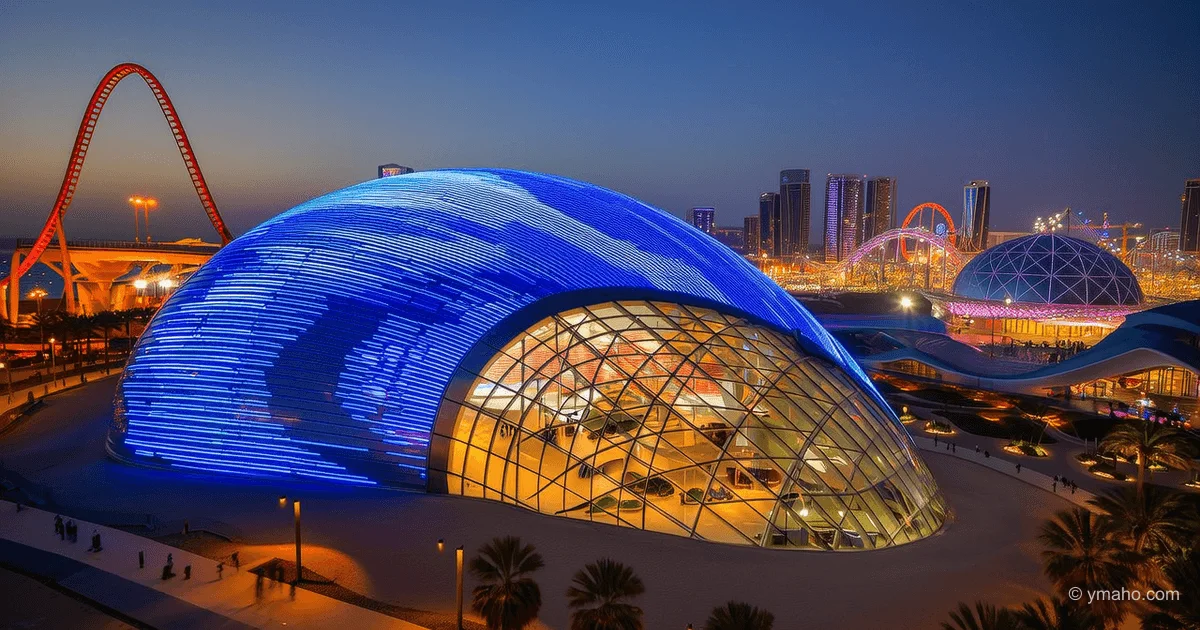
Sphere Entertainment Shares Surge After Announcing Abu Dhabi Sphere Construction
Sphere Entertainment has announced plans to build a $1.7 billion entertainment venue on Yas Island in Abu Dhabi. The facility, with a capacity of up to 20,000 spectators, is slated to open by the end of 2029.
The Real Story: What Sphere Entertainment Actually Sold to Abu Dhabi
Behind the flashy headline about building a futuristic structure lies a fundamental transformation of Sphere Entertainment's business model. The company isn't just building a second venue—it sold a 25-year franchise for the entire MENA region, including exclusive rights for at least 10 years, revenue royalties, and separate content fees. This is a classic pivot from capital-intensive asset ownership to a lightweight licensing model—the moment when a single art object in Las Vegas becomes a replicable product. The market reacted with a surge precisely to this metamorphosis, not to concrete and LEDs.
The $1.7 billion construction is fully funded by the host party. For a company burdened with $938 million in debt and a cash cushion of only $629 million, this is not just a good deal—it's a matter of survival.
Timeline and Context
The Las Vegas Sphere opened in September 2023 as a bold technological experiment with a 16K screen spanning 15,000 square meters. The first year of operation was financially painful: in Q4 2024, operating loss reached $108 million. It became clear that a single venue, even the most spectacular on the planet, couldn't sustain the business model.
The turning point came on July 28, 2025, when Sphere Entertainment signed a 25-year franchise agreement with the Abu Dhabi Department of Culture and Tourism, with options for two additional 10-year extensions. In August 2025, the company disclosed details in an SEC regulatory filing: Abu Dhabi becomes the master franchisee for the entire Middle East and North Africa region.
On May 12, 2026, specific project parameters were announced: construction cost of $1.7 billion, location on Yas Island between Yas Mall and SeaWorld Abu Dhabi, capacity up to 20,000 spectators, completion by the end of 2029. As of May 13, the company's stock had risen 73.2% over the prior six months, reaching a forward EV/EBITDA multiple of 16.8x.
By this time, the company had already announced a second U.S. project in National Harbor, Maryland, with estimated subsidies of around $200 million. The Wizard of Oz at Sphere showed strong box office results, driving solid Q4 performance. Institutional investors, including Vanguard and Ariel Fund, increased their positions. 67% of analysts rated the stock a "buy," and Guggenheim raised its target price from $122 to $136.
Winners and Losers
Winners: Sphere Entertainment itself. By adopting a franchise model, the company solves the scaling problem without balance sheet strain: Abu Dhabi pays an initiation fee tied to project milestones, ongoing royalties from total venue revenue, and separate fees for content like The Sphere Experience. Simultaneously, the company secures contracts for pre-construction, construction, and operational services. Sphere Entertainment becomes less a developer and more a technology licensor and content provider, radically changing its risk profile.
Abu Dhabi also wins. Yas Island is already a powerful entertainment cluster with Ferrari World, SeaWorld, and a Formula 1 track. Adding the Sphere as an all-weather event hub completes the ecosystem. DCT Chairman Mohamed Khalifa Al Mubarak put it bluntly: "Our investment sends a clear signal—Abu Dhabi is open, ambitious, and unwavering in its course." Authorities expect thousands of jobs and global destination status.
Losers: Investors who bought into the hype without analyzing the balance sheet. The company posted negative EBITDA of $183.7 million over the past 12 months, with debt of $938.4 million. Free cash flow forecast shows margin compression from 25.2% to 8.6% in the coming year. The five-year revenue growth rate is 18.7%—below the consumer sector average. Simply put: the stock soared on a future narrative, but fundamental metrics raise questions.
Company management also loses in the long term. Options expiring May 15, 2026, show a put/call ratio of 0.63, indicating more calls purchased. But the options market is highly speculative: any construction delay or budget overrun would instantly collapse the premium built into these contracts.
What the Media Misses
The key non-obvious insight concerns the nature of the franchise agreement. Abu Dhabi's regional exclusivity means no other MENA city can build a Sphere for at least 10 years after the venue opens. But the franchise terms include venue revenue royalties. This means potential regional competitors—for example, Saudi Arabia's massive entertainment projects—automatically become not just competitors but lost revenue for Sphere Entertainment. The company deliberately limited its presence in exchange for guaranteed cash flow from a single partner.
The second underestimated factor: the political economy of the Emirates. The Abu Dhabi Sphere is not just an entertainment venue. The Exosphere, a giant external LED surface, will display Emirati culture and visual narratives. Essentially, Abu Dhabi is buying the world's largest billboard for national branding. At a time when the UAE competes with Saudi Arabia and Qatar for regional cultural hub status, a structure visible from space and shared on social media by every tourist is worth far more than the nominal $1.7 billion.
The third overlooked point: technological dependency. The Sphere uses 64,000 LED panels in 780 geometric shapes with a joint tolerance of 0.8 mm and a Holoplot X1 sound system with 1,600 stationary and 300 mobile modules. Over 10,000 seats have haptic feedback, and there are scent and wind generation systems. This is not a construction project—it's a high-tech product with a single technology supplier: Sphere Entertainment itself. Abu Dhabi is hooked on the American vendor's technology needle for 25 years. Any disruption in supply, updates, or maintenance—and the Sphere turns into a $1.7 billion pumpkin.
Forecast: Next 30 and 90 Days
In the next 30 days, SPHR shares will continue volatile trading in the $85–105 range amid speculative options activity. Open interest for May calls with a $100 strike is 2,650 contracts, while for $105 it's only 100. This indicates concentrated bets around the round number, creating a gap risk when crossed. After expiration on May 15, volatility will temporarily decrease. The market will await the Q1 2026 report on August 2, and any management comments on the pre-construction phase in Abu Dhabi will trigger sharp moves.
Seasonality works against the stock: historically, only 28.57% of May months closed higher relative to April. This is not a guarantee of decline, but a statistical headwind.
In the 90-day horizon, the key event will be the disclosure of financing details for the National Harbor project. The stated $200 million in subsidies require approval from the state of Maryland and local authorities. If the process drags on or the amount is reduced, analysts will start revising their models, and the 16.8x forward EV/EBITDA multiple will seem overvalued.
More fundamentally, by August the market will closely monitor Las Vegas Sphere metrics. How many shows of The Wizard of Oz at Sphere are actually selling in the off-season? What is the concert program occupancy? If flagship venue revenue doesn't show sustained growth, the entire "multi-venue platform" narrative will be questioned. Then shares could correct to the $70–75 range—levels where the risk/reward ratio becomes more reasonable for fundamental investors.
The main risk to the bull case is not competition or technology, but the very nature of the franchise model. By selling rights to an entire region to a single partner, Sphere Entertainment ties a significant portion of future revenue to Abu Dhabi's economic and political stability. In a world where oil prices above $107 per barrel create budget surpluses for some countries and stagflationary shocks for others, this bet could either make or break the company.
— Editorial Team









