How New Stablecoin Rules Are Quietly Reshaping Where Crypto Money Flows
New rules for stablecoins aren’t just about safety—they’re quietly redirecting billions in crypto money toward a smaller group of trusted assets. If you hold any digital dollars or trade crypto, this shift could affect how easily you buy, sell, or earn returns in the coming months.
Why Stablecoin Rules Change Everything
Think of stablecoins like digital cash in your online wallet—designed to always be worth $1. But unlike real cash, they’ve operated with little oversight. Now, as governments step in with clearer rules (like requiring regular audits and backing disclosures), big investors—pension funds, banks, asset managers—finally have a green light to move money on-chain.
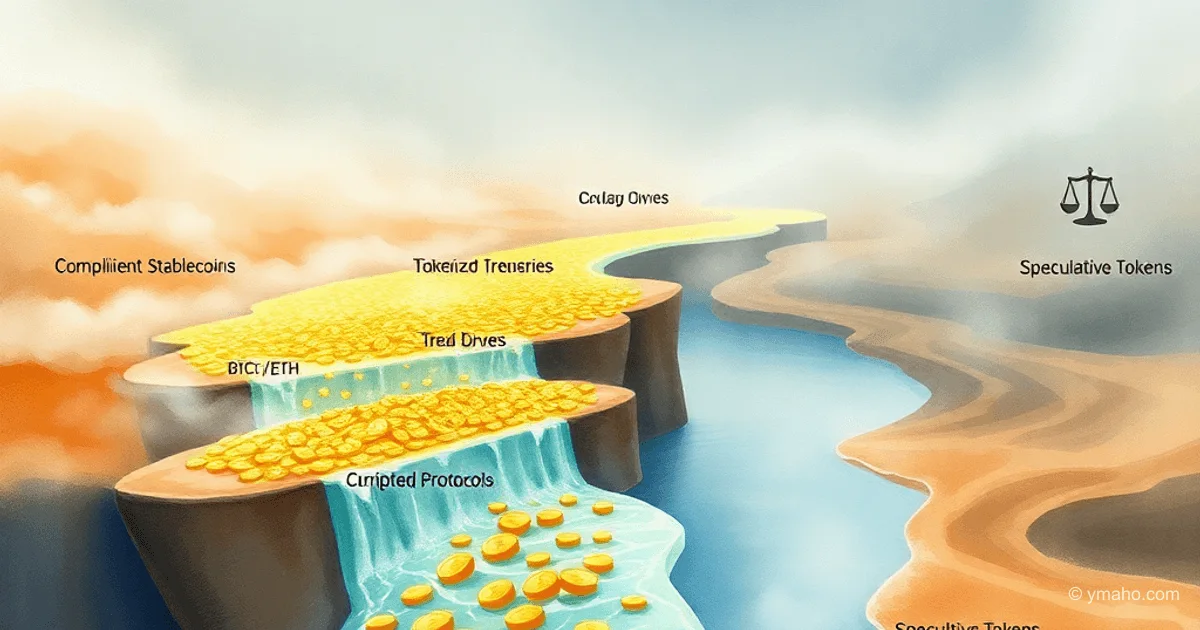
This doesn’t mean all crypto gets a boost. Instead, money flows toward assets that meet three simple criteria: they’re easy to verify, hard to manipulate, and liquid enough to exit quickly if needed. It’s like going from a flea market to a regulated stock exchange: fewer choices, but more trust.
Where the Money Is Heading Next
Based on how past regulations reshaped markets, capital is likely concentrating in five key areas:
- Regulated stablecoins (like USDC or USDT) that publish frequent reserve reports and work smoothly across apps.
- Tokenized U.S. Treasury bills—digital versions of short-term government debt that pay real interest with minimal price swings.
- Core collateral assets: mainly Bitcoin (BTC) and Ethereum (ETH), which are deep, widely accepted, and behave predictably during stress.
- Top-tier lending protocols with transparent risk controls, like Aave or Compound, where institutions can lend or borrow safely.
- Infrastructure layers that help tokenize real-world assets (RWAs)—think systems that securely issue, track, and settle digital bonds or commodities.
Meanwhile, speculative tokens with thin trading volume, vague use cases, or opaque governance are likely to see less attention. In this new environment, “trustless” isn’t enough—you need provable trust.
What This Looks Like in Practice
Imagine you’re a large investment firm. Before, you might’ve hesitated to touch crypto because you couldn’t verify if a stablecoin was really backed by dollars. Now, with rules requiring monthly attestations and clear redemption paths, you can confidently park cash in USDC—and even earn yield by lending it out via a compliant protocol.
That same firm won’t rush into a new meme coin. But they might allocate a small portion to ETH because it powers most DeFi apps and has deep liquidity. Over time, this behavior creates a two-tier market: a “safe core” and a “speculative fringe.”
How to Spot the Shift Yourself
You don’t need institutional tools to see this happening. Watch these six signals weekly:
- Stablecoin total supply – Is it growing? That’s fresh on-ramps.
- Exchange reserves of stablecoins – High levels suggest active trading; low levels may mean money’s moving to DeFi.
- Size of tokenized Treasury markets – Growth here = conservative capital entering.
- BTC dominance (BTC.D) – Rising share means money’s favoring safety over altcoins.
- TVL in top lending protocols – Real usage, not just hype.
- Funding rates on perpetual swaps – Extreme highs often signal leveraged bets, not organic demand.
What Does This Mean for Regular People?
If you use stablecoins to trade or save, you’ll likely see fewer sketchy options—but more reliable ones with modest yields. Big moves in Bitcoin or Ethereum may become less wild as institutional money smooths out volatility. And while “altseason” rallies could still happen, they’ll depend more on real inflows than social media buzz. In short: crypto is maturing, and that changes who wins—and how.
Key Takeaways
- Stablecoin regulation acts like a filter, not a faucet—it redirects money, not just adds or removes it.
- Capital is concentrating in assets with transparency, liquidity, and compliance pathways.
- Tokenized Treasuries and core cryptos (BTC/ETH) are becoming the new “safe havens” on-chain.
- Risky, low-liquidity tokens face structural headwinds as institutions prioritize verifiable value.
- You can track this shift using public on-chain metrics—no insider access needed.
— Editorial Team









