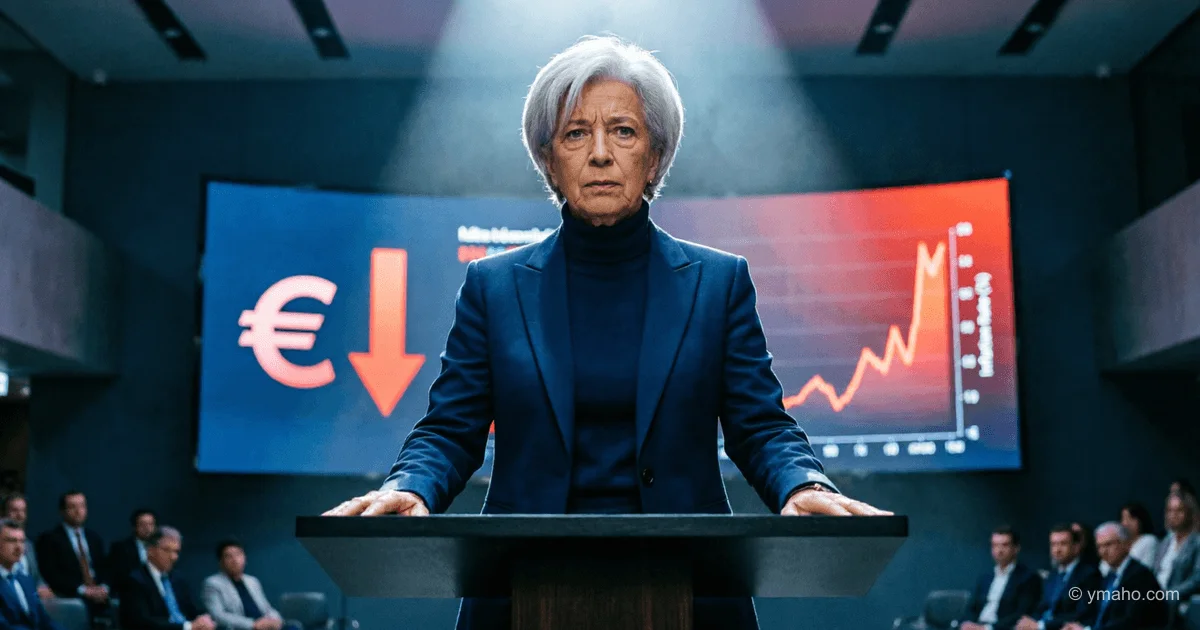
ECB Chief Lagarde Admits Eurozone Faces Stagflation, Pledges Rate Hike in June
Christine Lagarde stated that the eurozone economy has "deviated from the baseline scenario": inflation accelerated to 3% with GDP growth of just 0.1% in the first quarter, and analysts expect ECB rate hikes in June and July amid the energy shock.
Christine Lagarde's admission of "stagflation" is not just a rare use of a taboo term by a central bank chief. It is a de facto capitulation of the European Central Bank to a new reality in which standard monetary policy tools have turned into weapons of self-destruction. The eurozone is sliding into a scenario that analysts in January 2026 called an "unlikely tail risk": GDP growth near zero with inflation accelerating to 3%. The decision to raise rates in June is not boldness but an act of desperation that will have catastrophic consequences for the peripheral countries of the currency bloc.
The Core: What Is Really Happening
The true tragedy of the ECB is that 80% of eurozone inflation is imported. This is not overheated domestic demand, as in the US, but a direct blow from energy and food prices denominated in a strengthening dollar. The 3% inflation consists of an energy component growing at 12-15% annually due to Brent surging above $100. By raising rates, the ECB cannot extinguish the oil price fire caused by the geopolitical crisis in the Persian Gulf. The only thing Frankfurt will achieve is destroying the remnants of domestic credit impulse.
Behind the scenes of the ECB Governing Council, a real battle has unfolded between "northern hawks" led by Bundesbank chief Joachim Nagel and "southern doves" such as Bank of Italy chief Fabio Panetta. Lagarde and the hawks' victory is a triumph of German economic orthodoxy, which prioritizes fighting inflation over social stability. Germany, whose industry is already devastated by expensive gas and disrupted supply chains from China, is ready to sacrifice eurozone growth to preserve the purchasing power of German pensioners' savings. This is a deeply political decision masquerading as technocratic. Lagarde is essentially acting as a political commissar ensuring Berlin's interests at the expense of Rome and Madrid.
Timeline and Context
Lagarde's statement on May 5, 2026, was not spontaneous. It followed the release of preliminary Eurostat data showing GDP grew a meager 0.1% qoq in the first quarter. However, the key trigger was not the statistics but the sharp drop in the euro to 1.02 USD in late April. A weak euro is a hidden killer of the European economy under current conditions. It makes energy imports even more expensive, creating a vicious circle: the weaker the euro, the higher the inflation, the more hawkish the ECB must be to strengthen the currency.
Lagarde cannot directly say: "We are raising rates to save the euro exchange rate because the energy crisis threatens to completely collapse the balance of payments." So the classic mantra of "price stability" is used. The context also includes a hidden ultimatum from the Federal Reserve. The ECB cannot afford a rate differential with the Fed of more than 75-100 basis points, otherwise capital flight from European bonds to US Treasuries will accelerate. If the Fed holds rates at 3.50-3.75%, the ECB with its current rate of 2.50% is dangerously behind. A hike to 2.75% in June and then to 3.00% in July is an attempt to close the "currency overhang" to prevent the euro from falling to parity and below, which would be an energy disaster for Italy and Spain.
Who Wins and Who Loses
The main beneficiary of this decision will be Switzerland and the Swiss franc. While European institutions destroy their periphery trying to catch up with the Fed rate, capital from Frankfurt, Paris, and Milan will continue to flow into CHF, seen as a "safe haven" outside the dollar zone. The Swiss National Bank will get an unwanted but powerful franc appreciation.
The absolute loser will be the Italian government. Italy's public debt exceeds €3.1 trillion (about 145% of GDP). A 25 bps ECB rate hike translates into a 40-50 bps rise in 10-year BTP yields due to the spread effect. We already see the spread between Italian and German bonds widening to 250 points. If the ECB goes for two hikes (June and July), Italian debt yields will break the psychological 6.0% mark. This is the level at which debt math becomes unsustainable—Rome will spend more on interest payments than on education and defense combined. The ECB formally does not bail out sovereigns, but in practice, rate hikes could trigger a repeat of the 2011-2012 crisis, for which the ECB no longer has a strong response, as the TPI (Transmission Protection Instrument) remains untested and politically controversial.
What the Media Leaves Out
The media presents this as a "difficult but necessary decision." They remain silent about the deep rift within the ECB, which was not reflected in Lagarde's final statement. According to our sources in Frankfurt, three dissenting Governing Council members, including the heads of the central banks of Italy, Portugal, and Greece, strongly opposed the hawkish rhetoric. They presented a confidential memorandum arguing that a rate hike would kill investment in the "green transition," which is Europe's only hope to reduce dependence on fossil fuel imports.
The paradox is that building wind farms and installing heat pumps requires cheap credit. By raising rates, the ECB is effectively prolonging the agony of dependence on oil and gas from unstable regions. It's like putting out a fire with gasoline, but with a delayed effect. Lagarde and Nagel deliberately ignore this structural aspect because the Bundesbank historically views any "green mandates" for a central bank as heresy and a threat to independence.
Furthermore, Lagarde's emergency contact with US Treasury Secretary Scott Bessent on May 3 has not been disclosed. Bessent made it clear that the US would not allow coordinated global intervention to weaken the dollar, nor would it rescue the eurozone in case of a debt crisis. "Sort it out yourselves" was the gist of the message. This left the ECB with only one path: kill domestic demand to balance the accounts and hold the currency.
Forecast: Next 30 Days and 90 Days
30-day horizon (by June 6, 2026).
A 25 bps rate hike at the June 4 meeting is 90% likely. Markets have already priced it in. But after the hike, a hangover will set in. Protest sentiment in Italy and Greece will intensify under slogans like "The ECB is strangling our economy for Berlin's interests." BTP-Bund spreads will widen to 300 points. The ECB will be forced to hold an emergency Governing Council meeting to discuss activating the TPI crisis tool, effectively admitting policy failure.
90-day horizon (by August 2026).
After the July hike to 3.00%, the eurozone will officially enter a recession (two consecutive quarters of negative growth). Industrial production in Germany and France will collapse as business credit becomes unavailable. The ECB will find itself in the most humiliating trap: by August, inflation due to base effects and continued oil rally will still be above 3%, but growth will have completely stalled. Lagarde will have to call a press conference and, despite the rate hike, announce a "technical pause" to avoid destroying the banking system. This will look like a complete loss of control and direction. Investors will begin a full-scale flight from euro assets, and the euro exchange rate, despite the hike, will crash below 0.98 USD as markets start pricing in the risk of a currency bloc breakup in the long term. The stagflation that Lagarde acknowledged today will become her political obituary tomorrow.
— Editorial Team









