Astronomers Find Star That May Be the 'Daughter' of the Universe’s First Stars
A star discovered far beyond our galaxy may be the closest thing scientists have ever found to a direct descendant of the universe’s very first stars—cosmic giants that lit up the darkness after the Big Bang. While those original stars vanished billions of years ago, this newly studied object carries their chemical fingerprint, offering a rare window into how the universe evolved from pure simplicity to the complex chemistry that makes planets—and us—possible.
Why This Star Is So Special
Most stars today, including our Sun, are made of a mix of hydrogen, helium, and heavier elements like carbon, oxygen, and iron. These “metals” (as astronomers call anything heavier than helium) come from earlier generations of stars that lived, exploded, and scattered their guts across space. But SDSS J0715-7334 is different. It’s almost entirely hydrogen and helium—so clean it contains just 0.005% of the metals found in the Sun. That makes it the most chemically pristine star ever observed.
Think of it like baking bread. If the early universe was flour and water (hydrogen and helium), the first stars were the ovens that created new ingredients—yeast, salt, sugar—through nuclear reactions. When they exploded, those ingredients got mixed into the next batch of dough. SDSS J0715-7334 is like a loaf baked from dough that only got a single pinch of yeast from one very early oven. Everything else stayed untouched.
Tracing Back to the First Stars
Scientists believe this star formed from a gas cloud polluted by the supernova of a true Population III star—the mythical first generation that formed from nothing but Big Bang leftovers. By analyzing its chemistry, researchers deduced that its “parent” star must have been at least 30 times more massive than our Sun and exploded with unusual force. That explosion seeded the surrounding space with just enough heavy elements to form SDSS J0715-7334—but not enough to make it chemically rich.
No one has ever seen a real Population III star. They likely burned too brightly and died too quickly to survive to the present day. Finding their offspring is the next best thing: like discovering an ancient letter written by someone who met Cleopatra—you didn’t see her yourself, but you’re holding proof she existed.
The ‘Ancient Immigrant’ From Another Galaxy
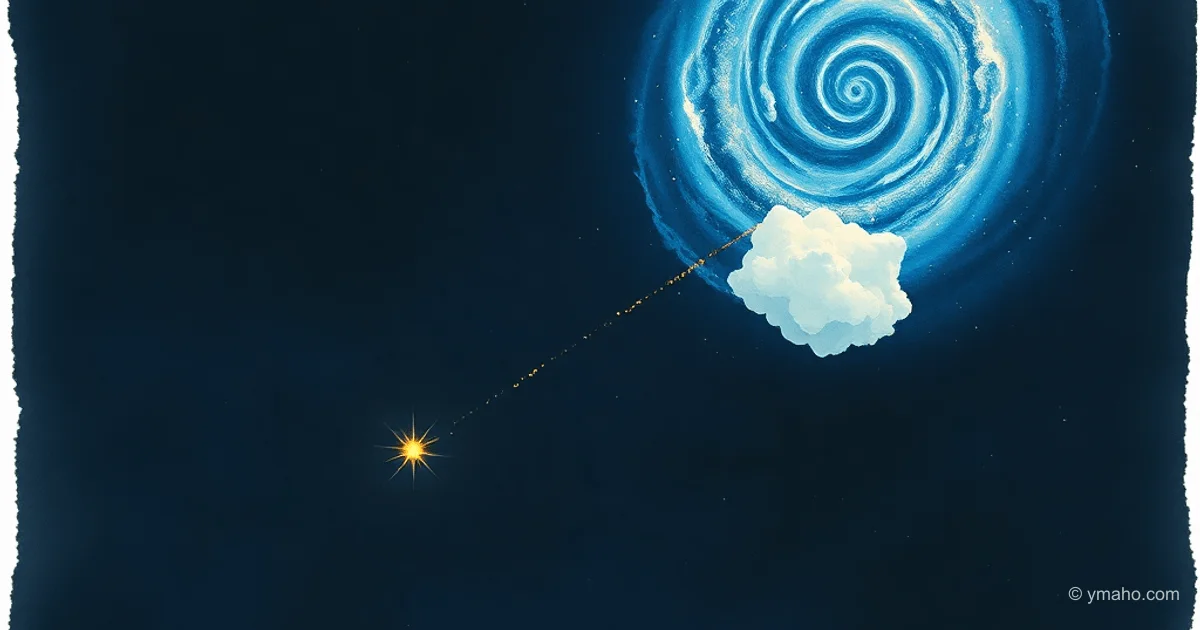
This star isn’t even in our Milky Way. It’s located about 80,000 light-years away and appears to be drifting from the Large Magellanic Cloud (LMC), a small satellite galaxy only recently captured by the Milky Way’s gravity. Because the LMC spent most of cosmic history isolated, it didn’t churn out as many generations of stars as our galaxy did. That means its stellar population is less “polluted”—making it a better hunting ground for ancient, metal-poor stars.
Researchers nicknamed SDSS J0715-7334 the “Ancient Immigrant” because it seems to be migrating inward from the LMC’s outskirts. Its orbit matches the motion of that galaxy, suggesting a shared origin.
What This Means for Understanding Cosmic History
Studying stars like this helps scientists test theories about how the first stars lived and died. For example:
- The low carbon content suggests the parent supernova didn’t fully explode—it may have collapsed directly into a black hole, spewing only a light dusting of elements.
- The extreme rarity of such stars implies that true Population III stars were either very massive (and thus short-lived) or formed in environments we haven’t fully explored yet.
- Galaxies like the LMC might hold more of these time capsules than the Milky Way, guiding future telescope searches.
Key takeaways
- SDSS J0715-7334 is the most chemically pristine star ever found, with almost no elements heavier than hydrogen and helium.
- It likely formed from gas polluted by a single supernova from one of the universe’s first stars (Population III).
- Located near the Large Magellanic Cloud, it’s nicknamed the “Ancient Immigrant” due to its migration path.
- Its composition suggests its parent star was at least 30 times the Sun’s mass and exploded unusually.
- This discovery supports the idea that satellite galaxies may preserve more relics from the early universe than the Milky Way.
What does this mean for regular people? While it won’t change your daily life, it reshapes our origin story. Every atom in your body—except hydrogen—was forged in stars. Finding a star so close to the beginning helps us trace that cosmic recipe back to its very first step. It’s like finding a page from the universe’s original cookbook.
— Editorial Team









