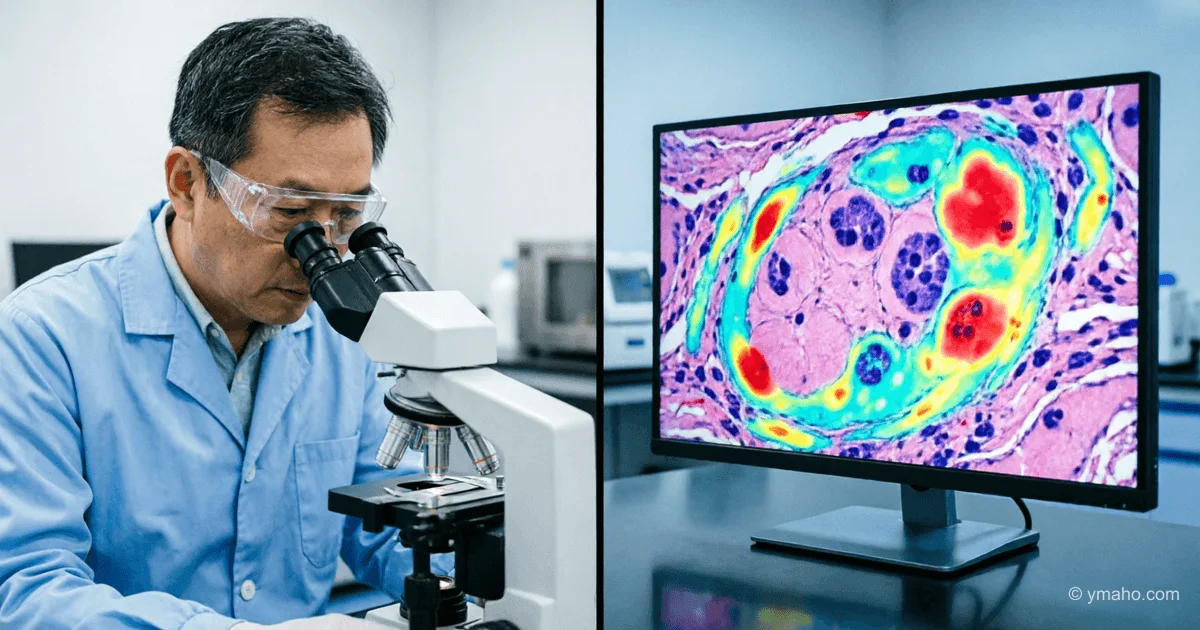
Nature Communications: AI Tool Gives Pathologists 'Spatial Super-Vision' to Detect Hidden Cancer
Scientists at QIMR Berghofer have developed an AI tool called STimage that analyzes standard histological samples using spatial biology. The technology can detect hidden genetic markers of breast, skin, and kidney cancer without additional expensive tests.
The news about STimage, published in Nature Communications by the Nguyen group at QIMR Berghofer, at first glance seems like just another academic preprint about 'AI in medicine.' But if you read beyond the press release and look at related events, a completely different picture emerges. This is not a story about yet another diagnostic algorithm—it's a story about how spatial biology is becoming nearly free, and who stands to lose billions as a result.
The Core: What's Really Happening
STimage is a tool that predicts spatial gene expression patterns using only standard H&E-stained histology. It requires neither spatial sequencing, fluorescent probes, nor expensive reagents. Trained on paired 'H&E + spatial transcriptomics' data, it learns to see molecular patterns in ordinary morphological images—essentially reading genetic information from the shape and color of cells.
The market has perceived this as a 'tool for pathologists.' But the real significance runs deeper: STimage turns the most expensive part of modern molecular diagnostics—spatial analysis—into a computation costing pennies. The cost of a single spatial transcriptomics experiment on the Visium platform from 10x Genomics is about $6,500, excluding sequencing. Running STimage on an existing H&E slide costs less than one dollar per inference. That's a four-order-of-magnitude difference.
The Nguyen group didn't just train another neural network. They solved the problems of uncertainty and interpretability: STimage outputs not a point estimate but a probability distribution for each gene at each tissue spot, and shows which morphological structures the model relied on. This is not a conference demo—it's an architectural solution that makes the system suitable for clinical validation.
Timeline and Context
To understand why Nature Communications accepted this work now, look at the timing of publications on spatial biology. Since early 2026, three landmark papers have been published, each hitting the same point: spatial biology is becoming industrial.
The first was the launch of G4X from Singular Genomics in February 2026: 128 samples per run, cost in the 'low hundreds of dollars,' 500-plex RNA plus 18 proteins simultaneously. Singular CEO Josh Stahl directly stated: 'This is an inflection point for spatial—now you can analyze cohorts, not showcase experiments.' Validation on 1,700 samples and 400 million cells is not an academic standard; it's preclinical preparation. Singular is clearly preparing the platform for registration as a medical device, and the US commercial launch is the first step.
The second is STimage from QIMR Berghofer in Nature Communications. The third is a study from April 30 in Science, showing that the OpenAI o1 model outperforms physicians in emergency diagnostics. Together, these three events create an infrastructure triangle: cheap spatial data acquisition (Singular G4X) + cheap inference from H&E (STimage) + general-purpose reasoning models capable of interpreting clinical context (o1/GPT-5).
Nguyen himself mentions clinical application of STimage in two years. This seems plausible, given that the training set of three cancers and one autoimmune disease has already shown the ability to stratify patients by survival and treatment response.
Who Wins and Who Loses
Winners:
Pathologists in small hospitals. They suddenly gain access to molecular diagnostics that currently exist only in large academic centers. For a 200-bed hospital with an annual budget of $150 million, this means being able to make diagnoses requiring spatial information without sending slides to a reference lab costing $3,000–$7,000 per test. No new equipment is needed—just a slide scanner and a standard GPU server.
QIMR Berghofer and personally Associate Professor Quan Nguyen. The National Centre for Spatial Tissue and AI Research (NCSTAR), which he leads, becomes a global hub of expertise in a field that will be worth $15 billion in three years. The institute already receives ARC and NHMRC grants, but the main asset is not money—it's the data and model architecture validated in Nature Communications.
Patients with breast, kidney, and skin cancer. These three diseases were included in the STimage training set. Predicting treatment response and survival is functionality that allows moving from 'diagnosis' to 'prognosis and treatment selection.' With one course of immunotherapy costing around $150,000 per year, the ability to predict drug response saves the healthcare system an amount comparable to the cost of the therapy itself.
Losers:
10x Genomics. The Visium platform is the gold standard for spatial transcriptomics, but each experiment requires purchasing a slide for $1,500–$2,500 and deep sequencing. If STimage learns to predict spatial expression of even the 500 most clinically significant genes, the need for physical spatial sequencing for diagnostic purposes will simply disappear. 10x Genomics' market in the spatial biology segment—approximately $450 million in 2025—will begin to shrink from the moment of clinical validation of STimage-like tools.
Visiopharm, Indica Labs, Paige.AI, and other developers of paid digital pathology software. Their business model is based on selling licenses with annual fees of $50,000–$200,000 per workstation. An open-architecture tool published in Nature Communications and validated on public datasets creates a dangerous precedent for them: algorithms become publicly available, and value shifts from software to data infrastructure and clinical validation.
Pathology scanner manufacturers (Leica, Hamamatsu, 3DHISTECH). Ironically, STimage increases the value of slide scanning—but simultaneously lowers the barrier to entry for new manufacturers. If the key value is not in software but in digitization quality, Chinese manufacturers with scanner prices of $40,000 versus $150,000 for Leica gain an argument for market entry.
What the Media Isn't Saying
First: Singular Genomics and STimage are two pieces of the same puzzle, and this is no coincidence. Singular has invested tens of millions of dollars in creating a platform that generates massive labeled spatial data. Each G4X run—128 samples, 500 RNA transcripts, 18 proteins—is not just research; it's fuel for training exactly the kind of models like STimage. Singular lists 'AI-driven insights' as one of its three key directions. It can be expected that Singular will either acquire a development like STimage or create its own. In any case, the 'data → trained AI → clinical application' model is no longer a theoretical construct but a roadmap.
Second: STimage doesn't just predict genes—it predicts uncertainty. In clinical diagnostics, this means the pathologist sees not only 'this region looks like a tumor' but also 'the model is 92% confident in this, but there is an 8% probability of an alternative scenario.' This changes the paradigm of responsibility: the physician makes a decision not based on a 'black box' but on a transparent probability distribution. The FDA and EMA will require exactly this approach for clinical validation of AI tools, and the Nguyen group has already built it into the architecture.
Third: The cost of inference is the most underestimated aspect. Press releases say 'low cost' but don't give numbers. The estimate of 'less than a dollar' follows from the architecture: the model works with pretrained encoders (CNN or pathology foundation models), inference on one slide requires a single pass through the network, costing cents on a GPU. Meanwhile, the savings are thousands of dollars per sample compared to spatial sequencing. Medical CFOs will see this differently: every diagnostic test that can be replaced by computation adds 2–4 percentage points to the operating margin of a pathology department.
Fourth, and most importantly: STimage is trained to predict gene expression, but nothing prevents training it to predict anything else—mutations, microsatellite instability, immunotherapy response signatures. This is a generalizable framework, not a narrow tool. Today—three cancers and one autoimmune disease; tomorrow—any phenotype for which a labeled spatial dataset exists. This is not a 'tool for pathologists'; it's a platform that turns histology into an omics technology.
Forecast: Next 30 Days and 90 Days
30 days (by June 5, 2026):
QIMR Berghofer will announce a partnership with one of the major digital pathology platforms—most likely Paige.AI or PathAI—to integrate STimage into a commercial product. The deal size will be in the range of $5–15 million for an exclusive license in certain territories.
The pathology community will react in two ways: academic centers will begin reproducing results on their own data; private labs will ignore it, awaiting clinical validation. The split between 'early adopters' and 'skeptics' will deepen.
90 days (by August 5, 2026):
The first preprints applying STimage to new cancer types will appear—likely lung and colorectal. If prediction accuracy for key biomarkers (PD-L1, MSI) proves clinically acceptable, the FDA will begin informal consultations on regulatory pathways for this class of tools.
Singular Genomics, 10x Genomics, and NanoString will accelerate development of their own AI models trained on their unique datasets. A race will begin to 'create the most comprehensive training set,' and Singular, with its throughput, has a head start.
Key strategic forecast: The spatial biology market will split into two segments. The first is 'research': expensive wet methods for discovering new biomarkers and validating hypotheses. The second is 'clinical': AI inference that turns standard histology into spatial omics at the cost of computation. STimage is the first representative of the second segment, but not the last. Investors who understand this distinction will begin to revalue companies based on which segment they play in.
Nguyen and his team have created not just a tool but a precedent. After STimage, every manufacturer of spatial biology platforms will have to answer the question: 'If your method costs $6,500 and AI inference gives 80% of the same information for a dollar, what is your competitive advantage?' No one has an answer yet.
— Editorial Team









