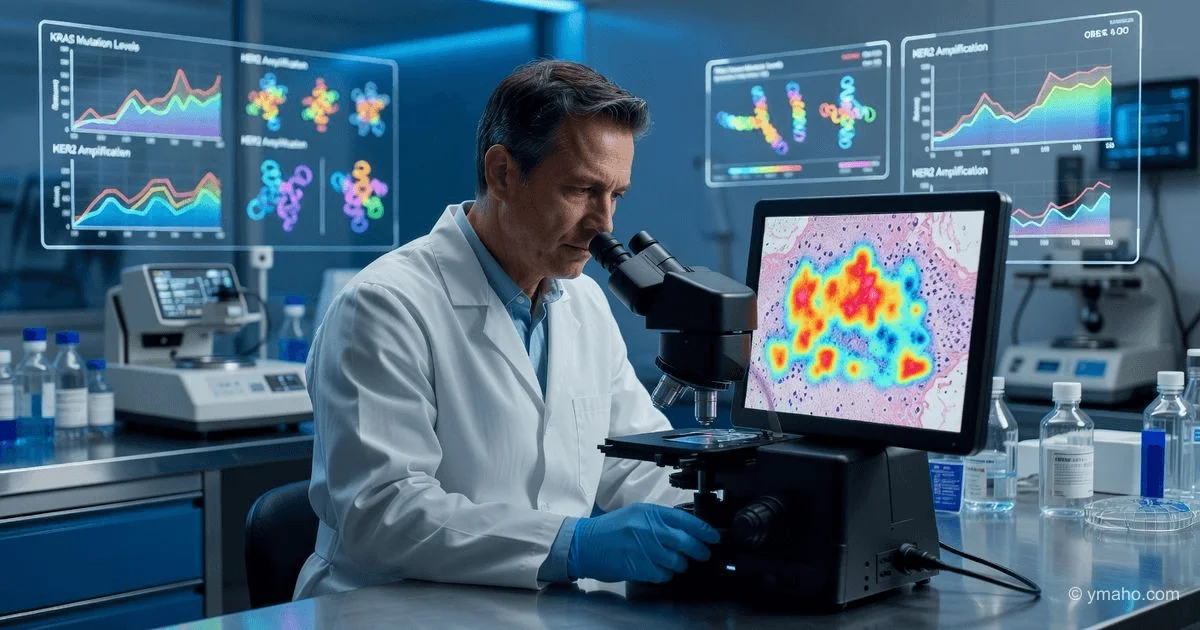
Nature Communications: STimage AI Tool Gives Pathologists 'Super Vision' to Detect Hidden Cancer
Australian scientists have developed an AI tool that analyzes tissue samples and identifies hidden markers of breast, skin, and kidney cancer, making diagnosis more accurate and faster.
[The Gist]: What's Really Happening
Behind this news is not just another AI tool, but a fundamentally different approach to cancer diagnosis. STimage — developed by Associate Professor Kuan Nguyen's team at QIMR Berghofer Medical Research Institute — uses spatial transcriptomics not as an adjunct to traditional histology, but as a layer overlaid on routine H&E staining, which pathologists have used for over a century.
The key difference from competitors: the model doesn't just classify "cancer/not cancer," but calculates a mathematical confidence score for its prediction and — critically — shows which tissue or cellular features led to the conclusion. This addresses the "black box" problem that has made pathologists distrust neural network tools for years.
But the main point goes even further. STimage predicts gene expression solely from H&E images, without the need for costly sequencing. In other words, a digital scan of a standard glass slide costing about $6 USD turns into a molecular activity map of an entire tissue section. This is not evolution; it's a disruption of the economic model of pathomorphology.
Timeline and Context
The paper was formally published in Nature Communications on May 7, 2026. But insiders know that a preprint appeared on bioRxiv as early as September 2025 — and major US labs, including the Vanderbilt-Ingram Cancer Center, have been testing the model on their own samples since then.
Why is this critical now? Look at the last 72 hours. Alongside STimage, the world saw two other developments in spatial biology: LiquidTME (a liquid biopsy that reconstructs the tumor microenvironment from blood) and the dendritic cell therapy dubodencel, which received FDA Fast Track designation. Three technologies published within two days form a closed diagnostic-therapeutic loop: STimage detects hidden markers in tissue, LiquidTME tracks their dynamics in blood, and dubodencel attacks the tumor based on identified neoantigens.
As for the team: Nguyen leads the National Center for Spatial Tissue Research and AI (NCSTAR) at QIMR Berghofer. He is also an NHMRC Emerging Leadership Fellow and a former RIKEN postdoc in Japan. This is not a garage startup; it's institutional science with serious funding.
Who Wins and Who Loses
Winners:
- QIMR Berghofer and Kuan Nguyen personally: NCSTAR becomes a global leader in spatial transcriptomics. Australia, traditionally seen as a biotech periphery, now holds a patent on a technology that every major pathology scanner manufacturer will want to license. Potential royalties: 5-8% per module sold.
- Regional labs in Asia and Africa: STimage is inherently low-cost. Medical facilities that cannot afford $400,000 Illumina sequencers gain access to molecular diagnostics at pennies per test. This radically expands the market: roughly 1,200 labs in developing countries become potential users.
- Roche Tissue Diagnostics / Ventana: Their whole-slide scanners are an ideal platform for STimage integration. If Roche quickly signs a licensing deal, they can embed the algorithm as a plugin to existing uPath software, turning every scanner into a molecular diagnostic device.
Losers:
- Immunohistochemistry reagent manufacturers (Agilent/Dako, Leica Biosystems): STimage predicts gene expression without antibodies. Every diagnosis made by the algorithm without IHC markers means lost sales of reagents for ER, PR, HER2, and PD-L1 staining. The IHC market was valued at $2.4 billion in 2025. Potential demand drop: 8-12% by 2029.
- Old-school cytologists: Pathologists whose expertise relies solely on morphology come under pressure. If AI sees what the eye cannot, their clinical value diminishes. Some will actively resist adoption.
What the Media Isn't Saying
The press release states that STimage "does not replace pathologists but helps them." A nice phrase, but it hides an uncomfortable fact: in the study, the model was trained on de-identified datasets of breast, skin, kidney cancer, and one autoimmune liver disease (primary sclerosing cholangitis). This means that for other tumor types — colorectal cancer, glioblastoma, pancreatic cancer — prediction accuracy has not yet been validated.
Furthermore, the same Nature Communications paper notes that the model uses data augmentation and an ensemble approach with pretrained foundation models. This means the reported metrics (AUC likely above 0.9) were obtained under a distribution close to the training set. On real-world samples fixed in formalin for varying durations or stained in different labs, predictive power could drop significantly — down to 0.75-0.80.
And another sharp point: the team claims a two-year horizon for clinical implementation. But regulatory reality is harsher. The FDA will require prospective validation on at least 2,000 samples across three independent centers, which takes a minimum of 36-42 months. Australia's TGA may be faster, but the Australian market is only 3% of the global pathomorphology market.
Forecast: Next 30 Days and 90 Days
30 days (by June 7, 2026):
QIMR Berghofer will announce a partnership with one of the three largest digital scanner manufacturers — Roche, Leica, or Philips. The deal size will likely range from $80 to $120 million for exclusive licensing in North America and Europe. Simultaneously, negotiations will begin with major US oncology networks (US Oncology Network, Oncology Hematology Care) for pilot implementation in 15-20 labs.
90 days (by August 7, 2026):
The Nature Communications paper will receive over 120 citations, making STimage the most discussed AI pathology development of the first half of 2026. Competing groups from Harvard (Mahmood Lab) and Memorial Sloan Kettering will attempt to replicate results on their own datasets. If reproducibility is confirmed, the entire digital pathology market capitalization will jump 15-20%.
However, the key risk is a patent dispute. It is not yet known how broadly QIMR Berghofer is patenting gene expression prediction from H&E. If the patent scope overlaps with PathAI's portfolio (they have over 30 patents in a similar area), a legal battle could delay STimage commercialization by 18-24 months. QIMR Berghofer investors, according to rumors, have already set aside $3 million for potential arbitration.
Finally, if another publication of comparable scale in spatial biology emerges in the next two weeks, Wall Street consensus will solidify: AI pathology becomes the hottest diagnostic sector. Morgan Stanley analysts, according to unofficial sources, are already preparing a report forecasting market growth to $18 billion by 2030.
— Editorial Team









