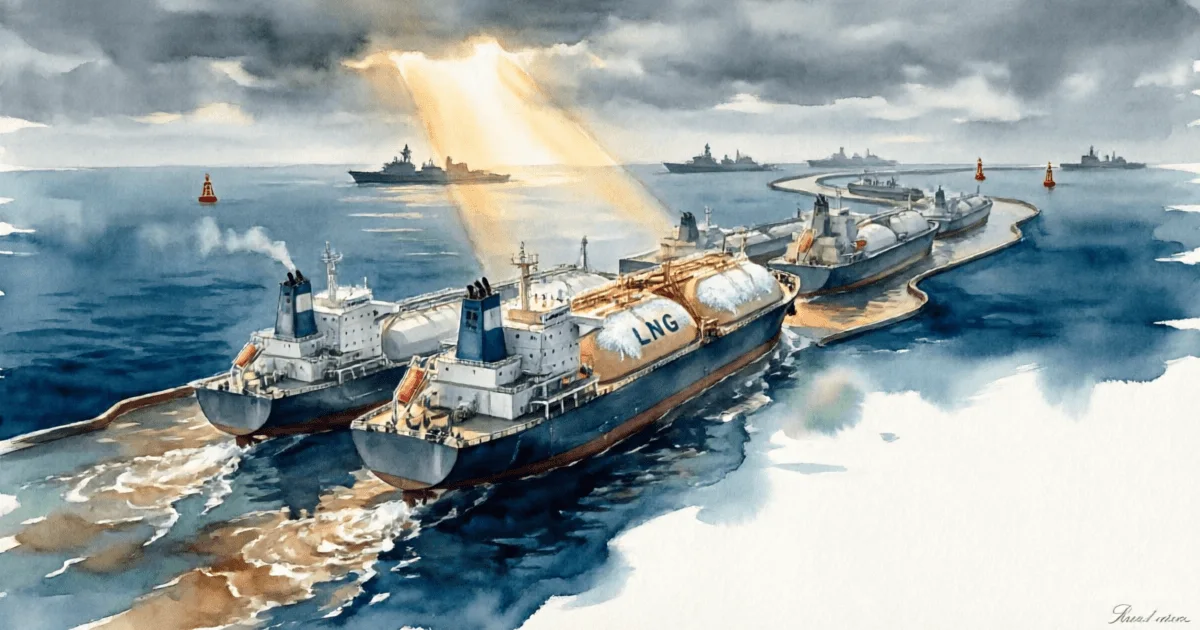
Strait of Hormuz Blockade: Why Gas Tankers Are Turning Back and How This Will Hit Prices
Imagine the main highway used by a fifth of all fuel-carrying trucks worldwide suddenly blocked by concrete barriers. That’s exactly what’s happening right now in the Strait of Hormuz, and the effects are already being felt across global energy markets.
The Chokepoint of Global Energy
The Strait of Hormuz functions like the narrow neck of a bottle: through it flows a massive volume of liquefied natural gas (LNG). LNG is regular natural gas cooled to extremely low temperatures so it turns into liquid form, making it easier to transport on giant ships. When this maritime corridor gets blocked, fuel simply can’t reach factories and power plants around the world.
Several large tankers loaded in Qatar have been effectively trapped in the Persian Gulf for over a month. After direct warnings from Iranian authorities about closing the strait, captains made the decision to turn their vessels around or stop drifting at sea. Since late February, amid escalating military tensions between the U.S., Israel, and Iran, no loaded gas vessel has safely exited the region.
Chaos at Sea and Mixed Signals
The situation at sea resembles a high-stakes game of broken telephone. Iranian military forces have sent clear messages to crews that the route is closed, and one ship’s crew even reported coming under fire. Yet just days earlier, Iran’s foreign minister publicly stated the strait remains fully open for commercial traffic. This contradiction creates an atmosphere of unpredictability, leaving shipping companies unwilling to risk multimillion-dollar cargoes.
The de facto halt of this critical route has instantly cut off about twenty percent of global LNG supplies. Markets reacted predictably: prices began rising, and developing countries in Asia are already experiencing fuel shortages for power generation.
- Tankers are turning back toward Qatari waters or anchoring in place.
- Asian markets face disruptions in electricity supply.
- Global gas prices respond to every new signal from the region.
What Matters
- The Strait of Hormuz controls transit for a fifth of the world’s LNG, and its blockage immediately tightens supply.
- Military tensions between Iran and the Western coalition have turned a key trade route into a high-risk zone.
- Conflicting statements from Iranian officials amplify uncertainty for logistics companies.
- A gas shortage in Asia could trigger a chain reaction of rising energy prices worldwide.
What This Means for Ordinary People
When global gas supplies shrink, heating and electricity prices may rise—even in countries far removed from the conflict. For everyday consumers, this means utility bills and the cost of daily goods that rely on energy in production could quietly but steadily increase in the coming months.
— Editorial Team









