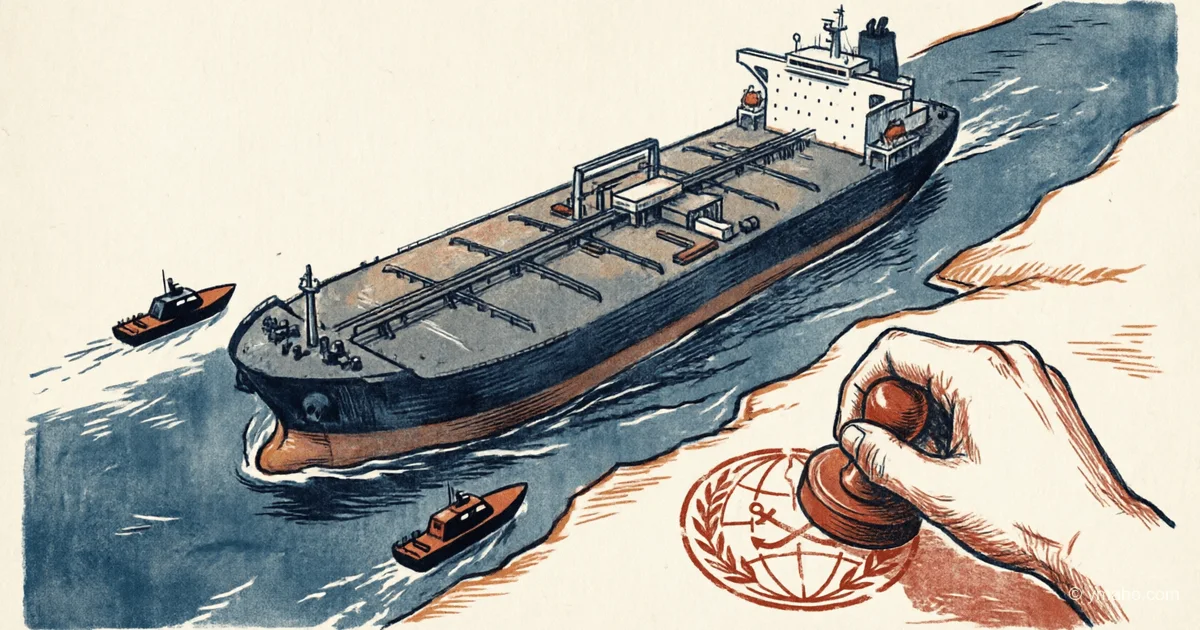
South Korean tanker passes through Strait of Hormuz for first time after coordination with Iran
A South Korean-operated vessel carrying 2 million barrels of oil began transiting the strait after receiving permission from Iranian authorities, marking the first such case since the start of the war.
The passage of the South Korean tanker Universal Winner through the Strait of Hormuz on May 20 is not just a logistical incident or a humanitarian gesture from Tehran. It is the official opening of a two-tier global oil market, where access to a physical barrel is determined not by the futures price on the ICE exchange, but by a political classification imposed by the Islamic Revolutionary Guard Corps. While traders in London and New York recalculate the fair value of Brent, the actual flow of crude is already regulated by a list of "friendly countries," and Seoul has just received a temporary pass into this closed club.
The essence: what is really happening
The Universal Winner, a VLCC-class supertanker operated by HMM, exited the Strait of Hormuz on the afternoon of May 20, carrying 2 million barrels of crude oil and a crew of 21, including 9 South Korean citizens. It is the first South Korean vessel to leave the Persian Gulf since February 28, when the US-Israeli military operation against Iran began. The tanker followed a route specifically designated by Iranian authorities, and critically, neither the South Korean government nor the shipowner paid Iran for passage—no fees, no compensation, no hidden payments.
This completely refutes the common narrative that Tehran has turned the strait into a toll road with a fixed tariff of $2 million per transit. In reality, a more complex and flexible system is at work, announced back in March: countries are divided into "friendly," "neutral," and "hostile," with different rules for each. South Korea, as a US ally and formally falling into the "neutral" category, managed to get the tanker through solely due to intensive diplomatic efforts: four phone calls between foreign ministers, a special envoy, and direct contacts between the embassy and Iranian authorities.
Timeline and context
Until May 19 inclusive, South Korean vessels remained trapped. After the conflict began in late February, traffic through the Strait of Hormuz collapsed by about 95%. For South Korea, whose refineries are historically geared to process Middle Eastern oil, this meant a growing crisis. As of mid-May, 26 vessels linked to Korean interests remained inside the strait. The situation escalated after early May, when another HMM tanker, the Namoo, was damaged in the region under still-unclear circumstances.
On May 16, active consultations resumed. On May 18, Iran notified the South Korean embassy in Tehran that it would allow passage for one specific vessel. On May 19, the tanker began moving, and on May 20, South Korean Foreign Minister Cho Hyun publicly confirmed: "At this very moment, our tanker is leaving the Strait of Hormuz." The Universal Winner is expected to arrive at the port of Ulsan on June 10.
Who wins and who loses
South Korea wins. The country gets not just 2 million barrels of oil. It gets proof that its diplomatic model—direct negotiations with Tehran without intermediaries and without violating the US sanctions regime—works. Seoul has demonstrated that it can simultaneously be a Washington ally and negotiate practical matters with the IRGC. Moreover, the Korean side stated that the US Treasury Department's consultation does not consider this a violation of the sanctions regime.
Iran wins. Tehran shows the world, and especially the remaining 25 Korean vessels and their owners, that its clearance system is not a bluff. By letting one vessel through without payment, it creates a precedent and an incentive for other countries to negotiate directly, rather than through American mediation. This strengthens Iran's negotiating position and demonstrates its control over the strait.
European and American companies lose. Every tanker passing under Iranian rules legitimizes a new reality: shipping through Hormuz is no longer governed by international law; it is governed by Tehran. Insurance premiums for Western shipowners remain prohibitive, and physical access to oil is closed.
What the media is not telling
Headlines focus on the "first tanker" but ignore the systemic shift. Iran's classification of countries is not a temporary wartime measure but an attempt to institutionalize a new order. As Al Jazeera reported, Tehran is already discussing the "Hormuz Pact"—a regional mechanism involving Asian states and select European countries to regulate shipping.
In this system, South Korea occupies a unique position. It is not on the initial list of "friendly" countries, which Tehran included Russia, China, India, Pakistan, and Iraq. Its vessel passed under an individual permit—meaning Iran is willing to trade passages on a case-by-case basis, evaluating each counterparty on a loyalty scale. For the global market, this means that oil pricing has finally lost its universal character: a Korean refinery gets Middle Eastern oil at one logistics cost, a European one at another, and an American one gets none at all.
Forecast: next 30 days and 90 days
30 days. South Korea will continue to extract the remaining 25 vessels, but the process will be slow and selective. Iran will dole out permits, linking them to political signals from Seoul regarding sanctions compliance. Insurance rates for voyages through Hormuz will remain at 5-8% of cargo value. Brent crude will retain a premium of $8-12 per barrel, built into the price since the crisis began.
90 days. The key question: will the South Korean precedent become a template for Japan, Taiwan, and EU countries? If so, the world will finally shift to a two-tier system of oil logistics. This will lead to a divergence in prices for Brent, Dubai, and Urals, which historically moved in close correlation. If US-Iran negotiations lead to a deal, the premium will collapse, and oil will plunge to the $85-90 per barrel zone, creating a new shock—this time for shale oil producers.
Editorial forecast
Asset: Brent crude oil (next month futures)
Direction: Sideways with potential for decline in the next 24-72 hours. The passage of the Universal Winner is a signal that the Iranian blockade is not absolute and diplomatic solutions are possible, slightly easing the risk premium. However, the fundamental deficit remains.
Key levels: Resistance at $112, support at $107. A break below support would open the path to $103.
Confidence level: Low. Any new incident in the Persian Gulf or statement by Trump could move the price 4-5% intraday.
Main risk: If the US considers South Korea's actions a violation of the sanctions regime and imposes secondary sanctions on HMM, the market will perceive this as escalation and Brent will rise above $115.
Editorial opinion, not investment advice.
— Editorial Team









