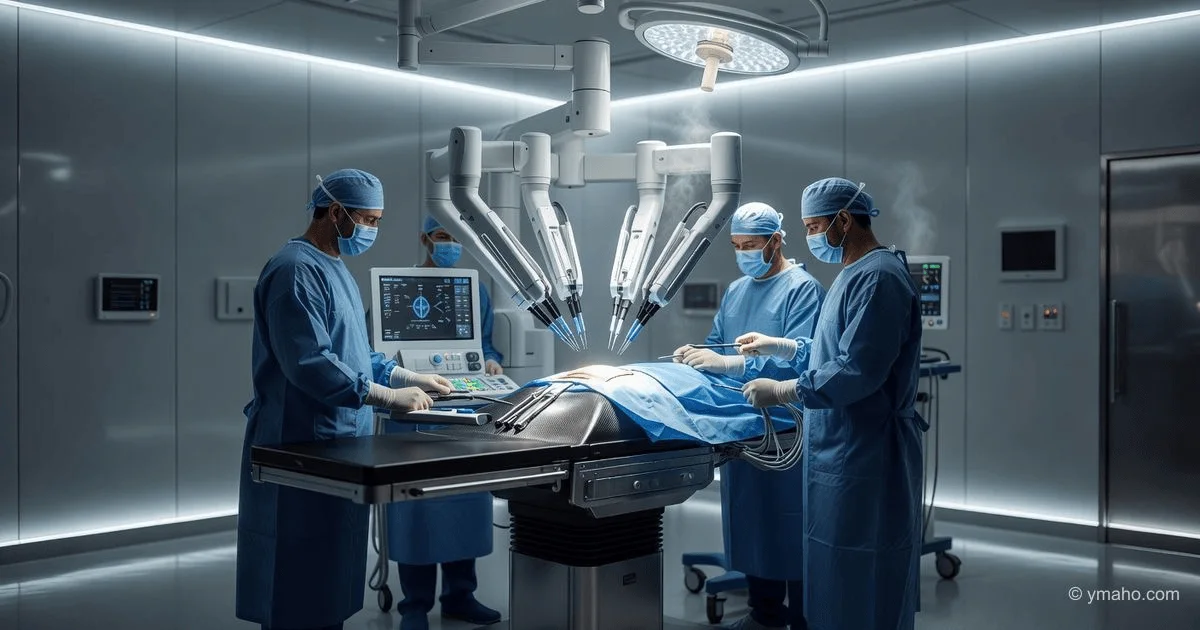
Scientists Complete Pivotal Studies of Ottava Robot and Prepare FDA Submission
Results from a clinical trial involving 30 patients who underwent bariatric surgery will be used to file an FDA application for approval of the Ottava robotic system for a wide range of upper abdominal surgeries.
The Gist: What's Really Happening
In reality, the completion of FORTE and the De Novo submission mark the moment when J&J stops playing catch-up and starts dictating its own architectural logic to the market. Thirty patients, zero conversions to open surgery, average weight loss of 30 pounds in 30 days — these numbers were already presented at ASMBS and spread across news feeds. But the dry figures hide the main point: J&J has provided clinical evidence for the first time that an integrated table-mounted architecture is not a design gimmick but a real advantage capable of redefining the economics of an entire operating room.
Insiders know: Ottava is not just a robot but a Trojan horse for the entire J&J ecosystem. Through it, Ethicon instruments, the Polyphonic digital platform, and eventually Monarch for endoluminal interventions enter the OR. That's why J&J filed for De Novo in January and has now added clinical data to it.
Timeline and Context
The timeline looks like this: November 2020 — Ottava concept announced. Late 2021 — timeline delayed by two years due to technical challenges. October 2024 — IDE submission, and less than a month later FDA approves it. April 2025 — first surgeries. January 2026 — De Novo submission based on preclinical data and initial experience. May 4–5, 2026 — full results presented at ASMBS.
Context adds drama. Intuitive Surgical placed 232 da Vinci 5 systems in the US in Q1 2026, capturing 85% of new installations. Moreover, da Vinci 5 delivers higher utilization than Xi, and total procedure volume grew by 17%. Intuitive has literally created a "Platform Upgrade Wall": while hospitals spend budgets on da Vinci 5 and sign multi-year contracts, the window of opportunity for Ottava closes with each quarter. J&J understands this, which is why it is pushing De Novo faster than ever.
Who Wins and Who Loses
Winners:
- J&J and its shareholders: Ottava is a long-awaited entry into a market that McKinsey estimates at $5 billion today, with a forecast of up to $20 billion by 2030. CFO Joe Volck confirmed the company expects approval "by the end of 2026, but no later than early next year."
- Bariatric surgeons: Roux-en-Y gastric bypass is a complex procedure requiring the robot to work in multiple quadrants. Ottava, with 30-pound weight loss in a month, has proven its suitability in this niche.
- Hospitals with small ORs: Five out of six sites performed surgeries in rooms previously considered unsuitable for robots. Ottava removes spatial barriers.
Losers:
- Intuitive Surgical in the long term: While they lock in the market with da Vinci 5, J&J is building a platform that requires no OR renovation and uses existing Ethicon instruments.
- Medtronic Hugo: Takes a second heavy hit after Ottava's approval. With only urology, Hugo risks remaining a niche player.
- Chinese manufacturers: MicroPort and others lose future US contracts, as competing with two American giants becomes nearly impossible.
What the Media Isn't Saying
Press releases talk about "complete success" and "zero conversions." But no one discusses the price. J&J acknowledged at the Barclays Healthcare Conference that Ottava's rollout will be a "slow start": 10–25 installations in the first year. That's minuscule compared to 1,500 installed da Vinci 5 units. J&J is deliberately sacrificing speed for launch quality — "go slow to go fast." The problem is that by the time Ottava is ready to scale, Intuitive will have upgraded its entire installed base.
Second point: De Novo, not 510(k). This means FDA considers Ottava a new class of device, slowing the process. However, if successful, J&J itself becomes the reference standard for future competitors.
Forecast: Next 30 Days and 90 Days
30 days (by June 7, 2026):
FDA will begin reviewing the De Novo and likely request additional data on long-term outcomes. J&J will respond with 90-day data. Intuitive will accelerate its trade-in program to lock in as many hospitals as possible before Ottava's launch. J&J will quietly start negotiations with the first 10–25 sites for a controlled launch.
90 days (by August 7, 2026):
If FDA raises no major issues, a decision could come in September–October 2026. J&J will announce readiness of a commercial batch of 50 systems. Around the same time, rumors about pricing will emerge — analysts expect a range of $1.4–1.7 million, comparable to da Vinci 5. Intuitive may start discounting service contracts. The robotic surgery market enters a new phase: from monopoly to duopoly, where the loser will be the one that misjudges the balance of speed and reliability.
— Editorial Team









