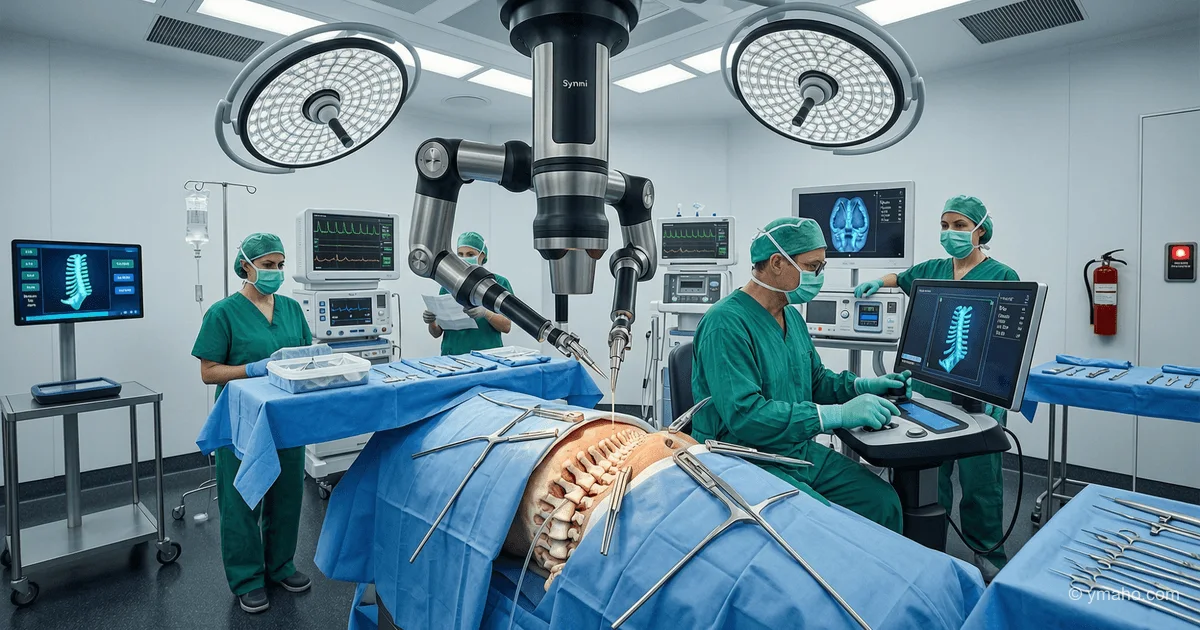
Symani Robotic System Used for Spinal Tumor Removal in World First
Surgeons at Rush University Medical Center have performed the world's first spinal tumor removal using the new Symani robotic microsurgery system. The technology enables ultra-precise manipulations within millimeter-scale spaces, paving the way for complex neurosurgical interventions.
The Bottom Line: What's Really Happening
On April 22, 2026, neurosurgeon Dr. John O'Toole at Rush University Medical Center performed a benign vertebral tumor resection using the Symani robotic system—not just a routine procedure, but the world's first application of this platform for spinal tumor removal. Formally, it's a proof of concept. In reality, it opens a new front in the competition for robotic surgery.
The real shift isn't that "a robot removed a tumor." Surgical robots have been doing that for decades. The shift is that Symani is the first system specifically designed for open microsurgery at millimeter and submillimeter scales, not for minimally invasive interventions on large organs. That's a different paradigm. Intuitive Surgical's da Vinci dominates laparoscopy, but its instruments are too large for microanastomoses of lymphatic vessels 0.3 mm in diameter or for maneuvers in front of the spinal cord via a posterior approach.
O'Toole described the situation clearly: the tumor grew from the bone into the space in front of the spinal cord, and the team had to "approach from the front and around the spinal cord from the back" to remove it completely. In such geometry, traditional instruments leave the surgeon with fractions of a millimeter margin for error. Symani, with its motion scaling up to 20:1 and tremor filtration, converts the surgeon's macro-movements into microscopic manipulations. Complete tumor resection with an excellent prognosis—an outcome that proves the concept.
Timeline and Context
Symani's trajectory to spinal surgery wasn't direct. The system was initially developed for reconstructive microsurgery and lymphatic surgery:
- April 2024: FDA granted Symani de novo classification for soft tissue manipulation in microsurgery—the first-ever approval of a robotic system specifically for open microsurgery, not laparoscopy.
- August 2024: Preclinical study of the system in neurosurgical procedures completed.
- October 2025: First human neurosurgical cases—three patients with moyamoya disease received indirect EDAS bypass.
- November 2025: MMI received an IDE from FDA for the REMIND study—Symani for Alzheimer's disease treatment via restoration of lymphatic drainage of deep cervical lymph nodes.
- December 2025: FDA clearance for NanoWrist Scissors and Forceps for soft tissue dissection.
- January 2026: MMI presented Symani at the J.P. Morgan Healthcare Conference for the fourth consecutive time, highlighting sustained investor interest.
- April 22, 2026: O'Toole performs the first spinal tumor removal using Symani.
- May 5, 2026: Rush publishes a press release about the surgery.
Concurrently, in May 2026, MMI completed the first procedure in the REMIND study—a microsurgical intervention on cervical lymph nodes of an Alzheimer's patient. Thus, O'Toole's spinal surgery is not an isolated event but part of a coordinated expansion of Symani into neurosurgery from three directions: cerebrovascular (moyamoya), neurodegenerative (Alzheimer's), and spinal (tumor resection).
Who Wins and Who Loses
Winners
Medical Microinstruments (MMI). The company gained platform validation in a new surgical vertical. Da Vinci doesn't penetrate open microsurgery due to instrument size. Symani, with 3 mm diameter NanoWrist instruments and ±90 degrees articulation, occupies a niche where direct competition with Intuitive Surgical is currently absent. Each proof of concept—spine, brain, lymphatics—strengthens MMI's position ahead of the next funding round. The company has already attracted Fidelity, RA Capital, and Deerfield Management.
Rush University Medical Center. The "world's first" status attracts patients with complex spinal pathology referred from other states. Rush became the first hospital in Chicago with Symani. The investment in the robot pays off not so much through direct surgical revenue (insurance coverage is limited) but through reputational capital and inflow of referrals for other specialties.
Neurosurgeons working with spinal cord vascular pathology. O'Toole clearly hints at the next target: "potentially even for small brain tumors in very deep and delicate locations." For surgeons operating on spinal cord arteriovenous malformations or intramedullary tumors, where the cost of error is paralysis, an instrument with submillimeter precision and elimination of physiological tremor is not a luxury but a necessity.
Patients with lymphedema. This is the most obvious niche for Symani—lymphatic vessels 0.2-0.8 mm in diameter require "supermicrosurgical" precision. MMI has already developed a dedicated reimbursement code for lymphatic procedures, which is critical for commercial success.
Losers
Intuitive Surgical—partially. Da Vinci remains unmatched in minimally invasive surgery, but MMI is biting off the microsurgical segment that Intuitive cannot serve with its current tools. For now, Symani and da Vinci do not compete directly, but MMI already positions itself as "the world's first robotic platform for open microsurgery"—a rhetorical challenge.
Surgeons not trained in robotic microsurgery. Data from a systematic review of 48 studies show that robotic procedures take significantly longer than manual ones—for example, arterial anastomosis 29 minutes vs. 12 minutes. But the learning curve is steep: "significant improvement in efficiency is observed as surgeons gain experience." Surgeons who delay platform adoption risk entering the game when their colleagues have already passed the learning plateau and closed the time gap.
Hospitals that invested in alternative microsurgical platforms. The microsurgical robot market is fragmented: MUSA, ZEUS, da Vinci, and Symani have all been tested for microanastomoses. But MUSA and ZEUS have minimal penetration. According to the systematic review, Symani and da Vinci dominate with 20 and 19 publications, respectively, while ZEUS has 5 and MUSA has 4. The first spinal surgery with Symani reinforces a winner-takes-most dynamic.
What the Media Isn't Saying
Insight #1: The spinal surgery is merely a byproduct of MMI's ambitions in neurodegeneration. All headlines are about a spinal tumor, but MMI's main play is Alzheimer's disease. The REMIND study is a first-in-human trial of a surgical intervention to improve clearance of amyloid-beta and tau proteins by restoring lymphatic drainage of deep cervical lymph nodes. If the hypothesis is confirmed, it will create a market next to which spinal surgery is a tiny niche. At the J.P. Morgan Healthcare Conference in January 2026, Mark Toland clearly focused on "neurosurgical research," and the spinal surgery is a demonstration of technological capabilities for investors, not an end business goal.
Insight #2: FDA granted an IDE for the Alzheimer's study with Symani—and almost no one noticed. The November IDE for REMIND went without widespread publicity, yet it is an unprecedented regulatory signal. The FDA has never before approved a clinical study of robotic surgery for treating a neurodegenerative disease. The approval was based on the hypothesis that improving lymphatic drainage could slow Alzheimer's progression. If REMIND shows positive data, MMI could apply for de novo or even PMA for an indication that would completely change the neurosurgical landscape.
Insight #3: MMI's financial model—creating reimbursement codes before scaling clinical data. The company already obtained a reimbursement code for surgical lymphatic procedures before publishing results from pivotal trials. This is a strategic move: reimbursement opens the path to commercialization even while the clinical evidence base is still being built. Symani's price is not publicly disclosed (a Chinese distributor lists it as "电议"—price on request), typical for high-acquisition-cost devices sold directly to hospitals. By indirect data, the system cost is in the $1-2 million range, and NanoWrist instruments are consumables with a recurring revenue model.
Forecast: Next 30 Days and 90 Days
30 Days (through June 6, 2026)
Rush will ramp up patient enrollment for spinal procedures with Symani. O'Toole is chairperson of the Department of Neurological Surgery, so he will promote the technology within his department. Expect announcements of a second and third case. Meanwhile, MMI is preparing interim data from the REMIND study—if early safety results are clean, the company will use them to attract additional funding.
Intuitive Surgical will conduct an internal threat assessment. Publicly, the company will likely remain silent. But analysts at Leerink or BofA may issue notes on competitive positioning.
90 Days (through August 5, 2026)
MMI will file for an expanded indication for Symani, including neurosurgical procedures. The current de novo clearance covers "soft tissue manipulation to perform microsurgery" but does not specify neurosurgery. The company will use data from three directions—moyamoya (three cases), spinal tumor (one case), REMIND (one case)—as part of the evidence base. The FDA will likely request more data, but dialogue is already underway.
MMI's market capitalization on private markets will rise. The company remains private, but valuations on the pre-IPO secondary market could reach $1 billion, especially if REMIND shows biomarker changes (secondary endpoint—changes in biomarkers and imaging six months after the procedure).
The critical point for the entire strategy: six-month cognitive assessments of the first REMIND patients. If they show stabilization or slowed decline compared to the expected trajectory, the market will see it as validation of the surgical approach to neurodegeneration. If not, MMI will remain in the reconstructive microsurgery niche, and O'Toole's spinal surgery will be seen not as a step toward something bigger, but as the platform's ceiling.
Finally, competitors will step up. Da Vinci is unlikely to redesign its instruments for microsurgery, but Medtronic or J&J may announce partnerships with microsurgical platform developers to avoid ceding the market entirely to MMI. J&J already introduced OTTAVA for soft tissue in 2026—the next logical step is competition in microsurgery.
— Editorial Team









