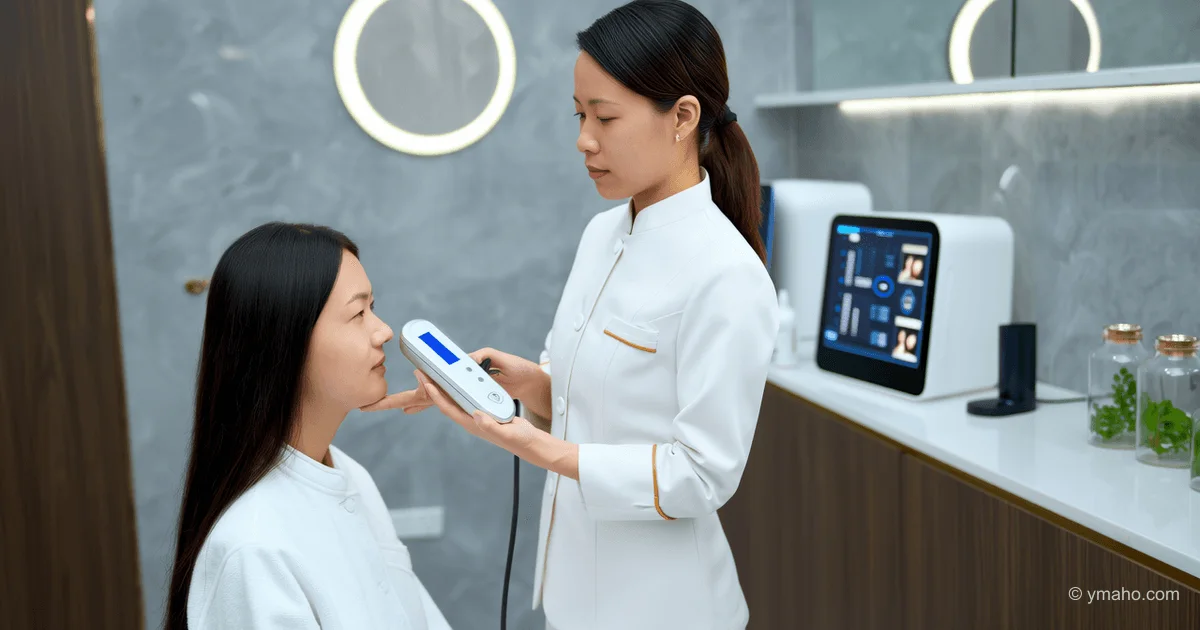
Thailand Brings T-Beauty to Taiwan Market via AI Skin Diagnostics
A major business mission of 29 Thai companies presented the 'Beauty is Health' trend and AI skin analysis systems in Taiwan. The focus is shifting to cellular restoration and personalized care.
How Thailand is building a bridge between Asian cosmetics and AI — and why $62 million is just the beginning
The Essence: What's Really Happening
From May 5-8, 2026, Taipei hosted the largest T-Beauty business mission in history: 29 Thai companies, 58 representatives, and 33 Taiwanese majors over four days of negotiations. On the surface, it's a routine B2B meeting. In reality, Thailand is officially launching its expansion into East Asia, not through mass-market channels, but via AI diagnostics and cellular technologies.
Key indicator: In 2025, Thai cosmetics exports to Taiwan reached $62 million — ranking 23rd among all product categories. For a country previously perceived as a supplier of coconut oil and spa accessories, this is a serious statement.
But the main story isn't last year's numbers; it's how Thailand is building its presence. This isn't the traditional 'cheaper than Korea' model. It's a full-fledged 'Beauty is Health' ecosystem: AI analyzes the skin, biomarkers determine needs, and personalized products address them at the cellular level.
Timeline and Context
Thailand's beauty expansion didn't happen overnight. It's the result of at least five years of systematic work. After the pandemic, Thailand — whose economy heavily depends on tourism — bet on exporting wellness services and products. The government subsidized R&D, universities (especially Mahidol University) developed cellular technologies, and private companies built production facilities meeting international standards.
By 2026, T-Beauty has a unique positioning. Unlike K-Beauty, which relies on trends and speed, the Thai model is based on medicine and traditional herbal knowledge. Add AI diagnostics, and you get a product that doesn't require consumers to understand ingredients. The algorithm decides for them.
Meanwhile, Taiwan's domestic market also evolved. Taiwanese consumers are among the most demanding in Asia. They value scientific approaches, read ingredient lists, and aren't swayed by marketing fluff. This makes Taiwan an ideal testing ground: if a product works here, it will work in Japan, Korea, and mainland China.
Who Wins and Who Loses
Losers — right now:
- K-Beauty in the 'affordable innovation' segment. Korean brands have dominated Asia with this model for decades. Now they face a competitor with medical positioning and AI tools, offering the same price but different legitimacy.
- Small-scale Taiwanese local brands. Media conglomerates like Storm Media already describe the Thai arrival as an 'army.' 33 Taiwanese companies entered partnership negotiations — a sign that local players prefer collaboration over competition.
- Traditional spa chains without digital infrastructure. If you lack a booking system, AI skin analysis, and integrated CRM, you're in the past. Thai companies brought digital solutions to Taiwan: AI diagnostics and online booking systems.
Who wins:
- Thai manufacturers with medical licenses. Companies like PharmaResearch (Korean brand Rejuran, active in Thailand) are already building a strategy around positioning Thailand as a 'regenerative medicine hub' for all of Southeast Asia. Thailand's aesthetic medicine market is valued at 76.5 billion baht ($2.1 billion) and growing 10-12% annually.
- Taiwanese tech companies developing AI for beauty. This business mission is their chance to enter Southeast Asian markets through Thai partners.
- The consumer. Competition among K-Beauty, J-Beauty, and T-Beauty in Asia will drive quality up and prices down in the personalized care segment.
What the Media Isn't Saying
Here's an insider insight that didn't make it into Taiwanese business press releases.
What Thailand presented in Taiwan under the 'AI skin diagnostics' brand is a Trojan horse. The real goal is deeper. Through AI systems, Thai companies gain access to Asian consumers' skin data — the most valuable asset in the beauty industry of 2026.
Let me explain. When a Taiwanese clinic or retailer installs a Thai AI system, every client's skin scan feeds the database. 33 Taiwanese companies mean potentially hundreds of thousands of scans per year. This data trains algorithms, predicts trends, and develops formulas that precisely match East Asian market needs.
This isn't a bet on a single product. It's a bet on data dominance in personalized cosmetics. In three years, whoever has the largest database of Asian skin will dictate ingredient trends. And Thailand started building that database on May 5, 2026, in Taipei.
Second non-obvious point: T-Beauty bypasses patent restrictions that K-Beauty faced. Korean innovations of recent years — from snail mucin to centella asiatica — have been widely copied and lost their differentiating power. Thailand bets not on exotic ingredients but on AI protocols and cellular technologies. A protocol can't be copied as easily as a snail cream formula. This creates a more sustainable barrier to entry.
Third point — geopolitical. In 2026, with trade relations between China and the West remaining tense, the 'Thailand → Taiwan → East Asia' route looks like an alternative distribution channel independent of Chinese platforms. For global investors seeking Asian beauty assets outside Chinese jurisdiction, this is a strong argument.
Forecast: Next 30 Days and 90 Days
30 days (by June 15, 2026):
- Three to five Thai companies will announce signed contracts with Taiwanese distributors. The first will be brands with AI diagnostics — they require minimal product adaptation and best demonstrate technological advantage.
- One Taiwanese retailer (likely POYA or Cosmed) will launch a T-Beauty shelf in test mode. If conversion rates are high, a permanent section will appear by autumn.
- Thai authorities will announce the next business mission — to Japan or Vietnam. The Taiwan expansion was the first step, and quick success will accelerate geographic expansion.
90 days (by August 15, 2026):
- At least one Taiwanese beauty company will launch a co-branded product with a Thai partner — likely in the 'cellular restoration' or 'personalized care via AI analysis' category. This will be a dual-branded product targeting both audiences.
- T-Beauty sales data from Taiwan for Q2 2026 will attract analysts' attention. If growth exceeds 15% quarter-over-quarter, global investors will start eyeing Thai beauty assets for M&A.
- Korean and Japanese beauty media will begin writing about the 'T-Beauty threat.' This will be a belated reaction to a trend already in motion. For the industry, it will signal: a third player has emerged in Asia, building its game not on trend-copying speed but on data ownership and medical expertise.
The main takeaway: Thailand isn't selling creams. Thailand is selling AI infrastructure for beauty retail and medical legitimacy. A country known as a spa tourism destination is building a digital beauty ecosystem. If this strategy works in Taiwan, by the end of the decade T-Beauty will stand alongside K-Beauty and J-Beauty — not as an 'exotic niche' but as a full-fledged third force in the Asian cosmetics industry. And $62 million in exports is just the initial stake in a game where bets are measured in billions.
— Editorial Team









