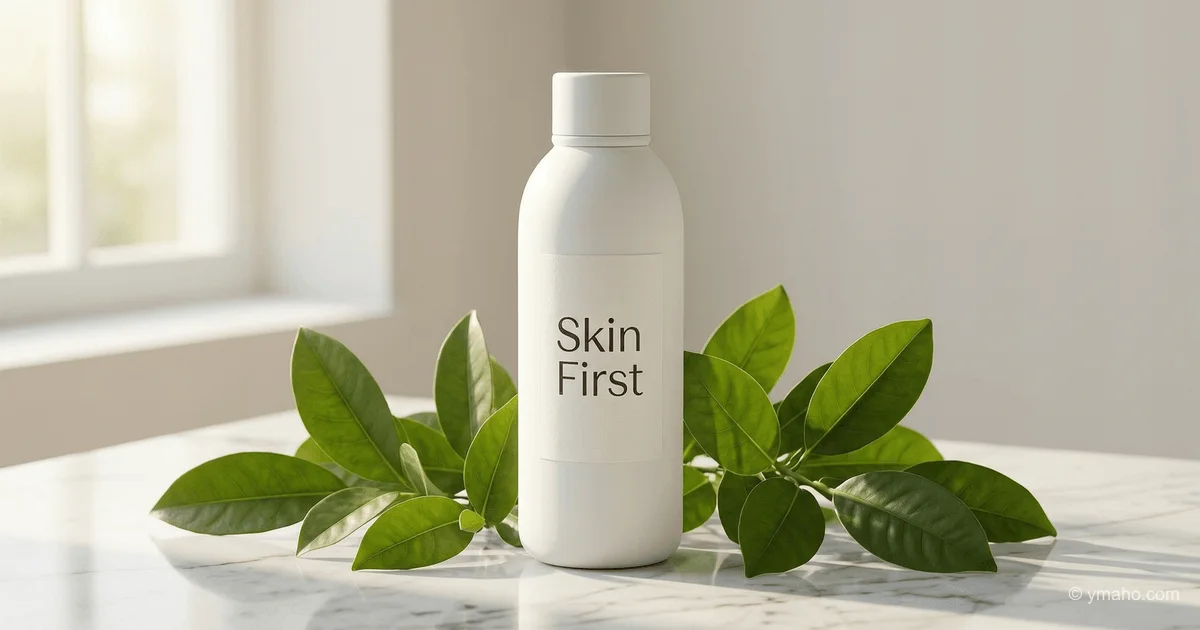
TaShe Professional Launches Its First Facial Care Line
The cosmetics brand introduced the Skin First series of 12 products in vacuum bottles. The products are aimed at maintaining natural skin health rather than masking imperfections.
Vacuum as a Manifesto: Why the Skin First Launch Is Not About Cosmetics, but About Reshaping the Skincare Device Market
The Gist: What's Really Happening
At first glance, the launch of the Skin First line by TaShe Professional — 12 products in vacuum bottles with the stated philosophy of "maintaining natural skin health, not masking imperfections" — looks like just another beauty brand entering the facial care segment. But if you read this launch not as a product news item but as a strategic maneuver, a completely different picture emerges.
TaShe is a Belarusian brand founded in 2019, with its own laboratory and production facility in Minsk, a portfolio of over 100 products, and ISO 9001 certification. For five years, the company methodically built expertise in hair and body care, gaining recognition in the segment of professional cosmetics for home use. And now — a leap into facial care.
But not just any leap; a leap with a very specific technological statement. Vacuum bottles are not a designer whim or a marketing metaphor for "purity." They are an engineering solution that places TaShe in line with a trend that the industry in 2026 calls the "Era of Precision Delivery." The main challenge facing any brand working with highly active ingredients is not the formula itself, but maintaining its stability from the first to the last pump. Oxidation, contamination, degradation of actives upon contact with air — these are the real killers of efficacy. Vacuum packaging solves this problem at the hardware level, creating an airless environment inside the bottle and ensuring almost complete evacuation of the product.
And here's where it gets really interesting.
Timeline and Context
TaShe is not operating in a vacuum — neither literally nor market-wise. The launch of Skin First in May 2026 falls precisely at the intersection of several powerful trends identified by industry analytics.
Trend one: Skinification of everything. LookFantastic, in its spring/summer 2026 trend report published on May 5, notes that "skinification" continues to dominate, and the skin itself becomes the main investment target, rather than makeup on top of it. Peptides saw a 79% increase in search queries in 2025, retinal nearly 50%, niacinamide 33.7%. Consumers are moving away from masking toward fundamental skin work, and TaShe with its "skin first" philosophy enters exactly this upward stream.
Trend two: Packaging as a functional interface. 2026 is the moment when the industry officially recognized that packaging has ceased to be a "silent vessel." It has become an active participant in delivering results. As GCI Magazine formulated in April 2026, "Efficacy is no longer determined solely by the chemistry inside the bottle — it is determined by the physics of how the formula is delivered to the skin." Vacuum bottles are the basic step of this paradigm: they prevent actives from dying before they reach the skin.
Trend three: Minimalism in routines. Consumers in 2026, according to TheIndustry.beauty, are abandoning excessive multi-step rituals in favor of "high performance, low effort." A line of 12 products covering all basic skin needs without unnecessary steps is precisely the answer to this demand: not 20 jars, but 12 products for all occasions.
Trend four: Return of trust in local production. The global market is making an increasingly clear turn toward niche and local brands that can offer production transparency and quality control. TaShe, with its own laboratory and ISO 9001 certification, finds itself in a winning position. Its own R&D base allows the brand to respond to trends faster than giants with their 18-month development cycles.
Who Wins and Who Loses
At first glance, TaShe Professional itself wins. The company is executing a classic upsell of its existing customer base: buyers already familiar with the brand for hair care get the opportunity to close their entire beauty routine with one manufacturer. This reduces the cost of customer acquisition in the new category to nearly zero — a rarity in the beauty market, where CAC (customer acquisition cost) reaches $30–$50 for cold audiences.
Moreover, the choice of vacuum packaging is a direct blow to competitors who still work with traditional jars. In 2026, when consumer literacy in ingredients has grown to the point that LookFantastic notes "fluency in the language of peptides, lipids, and ectoin," a product in a regular jar that the user dips their fingers into looks archaic. TaShe forces competitors to choose: either invest in repackaging their entire assortment or lose in perceived value.
Manufacturers of vacuum packaging systems are another beneficiary. The market for such solutions is growing along with the trend toward "smart packaging." Companies like Yituo Packaging, launching series with "absolute vacuum" systems, are seeing explosive demand.
Losing are brands that built their positioning on "naturalness" and "simplicity" but neglected the technological component. In 2026, consumers are no longer satisfied with a "paraben-free" label — they need proof that the formula will reach the skin intact. Brands without a technological background find themselves in a vulnerable position. The market is moving toward efficacy being valued higher than "naturalness," and this is a tectonic shift.
Also losing are cosmetologists working in the "come once a month for a procedure" paradigm. Skin First as a philosophy is a manifesto of self-sufficiency in home care. TaShe is not just selling jars — it is conveying the idea that competent home care can replace part of professional procedures.
What the Media Isn't Saying
The first non-obvious insight: vacuum packaging is not an improvement of the product, but the creation of a new type of contract with the consumer. When a woman buys a cream in a vacuum bottle, she is not paying for "natural ingredients" — she is paying for a guarantee that those ingredients will work on day 15, day 30, day 60 just as they did on day one. This is a contract for stability of results, and it costs more than a contract for "possible effect."
The second insight: 12 products are not just a line; they are a built-in retention strategy. Each product in the Skin First system creates an entry point into the brand's ecosystem. A user who starts with a cleanser is highly likely to return for a serum and then a night cream. This is a mechanic perfected by Apple: not selling a device, but building a universe that is hard to leave. TaShe — note this brand naming — is building an ecosystem model at a time when other Russian and Belarusian brands are still thinking in terms of "hit + a few companions."
The third insight concerns pricing. Vacuum packaging adds $0.50 to $1.50 to the product's unit cost depending on the complexity of the mechanism. But it also allows raising the retail price by 20-30% without consumer backlash — because the consumer perceives a vacuum bottle as a marker of premium quality. For the brand, this means expanding margins with relatively modest additional investments.
The fourth insight: Skin First launches at a time when the global makeup market is valued at $74.5 billion and is undergoing a fundamental shift toward a "skin-first approach." Demand is growing for hybrid formulas, products with skincare ingredients, and minimalist base layers. TaShe, with its manifesto of "skin health, not masking," hits the nerve of a global trend. Skincare is beginning to eat makeup from the inside, and this is a historic redistribution.
Forecast: Next 30 Days and 90 Days
30 days (by June 7, 2026). Skin First will go through the first wave of reviews in the beauty community. The key factor is the initial assessment of textures and sensorial experience. If TaShe has managed to solve the main problem of vacuum bottles — dosing stability from the first to the last pump — then word-of-mouth will ensure organic growth. K-beauty brands, dominating the skincare category with a 174% revenue increase on LookFantastic, will feel the breath of a competitor with an Eastern European production base.
Expect at least 2-3 prominent beauty bloggers to include Skin First in their "discoveries of the month." Also likely is news of TaShe's first collaboration with a retail chain for offline presence in the "face" category.
90 days (by August 7, 2026). By the end of summer, we will see competitive responses. First, several brands will launch their own lines in vacuum packaging — the precision delivery trend is too strong to ignore. Second, a discussion will begin about how much vacuum packaging actually affects efficacy, not just perceived value.
The key risk for TaShe is the gap between the stated philosophy of "skin health" and the actual composition of the products. In 2026, consumers are armed with apps for scanning ingredient lists and verifying claimed properties. If Skin First does not pass the scrutiny of the ingredient community, the backlash will be harsh. But if the formulas truly deliver on the stated philosophy, the line has a chance to become a bestseller.
Final conclusion: Skin First by TaShe Professional is not a story about 12 jars. It is a story about how a local brand with its own R&D base uses the global trend of skinification to transition from the "hair care" category to the "facial care" category. Vacuum packaging in this story is not a gimmick but a hardware argument: while competitors sell "cream in a jar," TaShe sells a "result delivery system." In a world where consumers speak the language of peptides and check ingredient lists via apps, this is the right bet.
— Editorial Team









