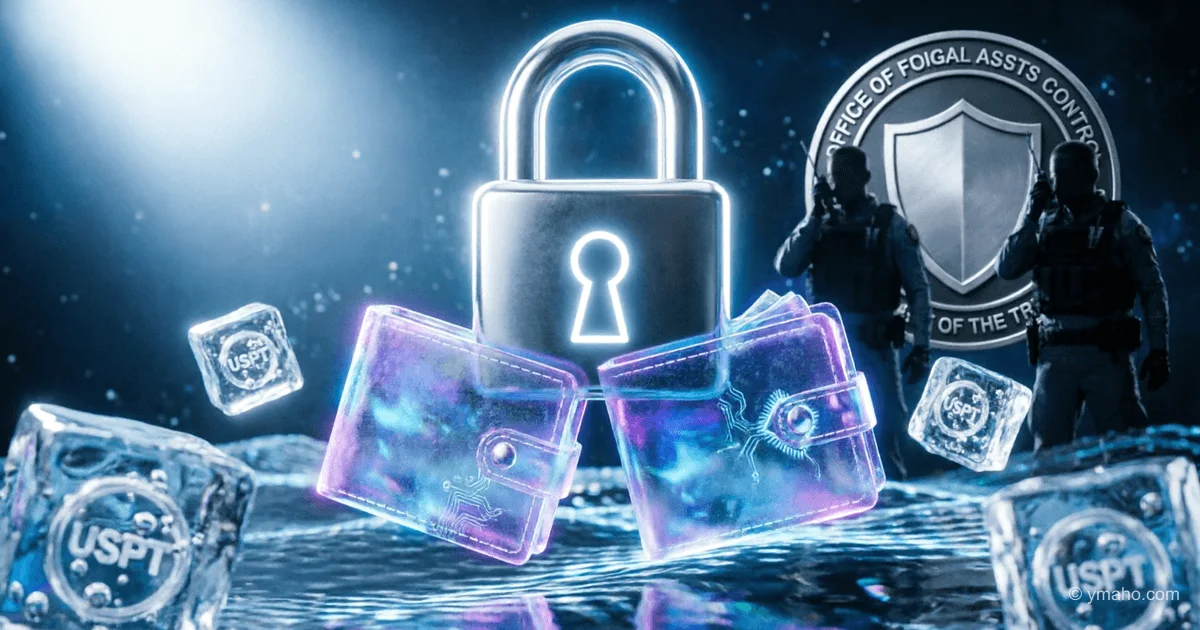
Tether Helps Freeze Approximately 344 Million USDT on Two Wallets on the Tron Network
A large sum was blocked at the request of US authorities on wallets linked to suspicious activity. This demonstrates the growing interaction of stablecoin issuers with law enforcement to combat illicit finance.
Tether Freezes $344M: Stablecoins Are No Longer a Haven for Illicit Funds
Introduction
On April 23, 2026, Tether, the issuer of the world's largest stablecoin USDT, announced the freezing of over $344 million on two wallets on the Tron blockchain. This action was taken in coordination with the U.S. Treasury Department's Office of Foreign Assets Control (OFAC) and other U.S. law enforcement agencies after these addresses were identified as linked to sanctions evasion, criminal networks, or other illegal activities.
The event drew the attention of the entire crypto community not only for its scale but also because it occurs amid growing regulatory pressure on stablecoin issuers. The Financial Action Task Force (FATF) recently warned that stablecoins are increasingly used for illicit operations, including sanctions evasion and money laundering.
This freeze was not just a technical measure but a vivid demonstration of how the role of digital asset issuers in the global financial system is changing: from anonymous "digital cash" to regulated participants actively cooperating with authorities.
Event Details and Timeline
What Happened
Tether announced that it had frozen USDT tokens worth over $344 million held on two wallets on the Tron network. The action was taken after U.S. authorities provided information indicating these addresses were linked to illegal activity.
According to blockchain security data, the distribution of funds was as follows:
- The first wallet contained approximately 213 million USDT
- The second wallet contained approximately 131 million USDT
The company did not disclose who controlled these wallets or specify the nature of the alleged illegal activity.
Reaction and Scale
Tether CEO Paolo Ardoino commented on the situation as follows:
"USDT is not a safe haven for illegal activity. When credible links to sanctioned entities or criminal networks are identified, we act immediately and decisively. We combine blockchain transparency with real-time monitoring and direct coordination with law enforcement to stop funds before they can be moved."
This freeze is one of the largest in Tether's history. The company reported that since beginning cooperation with law enforcement, it has frozen over $4.4 billion in assets, of which more than $2.1 billion is linked specifically to U.S. authorities.
Previous major freezes include:
- November 2023 — approximately 225 million USDT linked to a human trafficking network and a "pig butchering" scam in Southeast Asia
- January 2026 — approximately 182 million USDT on five Tron wallets
Impact and Significance
For the Crypto Industry: A Paradigm Shift
This event marks an important turning point in the perception of stablecoins. For a long time, the main argument of decentralized finance proponents was the impossibility for third parties to control or freeze funds. This incident demonstrates that this is not the case with centralized stablecoin issuers.
Tether, like other issuers, has the technical ability to freeze funds through a smart contract function that blocks the transfer or receipt of tokens by certain addresses. This capability, embedded in USDT's architecture, transforms the stablecoin from "digital cash" into something more akin to a traditional bank account that can be frozen at the request of authorities.
For Law Enforcement: A New Tool
For U.S. authorities, the freeze demonstrated the effectiveness of a new approach to combating illicit finance. Public blockchains leave a transparent trail of all transactions, allowing funds to be tracked. Combined with the issuer's ability to freeze assets, this creates a powerful deterrent mechanism.
Ardoino emphasized this advantage: "Public blockchains give investigators and issuers something that cash doesn't — a visible trail. Transactions can be traced, wallets can be flagged, and assets can be frozen before they are moved further."
For Society: The Cost of Centralization
However, there is another side to this coin. For ordinary users, the freeze of $344 million is positive news: criminals cannot use USDT for their purposes. But it also raises questions about how much "yours" what is stored in your wallet really is.
If an issuer can freeze an address at the request of authorities, it means the user does not have full control over their funds. This contradicts the very idea of decentralized cryptocurrencies like Bitcoin, where no one — not miners, not developers — can block a transaction or freeze a wallet.
Reactions from Key Players
Tether's Position: An Active Partner of Authorities
Tether consistently positions itself as a responsible participant in the financial system, ready to cooperate with regulators. The company emphasizes that it works with over 340 law enforcement agencies in 65 countries and supports over 2,300 cases worldwide.
Notably, the U.S. Trade Representative previously acknowledged Tether's contribution to law enforcement operations that led to the seizure of nearly $61 million and approximately $225 million linked to "pig butchering" scams.
Tether is also expanding its presence in the U.S.: the company launched the USAT token, compliant with federal stablecoin regulations, in partnership with Anchorage Digital, and this initiative is led by former White House crypto advisor Bo Hines. Additionally, Tether is preparing for its first full audit of its reserves, aiming to increase transparency.
Contrast with Circle: Two Approaches to Compliance
This incident also highlighted differences in the approaches of the largest stablecoin issuers. Earlier in April 2026, a $285 million hack of Drift Protocol occurred, in which attackers moved hundreds of millions of USDC across various networks.
Critics argued that Circle, the issuer of USDC, could have acted faster to freeze assets. Circle responded that it takes such actions only when it is a legal requirement or at the request of law enforcement.
Tether used this situation to emphasize its difference:
"Recent events have shown what happens when platforms do not act quickly: enforcement is disrupted, users are left vulnerable, and trust is undermined. Our approach is different."
As part of the aftermath of the Drift hack, Drift announced it would replace USDC with USDT as part of a recovery plan, supported by Tether's $148 million funding to compensate affected users.
Market and Analyst Reaction
Although the freeze itself did not cause significant fluctuations in USDT's price (expected given its dollar peg mechanism), it was perceived by market participants as a signal. Some analysts note that Tether is thus strengthening its position in the eyes of regulators, which could be beneficial in the long term, especially amid preparations for an audit and expansion in the U.S.
Forecast and Conclusions
Trend Toward Increased Control
The freeze of 344 million USDT is not an isolated incident but part of a consistent trend. Each year, stablecoin issuers cooperate more actively with authorities, and the volume of frozen funds grows. It can be expected that such actions will become routine in the future.
The FATF warning about the growing use of stablecoins for illicit operations will likely lead to stricter requirements for issuers worldwide. This may include mandatory user verification (KYC) for all stablecoin users and more stringent reporting procedures.
Consequences for Users
For ordinary, law-abiding users, increased control likely means more stability and less risk of encountering fraudsters. However, it also means that the anonymity long associated with cryptocurrencies is effectively disappearing for stablecoins.
For those who value privacy and decentralization, the following will become increasingly important:
- Coins with proven absence of a freeze function (e.g., Bitcoin)
- Privacy cryptocurrencies (Monero and others)
- Decentralized stablecoins (e.g., DAI, although it is not fully decentralized)
What This Means for Investors
For portfolio investors, this news has a dual significance:
- Centralization risk has decreased — Tether demonstrates its ability to protect its tokens from being used for illegal purposes, reducing regulatory risk for the company. This is a positive factor for those holding USDT as a trading tool or as a "digital dollar."
- But control risk has increased — the possibility of freezing reminds that USDT is not Bitcoin. If authorities ever need to block funds for political or other reasons, they have the tool to do so. Diversification across different asset types remains a sound strategy.
Main Takeaway
The event of April 23, 2026, is yet another confirmation that stablecoins are evolving from the "Wild West" of decentralized finance into a regulated segment of the global financial system. Tether, once considered a "gray horse" of the crypto market, now positions itself as a reliable partner of law enforcement.
"Blockchain transparency combined with the ability to freeze assets makes stablecoins no less traceable than bank accounts, and in some aspects even more so" — this conclusion will likely become a new axiom for everyone working with digital assets.
Tether's CEO summarized it as follows: "This is a responsibility that we, as one of the largest issuers in the market, take seriously." And, judging by all indications, this responsibility will only grow as stablecoins penetrate deeper into mainstream finance.
— Editorial Team









