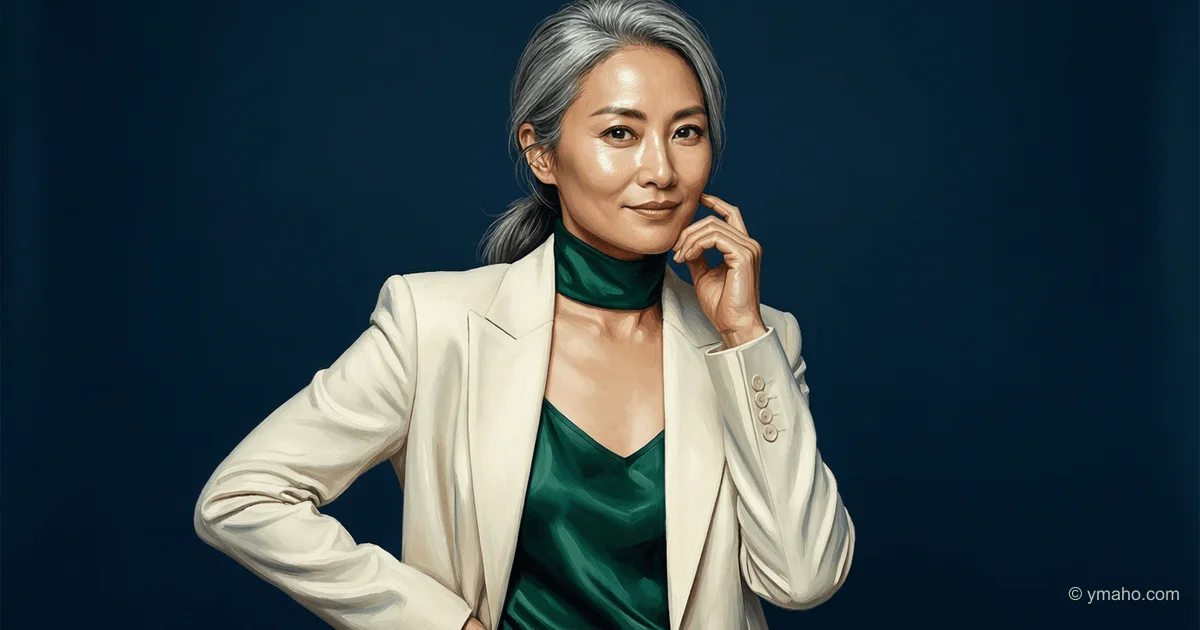
The Aesthetics of 'No-Makeup Makeup' and Natural Gray Hair as the New Standard
Moving from aggressive procedures to gentle cosmetic interventions is becoming mainstream. Women are abandoning total camouflage of gray hair and 'overdone faces,' choosing to support skin quality instead of altering features.
The Aesthetics of 'No-Makeup Makeup' and Natural Gray Hair: When the Beauty Industry Stops Lying
What looks like yet another trend toward naturalness is actually a documented moment when the cosmetics industry finally admitted: women are tired of lying to themselves and others, and the market is restructuring around 'honest' money.
I've been analyzing the beauty industry for over a decade, and I can say with confidence: May 2026 is not just another seasonal shift. It's the moment when three independent trends (abandoning heavy foundation, embracing gray hair, and the 'skinimalism' movement) converged at a single point.
Here's what's really happening.
[The Core]: What's Actually Happening
On May 22, 2026, European media documented what hairdressers had been whispering about for six months: covering gray hair is no longer fashionable. The 'salt & pepper' trend—a smooth transition between silver and dark strands—is becoming mainstream. Social media is flooded with videos of women sharing how they gave up dye and embraced their natural color.
But that's just the tip of the iceberg.
Meanwhile, in cosmetology, the concept of 'skinimalism'—minimalism in skincare—is gaining momentum. Experts talk about shifting from multi-step routines to approaches that maximize results with minimal products. The key principle: quality over quantity, clinically proven efficacy over marketing promises.
And here's the third component. More and more celebrities are publicly giving up Botox and fillers. 62-year-old Lisa Kudrow told The Hollywood Reporter on March 18, 2026, that she decided to stop Botox after unusual side effects—eye irritation and a 'strange pattern on her forehead.' TV host Yana Churikova admitted that after several sessions, her eyelid drooped—an individual reaction unrelated to the doctor's qualifications.
Why is this happening all at once? Because these are three manifestations of the same thing: women no longer want to be a 'product.' They want to be themselves. And an industry that has profited from insecurities for decades is forced to adapt.
Timeline and Context
Let me break down how we got here.
2024-2025: In the West, the movement against 'toxic' beauty culture gains steam. Studies emerge on the harms of constant dyeing (aggressive chemical formulas) and excessive injections (fillers migrate, Botox causes resistance).
January 2026: Industry forecasts officially name skinimalism the top trend of the year. It's about moving from complex multi-step routines to approaches focused on clinically proven efficacy.
March-April 2026: Lisa Kudrow and Yana Churikova publicly share their negative experiences with Botox. Their stories go viral because they voice what millions of women keep quiet: 'I'm afraid of aging, but I'm even more afraid of looking like not-me.'
May 22-23, 2026: European media document the natural gray hair trend. In major European cities, salons specializing in gray hair care open—strengthening treatments and gentle toning to prevent dullness.
May 2026: Simultaneously, the market records a surge in interest in 'silver beauty.' According to a Fortune Business Insights report from May 21, 2026, the global silver beauty market (products for aging skin and hair) is valued at $92.96 billion in 2026 and will grow to $155.31 billion by 2034, with a CAGR of 6.63%.
Who Wins and Who Loses
Winners: Salons transitioning to restorative treatments.
The hair dye industry is experiencing a tectonic shift. Women increasingly choose health over a new color. In salons, requests are no longer for 'cool blonde' or 'graphite shade,' but 'make my hair look expensive but still mine.'
The top three treatments now are those that don't change pigment but transform condition: keratin and hyaluronic acid hair Botox, lamination, and keratin smoothing. After one session, hair looks perfect for months, and maintenance is done with regular home masks and oils.
Winners: Manufacturers of 'smart' skincare.
According to a Personal Care Insights industry analysis from January 2026, sustainable skincare trends go beyond 'natural' labels toward science-backed ingredients combining performance and sustainability. Biotech ingredients (fermented lipids, ceramides, peptides, postbiotics) are produced in controlled environments with fewer resources and ensure better batch-to-batch reproducibility.
A key player in this field is Sequential, whose skincare director Petronius Khoudart predicts: in 2026, sustainability in skincare will be defined less by marketing claims and more by product efficacy and evidence.
Winners (and this is important): Consumers with average budgets, not just luxury.
The naturalness trend is linked not only to aesthetics but also to savings. Women are increasingly giving up regular dyeing to save money and time. The average cost of maintaining complex coloring in Europe is €80-150 per month, not including care products. Quitting dye saves €1,000-2,000 per year.
Losers: Manufacturers of permanent hair dyes.
Sales of at-home permanent dyes have noticeably dropped. Instead, people buy professional masks, scalp serums, and hair oils. Beauty bloggers no longer film dramatic transformations from brunette to blonde. Now they teach how to restore length, choose care based on hair condition, and avoid harm in the pursuit of color.
Losers: Cosmetic clinics living off the 'injection boom.'
Cosmetologist Alexandra Pashkova, in an interview with Life.ru on February 20, 2026, revealed an uncomfortable truth: excessive use of fillers, botulinum toxin, and biostimulants at age 20-25 can visually age the face more than natural aging. 'Injecting fillers without real indications creates excess volume where it was originally sufficient and disrupts natural proportions. The face becomes heavy and puffy, losing individuality.'
This is a direct threat to the business model of clinics that have convinced women for decades that 'aging prevention' starts at 25.
What the Media Aren't Saying
Insight #1: The gray hair and 'naturalness' trend isn't about liberation. It's about budget redistribution within the beauty industry.
Numbers you won't see in glossies. The silver beauty market was $88.33 billion in 2025. In 2026, it's already $92.96 billion. That's a $4.6 billion increase in one year. Money isn't leaving the industry. It's just flowing from the colorist's pocket to the serum manufacturer's and the salon owner's who does hair Botox.
The anti-aging skincare segment accounts for 40.54% of this market, and the fastest-growing segment is age-friendly makeup, with a projected CAGR of 8.23%. That is, 'makeup friendly to age'—products that don't mask but enhance.
Insight #2, the most important: 'No-makeup makeup' is an illusion. It takes a lot of cosmetics to create.
Here's the paradox of the trend. Marie Claire, analyzing the main beauty trends from the 2026 Fashion Weeks, writes directly: 'The 'clean face' trend is not just about minimalism, but about perfectly prepped skin with barely-there makeup. But to do no-makeup makeup, you need a lot of cosmetics—a primer to even out skin, concealer to hide flaws, foundation, a bit of highlighter, contour, bronzer, or blush.'
See? 'Naturalness' is the most expensive and labor-intensive type of makeup. It requires perfect skin, professional products, and makeup-artist-level skill. It's not 'I woke up like this.' It's 'I spent an hour and $200 on products so you'd think I'm wearing nothing.'
This isn't democratization of beauty. It's a new form of gatekeeping.
Insight #3: Celebrities quitting Botox isn't a revolution; it's a marketing move.
Notice: Lisa Kudrow says she's afraid of aging but looks forward to playing age-appropriate roles. Yana Churikova admits she hasn't given up other cosmetic procedures that don't require long recovery.
This isn't 'I've accepted my age.' It's 'I'm switching to other procedures.' Microcurrents, RF lifting, ultrasound, biorevitalization—all remain. Needles are just replaced by devices.
Forecast: Next 30 Days and 90 Days
30 days: A wave of articles on 'proper' acceptance of gray hair.
Expect dozens of pieces: '10 Steps to Beautiful Gray Hair,' 'How to Care for Silver Hair,' 'Best Products to Neutralize Yellow Tones.' Jhirmack already launched a shampoo and conditioner for gray and silver hair in April 2026. Other brands will follow within a month.
90 days: Conflict between 'naturalness' and 'professional makeup.'
On red carpets, stars will appear 'without makeup'—and receive scathing comments about 'unkemptness.' A public debate will arise: does a woman with gray hair and no foundation have the right to be on a glossy cover? The answer will depend on how many advertisers are willing to pay for 'honesty.'
Third scenario: The emergence of a new generation of 'natural' brands.
Startups offering multifunctional products (hydration + SPF + light tint in one bottle) will get venture funding. Investors are already looking for the 'next big thing' in the 'honest beauty' category. Deal valuations range from $10 to $50 million per brand.
Business takeaway for those reading between the lines: Watch companies that produce professional hair repair masks and scalp serums (Olaplex, K18, L'Oréal Professionnel). Their sales will rise amid the abandonment of dyeing—because 'growing healthy hair after chemicals' becomes women's top priority.
And don't forget the men's segment in silver beauty. It's growing at a CAGR of 7.10%. Men over 50 suddenly want to care for their gray hair too. That's a new audience no one talks about.
And if you're just a woman looking in the mirror and seeing silver strands and fine lines—here's the main advice. Don't dye. Don't get Botox. Buy a good shampoo for gray hair (with purple pigment to neutralize yellow) and a moisturizing serum with peptides. That will cost $50, not $2,000 a year on maintaining color and injections.
And remember: the beauty industry has spent decades convincing you that you're 'not good enough.' The naturalness trend is the first time the market says: 'You're already good enough. Now pay us to stay yourself.'
Ironic, right? But at least it's honest. And in a world where mascara with a production date of 'September 2026' is reality, honesty is already a victory.
— Editorial Team









