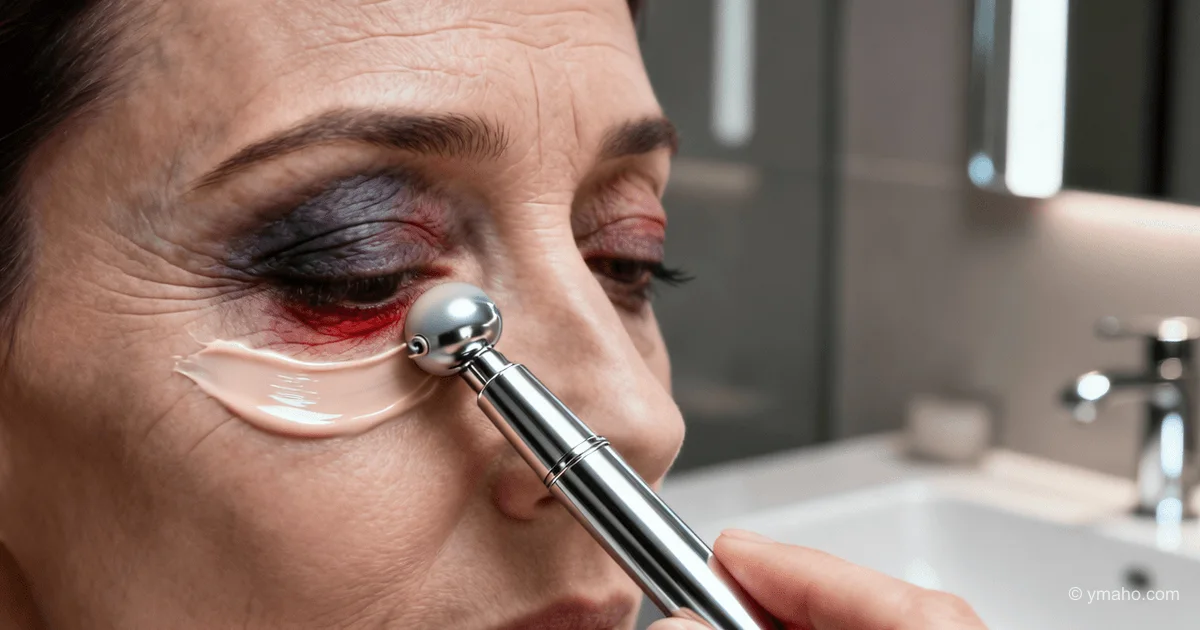
Tinted Eye Creams — The Ultimate Multifunctional Skincare Trend
Vogue and dermatologists highlight a new surge in popularity of tinted eye creams that simultaneously hydrate, smooth, and conceal dark circles thanks to pigments. Top products feature caffeine, niacinamide, and SPF, delivering an "instant well-rested eye effect" without heavy concealer.
The trend of tinted eye creams, which many media outlets present as yet another "revolution" in beauty routines, is actually a symptom of a much deeper and more painful transformation in the industry. Vogue's superficial analysis, praising the multifunctionality of products with caffeine and niacinamide, misses the point. We are witnessing not the birth of a new skincare category, but the cannibalization of two huge market segments — decorative cosmetics and classic dermatological skincare — compressed into a single product under pressure from inflation-weary consumers.
The Core: Tube Economics vs. the Illusion of Innovation
What is described as "innovation" is in fact a forced marketing response to declining purchasing power in the "mid-luxury" segment (mass-tige). Gen Z and millennial consumers are no longer willing to pay $45 for a separate concealer and $60 for peptide patches. A tinted eye cream covers both needs with a margin higher than classic skincare, but with the psychological positioning of "two-in-one" that justifies a price tag of $40–$55 per tube.
The real chemistry here is secondary. Yes, formulas have become more stable: the stability of ascorbic acid (vitamin C) and retinol has increased significantly compared to the 2010s. But this is evolution, not a breakthrough. The key driver is household microeconomics. Instead of selling two products, the industry creates a hybrid that replaces both while maintaining revenue at the level of one and a half average SKUs. This is a defensive strategy in a context where sales growth of foundation products is slowing (the foundation category growing only 15% in 2026 in some markets amid rising prices), and pure skincare creams are losing ground to massage devices.
Timeline and Context: From "Sunkissed" Aesthetics to Functional Pigmentation
The first wave of this trend did not start in 2026. As early as 2023, players like Colorescience and ReVive quietly lobbied for the introduction of tinted SPF in periorbital care. The main update in 2026, which the media has now placed on the news agenda, is the shift from "SPF protection with a tint" to "full-fledged skincare with a visual effect." Previously, pigment masked the white cast from titanium dioxide; now it intentionally color-corrects blueness and capillary networks.
This was facilitated by the "sunkissed makeup" trend of spring 2026, which legitimized semi-sheer coverage with visible skin texture. Once wearing a "plaster" became a faux pas, the boundary between "treating blueness with peptides" and "covering it with concealer" disappeared. Consumers were told: you are not masking a flaw, you are "completing your skincare with tinting."
Who Wins and Who Loses
The winners are raw material manufacturers of "mineral pigments + anti-aging actives." Companies producing expensive stabilized forms of vitamin C and CBD (BeautyStat, Saint Jane) suddenly gained a market not as "serums" but as "hybrids." Ron Robinson of BeautyStat accurately captured the moment: skincare must deliver visible results in the mirror immediately after application.
The clear losers are classic mass-market concealers. If a woman gets used to her under-eye puffiness being reduced by a rollerball applicator with caffeine while also masking vascular networks, she no longer needs a separate heavy corrector. Brands like Maybelline Instant Age Rewind, which built an empire on the concept of "concealing," will face an audience exodus to pharmacy luxury (the pharmacy segment here is the key channel).
What the Media Isn't Saying
Non-obvious insight: The most aggressive growth in the category is not from peptide products, but from those masking the consequences of lymphostasis caused by the previous trend — "face lifting taping." In pursuit of instant oval tightening, users overloaded their lymphatic system. Tinted creams with a pronounced cooling effect and drainage components (e.g., RMS ReFresh with SPF 30) are now becoming "first aid" remedies for morning puffiness, which tapes only worsened.
Second: The market does not mention that tinting components (iron oxides, mica) are technically inert pollutants for skin prone to milia. For dermatologists, this is a headache: patients apply a mixture of pigments and occlusives to the thin skin of the eyelids, causing duct blockage. But long-term risks are downplayed because the sales velocity of such products exceeds classic skincare by 30–40%.
Forecast: Next 30 Days and 90 Days
Within 30 days, we will see the launch of makeup removers "specifically for tinted skincare." Classic micellar water poorly removes stubborn silicones and pigments embedded in the microbiome lipid layer. Brands like Bioderma will release fractional formulas for double cleansing the periorbital area, focusing on gentle removal of tinted creams without friction.
Within 90 days, expect a scandal around shades in the premium segment. While everyone discusses 3–4 universal tones from YSE Beauty or Olehenriksen, dark-skinned consumers and Asian markets remain without adequate color adaptation. Since R&D in eye pigments is more complex (requiring consideration of venous blue and brown hyperpigmentation), the shade deficit will hit the reputation of brands claiming inclusivity. Expect open letters from dermatologists specializing in ethnic skin and demands to reduce the concentration of titanium whites, which give a gray undertone on dark skin.
This is not hype; it is market adaptation to the fact that women no longer want to pay twice. Marketing sells them beauty without makeup, while chemists sell makeup disguised as skincare. And as long as this paradox generates profit, tinted eye cream will remain the ultimate symbol of an era of rational consumption — where every dollar must work for both drainage and coverage.
— Editorial Team









