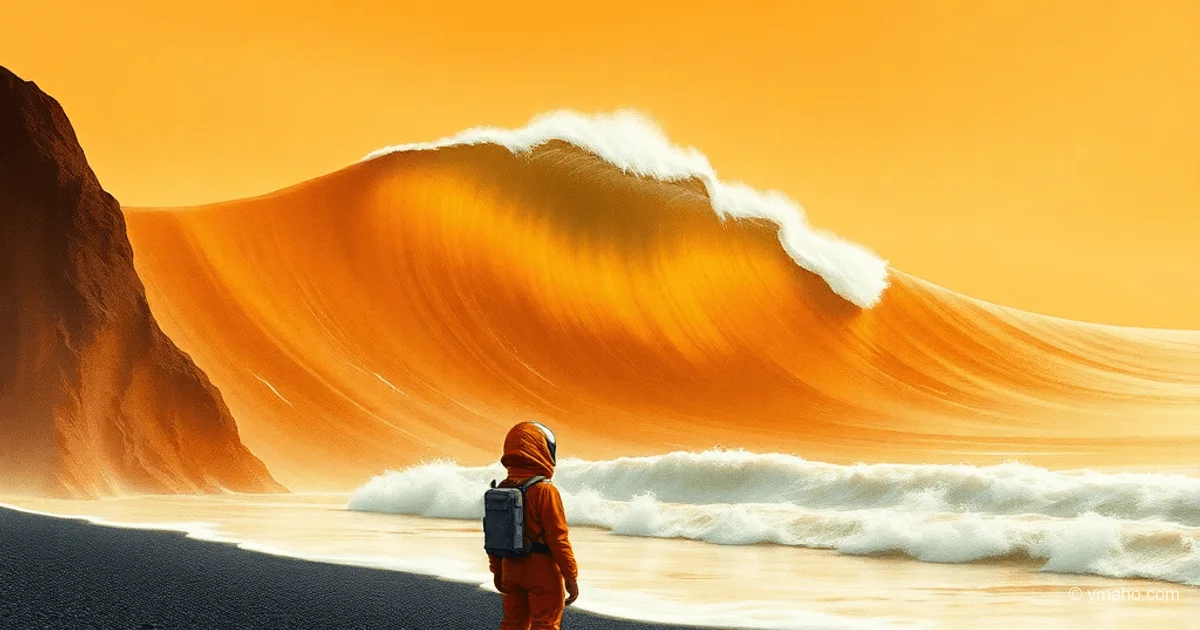
Why Waves on Saturn’s Moon Titan Could Be 10 Feet Tall — and Move Like Slow-Motion Giants
Imagine standing on the shore of a lake where a soft breeze barely rustles your hair — yet in front of you, 10-foot-tall waves roll toward the beach like slow-motion giants. This isn’t science fiction. It could be happening right now on Titan, Saturn’s largest moon, where oceans aren’t made of water but of liquid methane and ethane. And thanks to a new scientific model called PlanetWaves, researchers can now predict how waves behave on alien worlds — with surprising results that challenge everything we assume about oceans.
A New Way to Understand Alien Oceans
For decades, scientists trying to imagine waves on other planets mostly looked at gravity. But that’s like guessing how a boat will rock by only checking how heavy it is — you’re missing half the story. The new PlanetWaves model adds three crucial ingredients: atmospheric pressure, the liquid’s density (how heavy it is), and its viscosity (how thick or runny it feels). Surface tension — a measure of how much a liquid resists forming ripples — also plays a role.
The team behind PlanetWaves tested it first on Earth, using 20 years of real wave data from buoys in Lake Superior. When the model matched those measurements almost perfectly, they knew they could trust it to simulate oceans on distant worlds.
Titan’s Oily Seas and Gentle Breezes
Titan is the only place in our solar system besides Earth known to have stable liquid on its surface. But don’t pack your swimsuit: temperatures there hover around –179°C (–290°F), cold enough to turn methane into a liquid. These hydrocarbon lakes are more like oil than water — lighter and less sticky.
Combine that with Titan’s weak gravity (just 14% of Earth’s), and even a light wind can push the liquid into massive waves. “It kind of looks like tall waves moving in slow motion,” said lead researcher Una Schneck of MIT. On Earth, the same breeze might make tiny ripples. On Titan, it could build walls of liquid 3 meters high.
This matters more than just curiosity. Those waves might explain why Titan’s river deltas — where rivers meet lakes — are nearly invisible. On Earth, rivers deposit sand and mud to form fan-shaped deltas. But if Titan’s waves are constantly churning the shoreline, they could wash away any buildup before it forms.
What This Means for Future Missions
If NASA or another space agency ever sends a floating probe to Titan — like the proposed Dragonfly mission — engineers need to know what kind of waves it might face. A 10-foot wave in slow motion still carries energy. Designing a lander that can survive those conditions means understanding wave physics beyond Earth.
Beyond Titan: Waves Across the Universe
The PlanetWaves model doesn’t stop at Saturn’s moon. Scientists ran simulations for several other worlds:
- Ancient Mars: Billions of years ago, when Mars had thicker air and liquid water, gentle winds could’ve made decent waves. As the atmosphere thinned, stronger gusts would’ve been needed to stir the seas.
- LHS 1140b: A super-Earth exoplanet possibly covered in deep oceans. Its stronger gravity would squash waves smaller than Earth’s under the same wind.
- Kepler-1649b: A Venus-like world that might host sulfuric acid lakes. Because acid is twice as dense as water, it takes fierce winds just to make it ripple.
- 55 Cancri e: A scorching planet possibly dotted with lava lakes. Lava is extremely thick, so even hurricane-force winds (80+ mph) might only create tiny ripples.
Key Takeaways
- Waves on other worlds behave very differently due to gravity, liquid type, and air pressure.
- Titan’s low gravity and oily liquids mean small breezes can create huge, slow-moving waves.
- These waves may explain the lack of visible river deltas on Titan.
- Understanding alien wave dynamics is crucial for designing future space probes.
- The PlanetWaves model helps scientists explore ocean behavior across the universe — even on worlds we’ve never visited.
What Does This Mean for Regular People?
While you won’t surf Titan’s waves anytime soon, this research shows how deeply connected physics is across the cosmos. The same rules that shape ocean swells off California also govern methane tides on a moon a billion miles away. And as we dream of exploring other worlds, knowing how their “seas” behave brings us one step closer to building machines that can survive there — turning distant dots in the sky into places we might one day truly visit.
— Editorial Team









