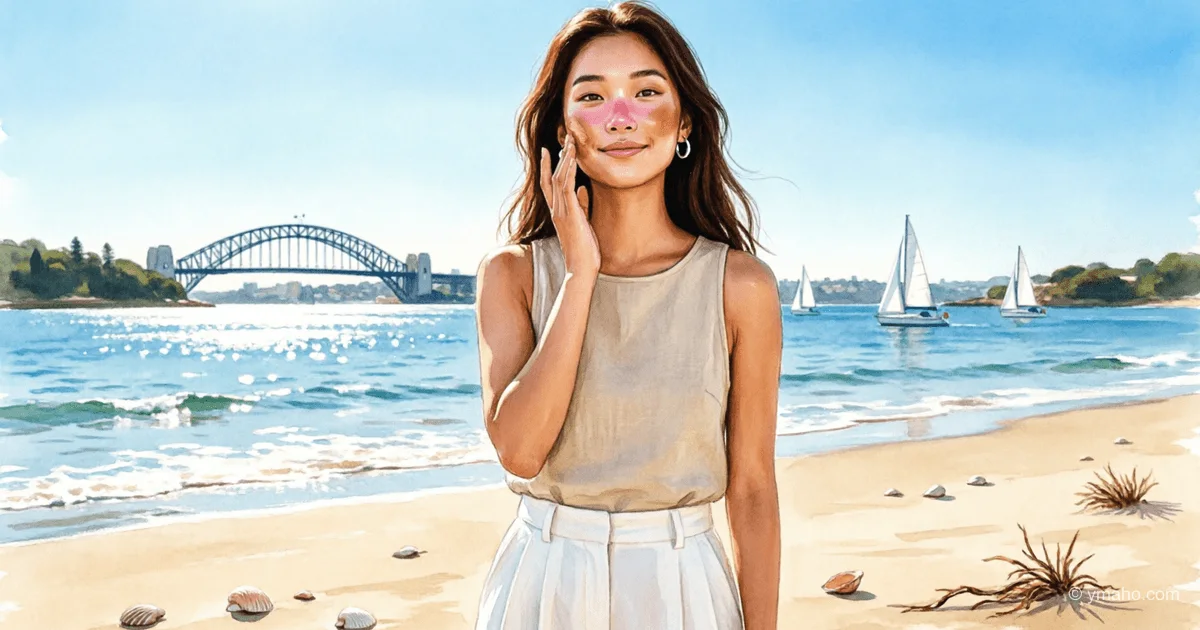
The #aussiegirlglam Trend Is Taking Off: The 'Post-Vacation Skin' Effect Without Heavy Makeup
A new beauty style inspired by Australian makeup artists is going viral on social media. Key techniques: bronzer as a sun-kissed veil across the entire face, blush swept over the bridge of the nose, and a soft, glowing lip contour to achieve a relaxed beachy look.
The #aussiegirlglam trend, which has exploded on social media, at first glance seems like another harmless aesthetic in the vein of "clean girl" or "latte makeup." But as someone who consults beauty brands on market entry strategies, I see behind this "sun-kissed haze" a cynical and precise business maneuver. This is not just a bronzer application technique; it's a geopolitical and economic response from the Southern Hemisphere to the dictates of the North American beauty establishment, repackaged into a viral video format.
The Essence: What's Really Happening
We are witnessing a shift in the center of power in the global makeup industry. #aussiegirlglam is a market revolution carried out by Australian makeup artists like Tanielle Jai and Bronte Scullion. For a long time, Hollywood contouring or French nonchalance were considered the "gold standard." Now, the economic center of the beauty world is shifting to the Asia-Pacific region, and Australia, situated at the intersection of Western and Asian aesthetics, has finally converted its unique climate into a commercial trend.
The point isn't bronzer, but the formula of "sustainable beauty in a harsh environment." The Australian climate is harsh UV and extreme heat. The trend legitimizes a thick layer of foundation with SPF and makeup capable of withstanding 40-degree heat, calling it "lazy luxury." As the makeup artists themselves admit, this is makeup designed for shoots where the face must endure a 12-hour filming day under the scorching sun. We are being sold the image of a "girl just off the beach," when in reality it's a complex, multi-layered construction.
Timeline and Context
The starting point was May 2025, when cosmetics giant Mecca officially noted a shift in the Australian market towards "sun-kissed blush." But the real explosion came not from the movement itself, but from mass-market price dumping. In April 2026, the brand SHEGLAM, owned by Singapore's Roadget Business, launched a line of 197 products in the Australian Kmart chain. This event was the trigger that collapsed the barrier between expensive "Australian luxury" and affordable Asia.
The key turning point came in May 2026. Suddenly, Australian designer Carla Zampatti told Daily Mail that "the era of obvious trends is dead," and it was time for "conscious consumption." But right at that moment, social media was flooded with videos showcasing the "Australian glamour formula." The market faced a paradox: a mass trend is shouting that it is against trends. This is a defense mechanism from the luxury segment, which fears that its aesthetic will be stolen by Asian mass-market giants.
Who Wins and Who Loses
The main beneficiaries are Australian influencers and startups. Tanielle Jai has turned her reputation into capital: her cream bronzer Bronzour for $49 USD and Stayliner liner are sold as tools to achieve "that" Australian skin. This is a colossal leap for a local brand that was only known in niche circles a year ago. Asian tech giants like SHEGLAM also win, instantly copying textures and selling them for $6 USD. They profit from the global hype of the trend by offering a democratic version of the aesthetic.
The losers are American and European luxury conglomerates. Sephora and Mecca will try to sit on the fence, selling Haus Labs and Rare Beauty as a base for "Australian glow," but their margins are at risk. If beach chic can be put together for $30 USD at Kmart, why pay $72 USD for Chanel Les Beiges fluid foundation?
Another loser is the "clean" aesthetic of clean girl. #aussiegirlglam uses heavier coverage and faux freckles, overshadowing the minimalist transparency that American beauty giants bet on.
What the Media Isn't Saying
The biggest secret, known only to insiders, is that a key role in the genesis of this trend was played not by fashion, but by medical cosmetics. Australia is the world leader in skin cancer. The media machine supporting #aussiegirlglam is partly sponsored by SPF product manufacturers and dermatology clinics. The trend creates a fashion for "bronzer-sealed faces," which is essentially perfect advertising for thick foundation with sun protection.
No one talks about the second, shadow beneficiary: the artificial tanning industry. Real tanning in Australia has become a social taboo. The "post-vacation skin without vacation" trend is a goldmine for chemical tanning. When Jai talks about "multi-functionality" and applying bronzer to eyelids and lips, it creates a demand for a new type of product that mimics melanin, not just decorative powder.
Forecast: The Next 30 Days and 90 Days
First 30 days. In June, a "bronzer war" will begin on shelves. Fenty Beauty will release its version of a "sun-kissed veil" for dark skin, and Charlotte Tilbury will launch an "Aussie Glam Kit" as a limited edition for €120. Simultaneously, Ozon and Wildberries will see a flood of Asian liquid bronzers with aloe and niacinamide priced between $5 and $12 USD. The TikTok user's makeup bag will be split into two camps: expensive Australian "cream" and cheap Asian "dupe."
90 days. By the end of August 2026, we will see the trend being absorbed by medicine. Major cosmetics corporations like L'Oréal and Estée Lauder will start patenting molecules that provide a "tan effect without pigment" — a slight change in the optical properties of the skin. Simultaneously, audience fatigue will set in. #aussiegirlglam is too heavily dependent on makeup, and in September it will be replaced by "intelligent barrier care" — a trend focused on restoring the face after the harsh Australian summer. The beauty industry is already preparing the ground to sell us treatments for what it itself has created.
— Editorial Team









