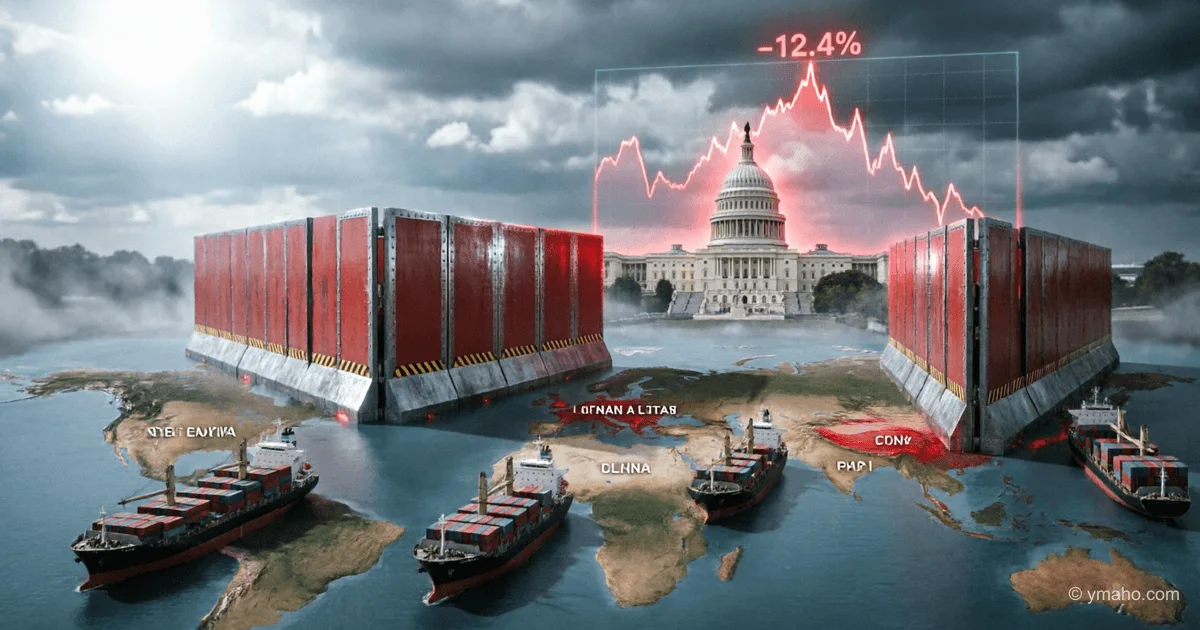
Trump Declares Global Trade War: Tariffs on China, India, and EU Reach 20–50%
The US has imposed a baseline 10% tariff on goods from all countries, with significantly higher rates for several nations, including China (20%), India (50%), and the European Union (20%). In response, the EU has announced countermeasures worth €26 billion, and the IMF has downgraded its global growth forecast to 3.0% for 2026.
Trade War 2.0: Why Trump's Tariffs on China, India, and the EU Are Reshaping the Global Economy
Introduction
On April 29, 2026, US President Donald Trump signed an executive order that economists have already called "the most sweeping protectionist act since the Smoot-Hawley Tariff of 1930." The new tariff policy imposes a baseline 10% import duty on goods from all countries without exception, while key trading partners—China, India, and the European Union—face discriminatory rates ranging from 20% to 50%. The stated rationale is "restoring trade balance and protecting national security," but the real reason runs deeper: the Trump administration, grappling with a protracted Middle East conflict and falling approval ratings ahead of the midterm elections, decided to tap into the American electorate's traditional fear of "unfair foreign competition." However, at a time when the global economy was just beginning to recover from pandemic and energy shocks, a new round of trade war threatens to trigger a global recession. The International Monetary Fund has already cut its global GDP growth forecast to 3.0% for 2026—the lowest since 2020, excluding the COVID-19 downturn.
Event Details and Timeline
The first signs of the impending changes emerged in March 2026, when Trump promised at a campaign rally in Ohio to "punish countries that have been looting America for decades." Yet no one expected the strike to be so massive and nearly simultaneous on all fronts. The April 29 order introduces a four-tier tariff system:
- A baseline universal tariff of 10% on all imported goods without exception. This applies even to goods from countries with which the US has free trade agreements—Mexico, Canada, South Korea. Exemptions are limited to a narrow range of items: pharmaceutical ingredients, certain medical equipment, and dual-use goods critical to national defense.
- An elevated tariff of 20% for China and the European Union. For China, this means the average weighted tariff on Chinese imports to the US jumps from the pre-reform 19% (after Trump's first term) to 39%, and for specific categories—such as electric vehicles, solar panels, and industrial robots—it reaches 100%. For the EU, the new tariffs hit hardest in German automotive manufacturing and French agriculture.
- A shocking 50% tariff on goods from India. This measure came as a surprise to New Delhi, which had been actively aligning with Washington over the past two years as part of the anti-China Indo-Pacific Partnership strategy. The reason: complaints from US pharmaceutical companies about "systematic intellectual property violations" and India's refusal to open its agricultural market.
- A separate "Chinese devil tariff" of 25% on imports from China, stacked on top of the 20%—totaling 45% on all product groups where the Chinese value-added share exceeds 60%.
An even more critical detail: the tariffs take effect immediately, without the typical 90-day consultation periods common in trade wars. Exemptions and procedures for obtaining individual licenses are virtually nonexistent. The administration has set up a special office at the Department of Commerce to review exemption requests, but according to Reuters, the office has only 50 staff to handle an expected 350,000 applications in the first 30 days.
Chronologically, this is not the first round of the trade war but rather its culmination. Trump's first term (2017–2021) brought tariffs on roughly $350 billion worth of Chinese goods and on steel/aluminum for all countries. Biden retained most of those tariffs. However, Trump's return to the White House in January 2025 after winning the 2024 election set off a steady escalation. In summer 2025, 100% tariffs were imposed on Chinese electric vehicles. In fall 2025, restrictions were placed on solar panel imports from Southeast Asia, where Chinese companies had relocated production. April 2026 became the final blow: the administration decided to strike massively on all fronts at once.
Impact and Significance (for the World / Industry / Society)
The scale of the shock is comparable to the collapse of Lehman Brothers in 2008, except this time the shock is trade-related, not financial. The difference is that in 2008, the first blow hit Wall Street; now it hits the ports of Long Beach, Rotterdam, and Shanghai.
Global chain reaction. The IMF estimates that raising the US average weighted tariff from 2.5% to roughly 15% (accounting for the new 10% baseline and higher rates for key partners) will reduce global trade volume by 8–10% within a year. This is an unprecedented contraction after the globalization boom of 1990–2010. According to the World Trade Organization (WTO), international merchandise trade volume will fall by 5.6% in 2026—twice as much as during the global financial crisis. Meanwhile, the IMF has downgraded its global economic growth forecast from 3.5% to 3.0% for 2026. One percentage point of global GDP growth represents roughly $1 trillion in lost value added.
US industry. Paradoxically, American manufacturers—for whom the tariffs are supposedly intended—are already sounding the alarm. The Motor & Equipment Manufacturers Association (MEMA) warned that the cost of assembling an average car in the US will rise by about $3,000–3,500 due to higher prices for imported components, from microchips (many still made in China) to leather seats (from India). The National Retail Federation estimates that consumer goods prices in the US will increase by 8–10% within six months, adding 1.5 percentage points to inflation already stoked by the oil shock from the Middle East.
Global trade architecture. This event marks the effective collapse of the WTO and the system of rules built since 1947. The new Trump administration has openly stated it "will not be bound by WTO rulings" and has promised in advance to veto any sanctions from a dispute panel. The EU, China, and India have already filed collective complaints with the WTO, but everyone understands this is merely a political gesture. Real trade policy will henceforth be based on bilateral deals and, most likely, on a tit-for-tat basis.
Consumers worldwide. Beyond prices, choice will suffer. Americans will no longer see cheap Indian textiles (a 50% tariff makes them more expensive than US-made alternatives) or Chinese electronics on store shelves. Europeans will lose some American goods after retaliatory tariffs are imposed. Developing countries, from Bangladesh to Vietnam, will find themselves caught between two fires as their main export markets—the US and EU—erect barriers.
Energy and commodity shock (linked to the Middle East conflict). An important factor that cannot be ignored is that the new trade war overlaps with the ongoing blockade of the Strait of Hormuz and oil prices above $100. In this context, any increase in import costs (tariffs) means even faster cost-push inflation. Morgan Stanley analysts estimate that the combined shock from oil and tariffs will add about 2 percentage points to core US inflation by the end of 2026, potentially forcing the Fed not only to hold rates steady but to raise them by 50–75 basis points, despite signs of an economic slowdown. The risks of stagflation are becoming a reality.
Reactions of Key Players
China. Beijing responded within 12 hours. China's Ministry of Commerce announced retaliatory 25% tariffs on US agricultural goods (soybeans, corn, pork) and 15% on aviation fuel and liquefied natural gas. China also restricted exports of rare earth metals (neodymium, praseodymium, dysprosium), critical to US defense and electronics industries. Export licenses will now be issued only with direct approval from China's State Council. Additionally, China stated it would accelerate the replacement of the dollar in international settlements within BRICS: starting June 1, 2026, all settlements between China and Russia, Iran, Brazil, and South Africa will be conducted in yuan and national currencies.
European Union. Brussels, as noted, announced countermeasures worth €26 billion. The exact list will be published on May 15, but according to leaks, it will include tariffs on American Harley-Davidson motorcycles, Kentucky whiskey, Florida oranges, and several pharmaceutical products. More significantly, European Commission President Ursula von der Leyen stated that the EU is "open to negotiations, but not under pressure." However, Trump has already indicated that talks are possible only if Europe drops its tariff on American electric vehicles (currently 10%) and increases purchases of US LNG.
India. New Delhi is in shock. The 50% tariff came as shock therapy for Narendra Modi's government, which had bet on a strategic partnership with the US against China. India has so far refrained from retaliatory measures, stating it "counts on negotiations." However, voices within the country are already calling for India to align more closely with China and Russia within BRICS to counterbalance US protectionism. Modi has called an emergency cabinet meeting for May 1.
IMF and World Bank. IMF Managing Director Kristalina Georgieva called the US administration's decision "a devastating blow to the multilateral trading system." She urged all parties to engage in dialogue, but as a senior IMF official said on condition of anonymity, "Georgieva is furious but can do nothing because the fund's largest shareholder is the US." The World Bank, in turn, announced the creation of a special fund to support developing countries hardest hit by the simultaneous rise in tariffs and food prices.
Trump and his administration. The US President held a brief press conference, calling April 29 "America's Economic Independence Day." "We are ending the era when America was looted by everyone," he said. When asked if he feared a recession, Trump replied: "A small adjustment is not a recession. American industry will start producing what used to be imported from China and India. This will create millions of jobs." Economists on his team seemed less confident: National Economic Council Director Kevin Hassett acknowledged that "elevated volatility is possible in the coming quarters."
Forecast and Conclusions
The situation is unfolding along the worst-case scenario. Unlike 2018, when the world experienced a "trade war lite" (tariffs on $50–60 billion), we now face a comprehensive tariff shock that will affect virtually all trade flows.
Short-term forecast (3–6 months). Inflation in the US and EU will rise by 1.5–2 percentage points. The Fed will be caught between the need to fight inflation (raise rates) and the risk of deepening a downturn (cut rates). With 80% probability, the rate will remain frozen at 3.5–3.75%, but if consumer price growth exceeds 4% year-on-year, the Fed may raise rates to 4%. Global trade will begin to contract as early as the second quarter of 2026, visible in declining container shipping volumes.
Medium-term forecast (6–12 months). China, India, and BRICS as a whole will start building an alternative trade architecture without the US. A system for settlements in national currencies will be launched, and a "BRICS Development Bank 2" will be announced to finance trade. The EU will find itself in a difficult position: it is not ready to quarrel with the US over NATO and Ukraine, but it cannot tolerate a 20% tariff either. A compromise is likely: the EU will reduce tariffs on American cars to 2.5% in exchange for the removal of the 20% tariff on Europe, but the baseline 10% tariff for all will remain, continuing to pressure European exports. India will likely emerge from negotiations empty-handed and pivot toward Asia and Russia, marking a geopolitical victory for China.
Long-term consequences (1–2 years). The world will enter a prolonged recession that could last until 2028. The IMF, in its crisis scenario (published the night after Trump's order), estimates global GDP losses of $2.5 trillion by the end of 2027—equivalent to the combined economies of India and Brazil. Global value chains built over 30 years will begin to fragment. Localization of production will accelerate, but at the cost of lower efficiency and higher prices for all goods.
Main conclusion. Trump has unleashed a global trade war at the worst possible time—when the world is already weakened by an energy shock, high inflation, and a debt crisis in developing countries. Unlike 1930, when the US imposed the Smoot-Hawley tariffs and triggered the Great Depression, today the world has almost no "safety cushions." Central banks have already used their tools, interest rates are already high, and pandemics have been weathered. Retaliatory measures from China, the EU, and likely India in the coming weeks will provoke a second round, and tariffs could rise to 60–80% on some goods.
The phrase "trade war is good and easy to win," which Trump repeated during his campaign, will likely enter textbooks as an example of the most dangerous economic fallacy of the 2020s. Winning such a war is impossible: everyone loses—consumers, businesses, and government budgets. But if there is one loser more than others, paradoxically, it is America itself, which is destroying the system it created and that brought it enormous dividends for decades. Welcome to the world of fragmented trade, regional blocs, and permanent economic uncertainty.
— Editorial Team









