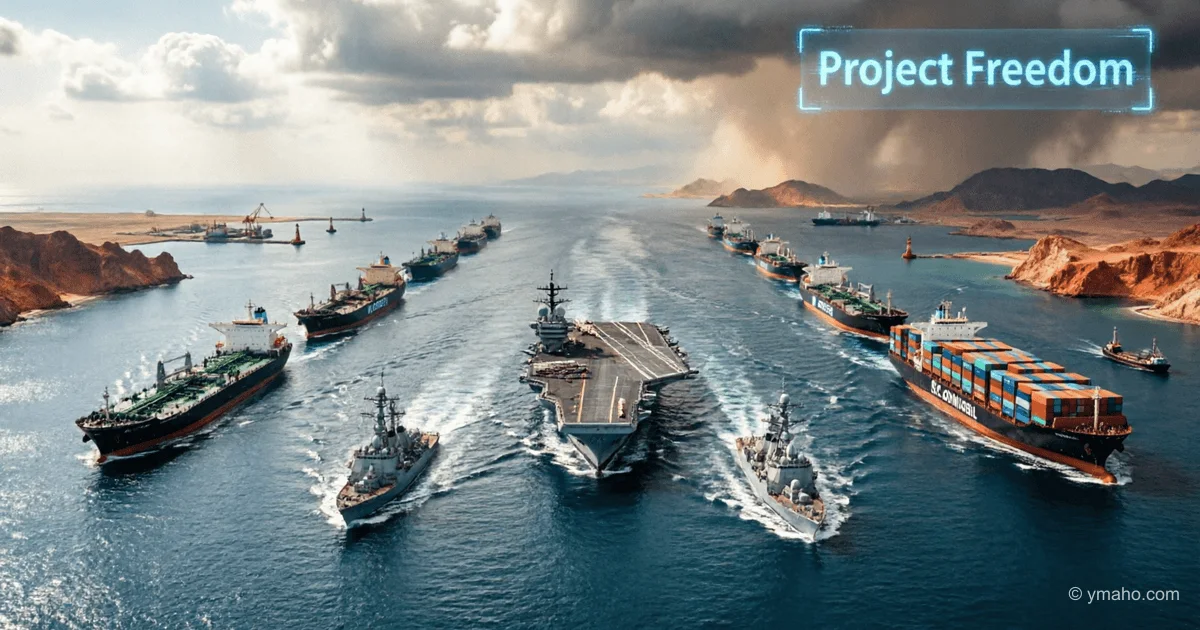
Trump Announces Launch of Operation 'Project Freedom' in the Persian Gulf
US President Donald Trump announced the launch of a military operation called 'Project Freedom' to escort commercial vessels stranded in the Persian Gulf through the Strait of Hormuz, calling it a 'humanitarian gesture.' An estimated 2,000 ships with 20,000 sailors are blocked in the region, running low on supplies.
Here is a detailed analytical article based on the provided context and news background, adhering to all language, currency, and format requirements.
Project Freedom: Rescue Mission or Camouflage for War? Analysis of the US Operation in the Persian Gulf
Introduction
On the morning of May 4, 2026, the global logistics and geopolitical map gained a new point of critical tension. While the world continues to watch the aftermath of an unprecedented split in the Fed and GDP falling below forecasts to 2.0%, the Trump administration announced the launch of a military operation codenamed 'Project Freedom.' Formally, the mission is humanitarian: to ensure a safe corridor for the evacuation or escort of approximately 2,000 merchant ships stranded in the Persian Gulf. On board these vessels are about 20,000 sailors, and according to official data, they are running out of critical supplies—fuel, water, and food.
However, calling the operation solely a 'humanitarian gesture,' as Trump attempted to present it, would be an analytical mistake. What is happening resembles a complex chess game where humanitarian rhetoric serves as a cover for testing Iran's 'red lines' by force, at a time when the US economy is already teetering on the brink of recession, and container giant MSC has already begun ground evacuation of cargo through Saudi Arabia, bypassing the Strait of Hormuz.
Event Details and Timeline
Operation 'Project Freedom' is a direct consequence of the deep logistical collapse that paralyzed the world's main oil artery. Over the past 72 hours, the situation has escalated to the limit. After the Islamic Revolutionary Guard Corps (IRGC) issued an ultimatum to civilian vessels over open radio frequencies demanding they leave anchorages, a chaotic exodus began. According to tracking systems, hundreds of ships, from giant VLCC tankers to dry cargo vessels, began moving haphazardly toward the port of Jebel Ali (UAE), creating a risk of mass collisions.
It was in this context that Trump's statement came. The US Navy will likely deploy an aircraft carrier strike group to create a 'security bubble' in the eastern Gulf. The problem lies in the physical impossibility of passing all 2,000 ships through the narrow bottleneck of the Strait of Hormuz simultaneously. This means the operation will likely stretch over weeks and require the establishment of temporary maritime control, which will inevitably provoke direct tactical incidents with Iranian patrol boats.
Impact and Significance
The economic significance of what is happening extends far beyond the humanitarian crisis with the sailors. It is a matter of the physical survival of supply chains. The previously announced detour by shipping giant MSC—delivering containers to Saudi ports of Jeddah and King Abdullah City, followed by overland transport to Dammam—shows the scale of costs for businesses. Freight rates on alternative routes have already broken historical records. While container shipping through the region previously generated a steady flow of over 150,000 containers per week, now each day of downtime costs global trade billions of USD. The 21.2% spike in US gasoline prices, which drove the Consumer Price Index (CPI) to 3.3%, is a direct precursor that 'military humanitarianism' will only accelerate inflation.
From a military perspective, the US operation creates a 'gray zone' effect. On one hand, the Pentagon claims to protect civilians. On the other, Iran's Khatam al-Anbiya headquarters has already warned that any unauthorized movement of ships poses a threat to navigation safety. This puts captains in a terrible dilemma: trust the US Navy escort and become a potential target for Iranian coastal defense forces, or remain trapped, burning fuel whose cost on board is already comparable to the freight price itself.
Reaction of Key Players
The reaction of major actors demonstrates the fragmentation of the international relations system. Iran uses a tactic of controlled escalation. General Ali Abdollahi not only criticizes Washington but also effectively imposes its control system on the maritime community, requiring coordination of movements with Iranian military. This is an attempt to legitimize the blockade as a form of sovereign regulation.
The US Federal Reserve, meanwhile, finds itself in a bind. The decision to keep the rate at 3.50-3.75% amid the Middle Eastern chaos and the largest split in the FOMC vote since 1992 demonstrates confusion. Four dissenting Committee members—a case recorded for the first time in 34 years—signal that monetary authorities no longer have a unified view on how to respond to 'military inflation.' Powell's departure on May 15 and the expected appointment of Kevin Warsh only increase turbulence: markets do not know whether the new chairman will fight harder against rising prices (accelerated by the oil spike) or start rescuing falling GDP and Treasury yields, which have already risen to 4.39%.
Europe's behavior is interesting. Despite the ECB signaling readiness to raise rates as early as June amid inflation accelerating to 3% in the eurozone, European powers have diplomatically frozen. For them, 'Project Freedom' risks dragging NATO into a conflict that would finally cut the European Union off from energy supplies ahead of the new heating season, as pipeline gas prices have already begun to correlate with maritime freight rates.
Forecast and Conclusions
Despite the White House's bravado and the S&P 500's record close at 7230.12, which perceives any military activity as a reason to bet on defense stocks, fundamental analysis paints a different picture. 'Project Freedom' enters the implementation phase at an extremely unfavorable moment of structural weakness in the US economy.
First, the logistics arithmetic does not add up. The capacity of the Strait of Hormuz is severely limited. An attempt to unblock it by force while the IRGC maintains control over the coastline and speedboats laden with explosives will likely lead not to free navigation but to single, heavily guarded convoys that will not save global trade from transport starvation.
Second, gold, the traditional fear indicator, although retreating from absolute highs to around 4,599 USD per ounce, still hovers near historical peaks. This suggests that large capital is hedging risks not so much of nuclear war but of global logistics paralysis. Investors understand: the land bridge through Saudi Arabia, which MSC is forced to build, costs logistics operators sums incomparable to maritime freight. A 200-300% increase in delivery costs will inevitably be reflected in the final price of goods in the US and EU as early as the third quarter of 2026.
Third, the political fate of the operation seems predetermined. Iran, judging by statements, does not intend to attack US carrier groups on the high seas, which would provide a pretext for a full-scale attack. Instead, Tehran will play a war of attrition, creating legal and navigational collisions, forcing captains to dock for inspections. Trump's strategy of calling the operation a humanitarian gesture puts him in a trap: any use of weapons against Iranian 'inspectors' will instantly turn rescuers into aggressors in the eyes of the world community. There is no way out of this situation without a full-fledged diplomatic agreement, not a military convoy. If Washington does not offer Iran a face-saving way to retreat, the 20,000 sailors risk becoming not rescued but long-term hostages of a new phase of the proxy war in the Gulf.
— Editorial Team









