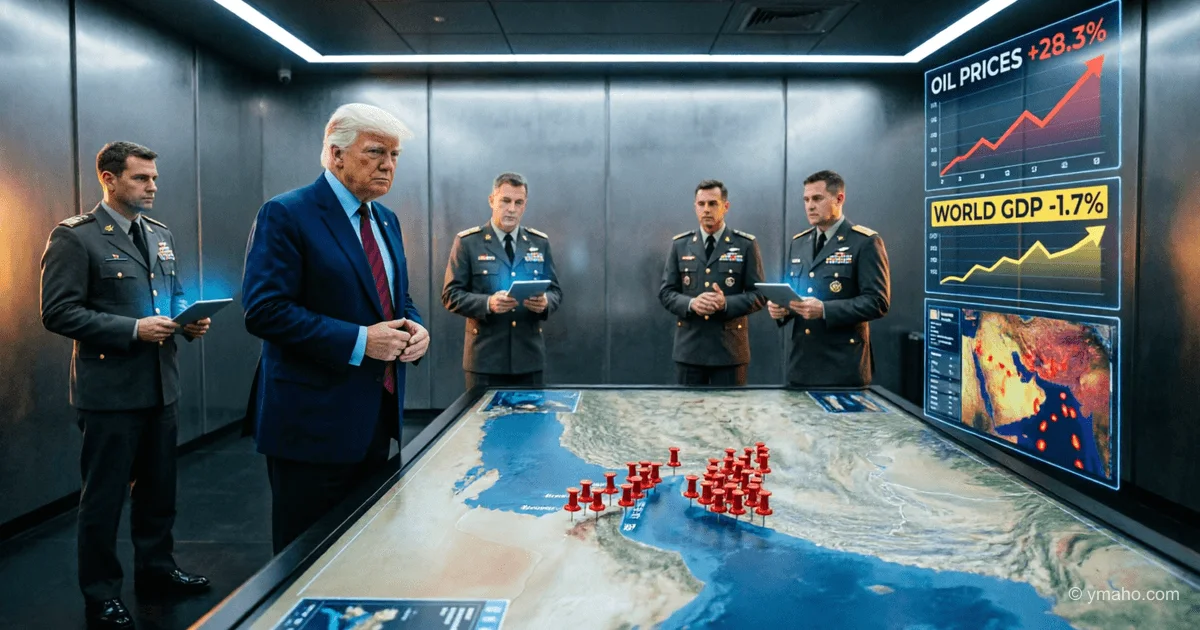
Trump Prepares Long-Term Blockade of Iran, Which Will Hit the Global Economy
The Wall Street Journal reports that Trump has ordered preparations for a multi-month blockade of the Strait of Hormuz, aiming to economically strangle Iran. However, the blockade will lead to record oil prices and trigger inflation worldwide, especially hitting developing countries.
A Long Blockade of Iran: A Strategy That Will Reshape the Global Economy
Introduction
On April 29, 2026, the world learned of a new twist in the Middle East conflict. The Wall Street Journal, citing US officials, reported that President Donald Trump had instructed his aides to prepare for a long, multi-month blockade of Iran. The calculation is simple: economic strangulation of Tehran will force it to capitulate, while resuming bombings or withdrawing from the conflict seem riskier to the White House.
However, this strategy carries enormous risks not only for Iran but for the entire global economy. The Strait of Hormuz, through which about 20% of the world's oil and gas supplies pass, is already paralyzed. A prolonged blockade means energy prices will remain at exorbitant levels of $100-120 per barrel, inflation will accelerate worldwide, and developing countries will face the threat of famine and defaults. Trump is betting on a "war of attrition," but the question is whose reserves of endurance will run out first—Iran's or the global economy's.
Event Details and Timeline
Washington's New Strategy. According to WSJ, at recent meetings with advisors, Trump concluded that a blockade is the least risky of the available options. Resuming bombings could lead to escalation with unpredictable consequences, while withdrawing from the conflict without guarantees would mean political defeat. The blockade, in his view, allows for "maximum pressure" on Tehran with minimal direct military risks to the US.
However, advisors are divided. Some officials call for increasing pressure, but others warn that keeping the Strait of Hormuz closed for months will harm the US economy and could cost the Republican Party the midterm elections in November 2026.
Crisis Timeline. The conflict began on February 28, 2026, with US-Israeli strikes on Iran's nuclear infrastructure. Iran responded by effectively closing the Strait of Hormuz. In early April, a temporary truce was reached, and a few ships even managed to pass. But then the US imposed its own naval blockade of Iranian ports.
On April 11, the first round of US-Iran talks took place in Islamabad, mediated by Pakistan. US Vice President JD Vance called them "substantive," but Iran did not agree to Washington's key demands—full reopening of the strait and abandonment of its nuclear program. A second round never happened. The truce was extended unilaterally by Trump without a specific end date.
On April 28, Trump wrote on Truth Social: "Iran has just told us that they are in a state of 'collapse.' They want us to open the Strait of Hormuz as soon as possible." Thus, he publicly confirmed that the blockade had achieved its goal—Tehran is under enormous pressure.
Impact and Significance (for the World / Industry / Society)
Oil and Gas. Traffic through the strait has almost completely stopped. Before the conflict, about 135 ships passed daily; now it's nearly zero. Goldman Sachs estimates that oil production in Gulf countries has dropped by 57% compared to pre-conflict levels. Brent is trading above $111, WTI around $100. The World Bank expects energy prices to rise by 24% by the end of 2026.
US Treasury Secretary Scott Bessent stated that the blockade is already close to forcing Iran to cut production, resulting in a loss of $170 million per day. The main export terminal on Kharg Island is nearly full, and within weeks, Iranian oil will have no storage space left.
Food Crisis. The blockade hits not only energy. One-third of the world's fertilizer exports (urea and ammonia) pass through the Strait of Hormuz, mainly from Qatar. Without fertilizers, there is no harvest. The Northern Hemisphere is in the midst of planting season, while South Asia is about to begin. Even if the strait opens tomorrow, the damage is done.
Developing countries will suffer the most. Thailand imported 71% of its urea from the Gulf, South Africa 67%, and India 41%. Russian Deputy Secretary of the Security Council Alexei Shevtsov warned that the fertilizer shortage will hit the entire world, especially African countries, where the issue is literally about the survival of millions.
Logistics Collapse. Over 100 ships are stuck in the conflict zone, about 20 of them in Iran's port of Chabahar. Approximately 20,000 seafarers are trapped. Ship management companies are forced to conduct daily crew checks, provide psychological support, and ensure food and water supplies, as crew replacements become nearly impossible.
Even if the strait opens immediately, restoring normal shipping will take weeks or months—too many links in the logistics chain have been broken.
Global Economy. Oxford Economics has lowered its global GDP growth forecast by 0.4 percentage points to 2.4%. The US forecast has been cut from 2.8% to 1.9%. US inflation in March already reached 3.3% year-on-year—the highest since May 2024—and will only rise, as the effect of higher energy prices spreads through the economy with a lag of about three months.
Reactions of Key Players
White House. Trump publicly stated that Iran has been "militarily defeated." The administration is ramping up financial pressure: the US Treasury, under Operation "Economic Fury," is targeting Iran's "shadow banking infrastructure," access to cryptocurrencies, the "shadow fleet," and Chinese independent refineries that continue to buy Iranian oil.
Iran. Tehran calls the actions "terrorist and illegal." Iran's UN envoy Amir Saeid Iravani accused the US of piracy and seizing commercial ships. The Iranian regime, as noted by Brookings Institution expert Suzanne Maloney, is ready to impose any economic hardship on the population rather than capitulate.
OPEC+ and UAE. Amid the crisis, the United Arab Emirates announced its withdrawal from OPEC effective May 1, 2026. The UAE had long been dissatisfied with quotas and disagreements with Saudi Arabia. However, while the strait is closed, increasing production is impossible, so the decision is more political than economic.
China and Developing Countries. Chinese "independent" refineries—among the main buyers of Iranian oil—have been hit by US sanctions. The broader issue: the blockade will hurt the entire Global South due to rising food and fertilizer prices.
Forecast and Conclusions
The "Prolonged Blockade" Scenario. Trump has made a strategic decision: an economic war of attrition is preferable to military escalation. This means the Strait of Hormuz will remain closed for at least several months, possibly until the end of 2026. Even if new talks follow, April's experience shows that Tehran is not ready to capitulate, and Washington is not ready to yield.
Economic Consequences. Oil prices will stay above $100, more likely in the $110-120 range. US inflation could exceed 4% by autumn, putting the Fed in a bind. Global growth will slow to 2-2.5%—not quite a recession, but very close. Developing countries, especially in Africa and South Asia, will face a food crisis.
Who Wins in a Long Blockade? The US has more financial and military resources but also more vulnerabilities—elections in November, high inflation, dependence on the global economy. Iran has fewer resources but a higher capacity to endure hardship. As experts note, a regime that has previously suppressed mass protests is ready to "impose economic problems on the population."
Main Conclusion. Trump is betting that economic strangulation will break Iran first. But the price of this bet for the rest of the world may be prohibitively high. The blockade, conceived as a weapon against one state, is already damaging the entire global economy. And the longer it lasts, the deeper the wounds—from crop failures in Asia to fuel shortages in Europe. In this war of attrition, there will be more than two losers.
— Editorial Team









