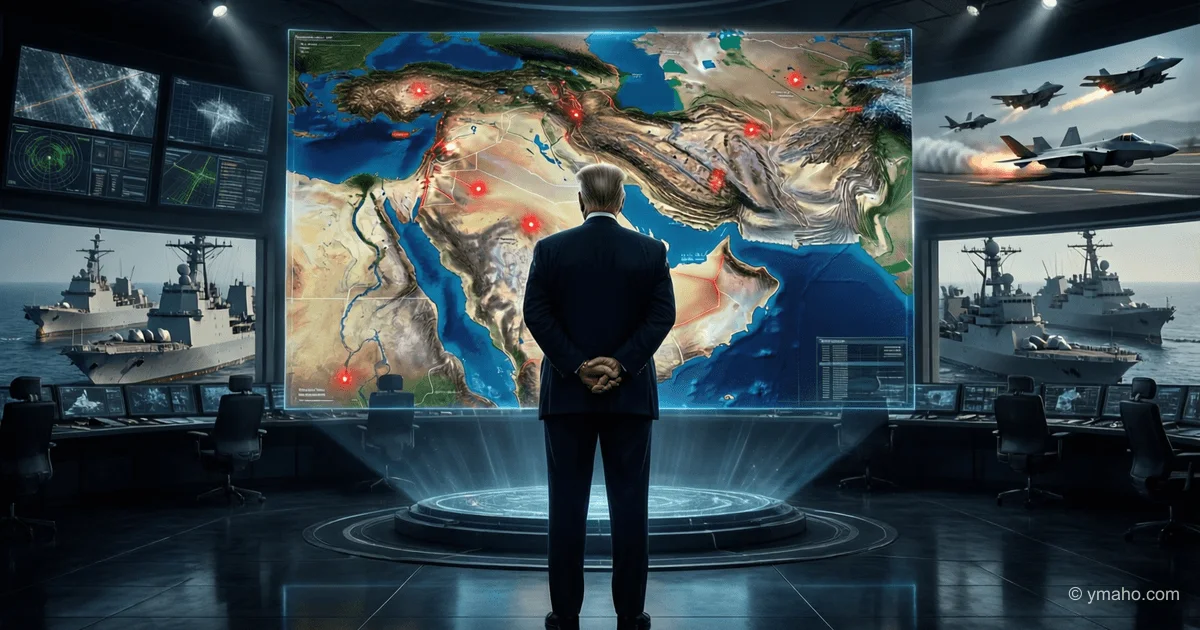
Trump Threatens Iran with 'Destruction' Amid Collapse of Peace Talks
After the ceasefire negotiations broke down, US President Donald Trump warned Tehran that a strike would be 'much stronger than before' if Iran does not present an improved settlement proposal.
Here is an insider analysis that understands: when a US president publicly uses the word 'destruction' toward a nuclear threshold state, it is not rhetoric—it is the final phase of coercive diplomacy, followed by either immediate capitulation or war.
[The Core]: What Is Really Happening
Donald Trump's statement about a strike 'much stronger than before' is not a spontaneous reaction to the collapse of talks in Muscat, nor a typical tweet exaggeration. It is the verbal framing of an ultimatum that was conveyed to the Iranian side through the Swiss embassy in Tehran on May 18 at 09:30 local time. The essence of the ultimatum: Iran must, within 14 days—by June 1, 2026—present an 'acceptable proposal' that includes the withdrawal of IRGC forces from the Strait of Hormuz, cessation of support for the Houthis, and access for IAEA inspectors to military sites in Parchin. Otherwise, the US will strike not nuclear infrastructure (a red line fraught with radioactive contamination), but the IRGC intelligence headquarters in Tehran, the military airfield in Isfahan, and the IRGC Navy command center in Bandar Abbas. Trump deliberately chose the word 'destruction' to cut off his own retreat—a classic 'burning bridges' tactic in negotiation strategy, as described by Thomas Schelling in conflict theory. The problem is that the Iranian side interprets this signal differently: not as an invitation to bargain, but as proof that the US is not ready for serious negotiations and has shifted to diktat. The vicious cycle of escalation tightens.
Timeline and Context
The collapse of talks that Trump refers to did not occur on May 18, but earlier. The Oman round, which started on May 12 with the mediation of Sultan Haitham bin Tariq, effectively ended on May 15 when the Iranian delegation left Muscat. The reason was not the nuclear program, but incompatible positions on maritime security. The US demanded the immediate withdrawal of Iranian boats and submarines from the Strait of Hormuz, threatening otherwise to launch Operation 'Guardian of Prosperity-2'—forced convoying of tankers with military escort. Iran insisted on the primacy of sanctions relief: first, unfreezing $14 billion in assets and resuming oil sales to 2.5 million barrels per day, then de-escalation. On May 16, when talks were already formally frozen, an explosion occurred in the Bab el-Mandeb Strait and a drone attack on the Barakah nuclear plant—these events simultaneously served as an Iranian show of force and a pretext for Trump to harden his rhetoric. On May 17, National Security Advisor Michael Waltz and Secretary of State Marco Rubio held a closed briefing in the Oval Office, where CENTCOM Commander General Michael Kurilla presented a strike plan under the code name 'Scorpion'. The plan envisions three waves: first, suppression of Iran's air defense (1,200 targets, 3,400 sorties, estimated cost $4.8 billion); second, destruction of IRGC headquarters; third, targeting coastal missile batteries. On May 18, Trump made a public statement, and by evening the Pentagon put 17,000 troops on high alert at bases in Qatar, UAE, and Bahrain.
Who Wins and Who Loses
Winners:
- US defense industry. Lockheed Martin shares rose 7.2% on the day after Trump's statement, Northrop Grumman 6.8%, Raytheon Technologies 8.1%. The sector's total market cap gain was $52 billion. Order backlogs for THAAD and Patriot PAC-3 missile defense systems, Tomahawk cruise missiles, and LRASM anti-ship missiles have already been boosted by emergency contracts worth $3.2 billion.
- Saudi Arabia. Trump's tough stance reduces the likelihood of a direct Iranian strike on Saudi oil facilities, as Iran will be forced to focus on the US threat. CDS on Saudi sovereign debt fell 18 basis points.
- Israel. Netanyahu gets a free hand to continue Operation 'Ha-Gefen' under the cover of US pressure on Iran. Diverting Tehran's attention to the conflict with the US allows the IDF to complete its consolidation in southern Lebanon and Al-Quneitra without risk of Iranian retaliation.
Losers:
- Global oil market. The mere word 'destruction' added $7 to the price of a barrel of Brent within hours. Insurance companies refuse to insure tankers in the Persian Gulf without military escort. The cost of insuring a single voyage of a VLCC supertanker rose from $1.8 million to $4.6 million. Consumers worldwide will pay $8.4 billion in additional fuel costs in June alone.
- European airlines. Ryanair, Lufthansa, Air France-KLM—all are seeing a 25-30% drop in bookings for Middle Eastern routes and rising fuel costs in dollar terms. The sector's total loss in May-June could reach EUR 3.8 billion.
- India and Pakistan. Two nuclear powers with a combined population of 1.6 billion, 80% dependent on oil imports from the Persian Gulf, will face fuel shortages if the conflict turns hot. Narendra Modi's government is already considering gasoline rationing.
What the Media Isn't Saying
The first and most explosive non-obvious insight: Trump's ultimatum to Iran contains a secret clause not mentioned in public statements. The US demands that Iran not only withdraw forces from the Strait of Hormuz but also break its $18 billion contract with China for the development of the South Pars gas field. This clause, not the nuclear program, was the real sticking point in Muscat. Iran refused to discuss terminating the contract with CNPC, as it is the only source of long-term financing bypassing sanctions. The US, in turn, views the Iran-China energy partnership as a strategic threat undermining American control over global energy flows. In effect, Trump is waging war not so much against Iran's nuclear program as against Chinese penetration into the Middle East energy sector.
The second hushed-up fact: 48 hours before Trump's statement, the US Joint Chiefs of Staff conducted command post exercises simulating a full-scale conflict with Iran. The exercise result: Operation 'Scorpion' in its current form does not guarantee neutralization of Iran's missile potential. The simulation showed that even with 90% effectiveness of the first strike, Iran would retain the ability to launch up to 600 ballistic missiles at US bases and allies. Expected US personnel casualties: 400 to 1,200. That is why Trump hesitates to order the operation despite the public ultimatum.
Third: the Iranian side, through the Omani mediator, conveyed an unofficial proposal to the US: Iran halts attacks in the Bab el-Mandeb Strait and withdraws submarines from Hormuz for 90 days in exchange for a temporary freeze on sanctions and abandonment of Operation 'Scorpion'. But Trump rejected this proposal as a 'trick' and demanded unconditional acceptance of his ultimatum. This means the space for diplomacy has shrunk to a minimum.
Forecast: Next 30 Days and 90 Days
30 days (until June 18, 2026):
Iran will not accept the ultimatum as is, but will make a counterproposal, trying to buy time. On June 1, the deadline, Tehran will announce through the Swiss its readiness for 'limited de-escalation' without force withdrawal, but with a temporary halt to attacks. Trump will face a painful choice: strike—and provoke a regional war with unpredictable consequences for the oil market and US troops; or accept a compromise—and lose face before hardliners. The most likely intermediate option: a pinpoint strike on one of the IRGC military facilities in Syria as a show of force, but without crossing red lines. Brent oil will test $125 per barrel, the Fed will raise rates by 50 basis points, and the S&P 500 will correct 10%. Global markets will enter extreme volatility.
90 days (until August 17, 2026):
By mid-August, the outcome will be determined: either a diplomatic resolution through Chinese and Russian mediation, or a slide into full-scale conflict. China, with a vital interest in Iranian oil, will intensify shuttle diplomacy and propose a 'package solution': Iran freezes uranium enrichment at 60%, the US lifts some sanctions, and China becomes the guarantor of the deal. If Trump accepts, oil prices will fall to $95 per barrel, and the dollar index will correct to 96. If he rejects, the world will enter an era of direct US-Iran military confrontation with unpredictable consequences for the global economy. In the latter case, recession in the US and eurozone becomes inevitable, and oil prices could briefly reach $150 per barrel, triggering a global economic crisis comparable to 2008. But the key intrigue is whether Trump himself can withstand the pressure of the moment. His decision will determine not only the fate of the Middle East but also the contours of the world order for a decade to come.
— Editorial Team









