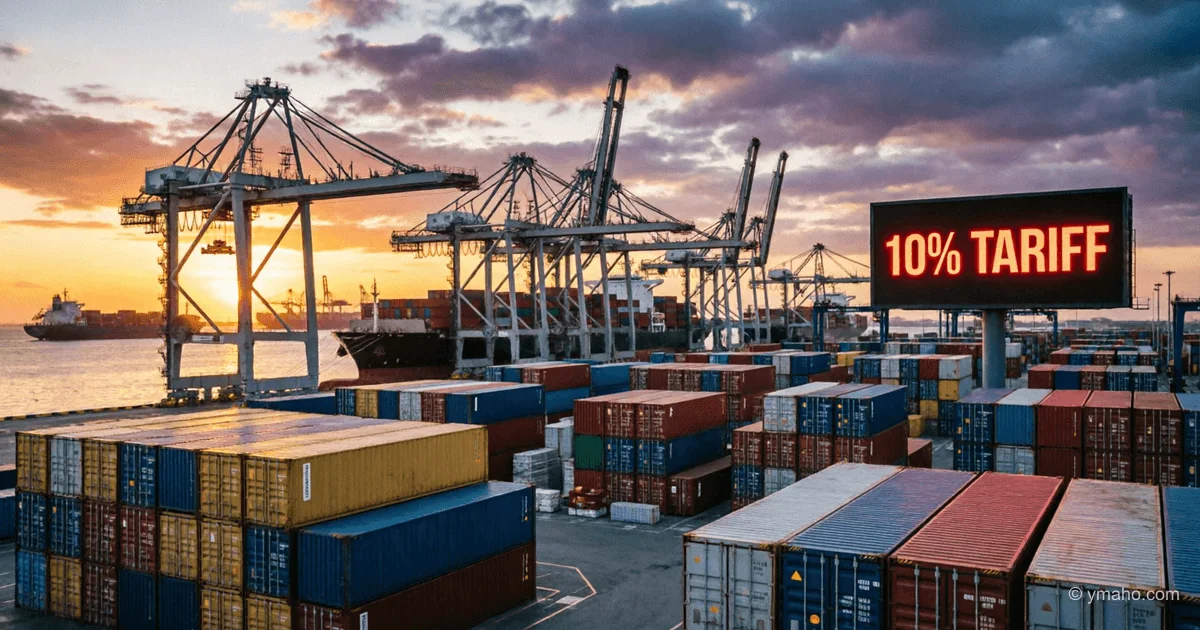
Trump Declares Trade War on the World, Imposing Tariffs on Over 180 Countries
A baseline 10% tariff takes effect on April 5, with China facing 34%, the EU 20%. China and the EU have already threatened retaliatory measures.
"Trade War Against the Whole World": How Trump's Tariffs Are Reshaping the Global Economy
Introduction
On April 29, 2026, U.S. President Donald Trump did what global markets had feared for the past two years—announced the imposition of customs tariffs on more than 180 countries and territories. The baseline rate of 10% takes effect on April 5, but conditions for key trading partners proved significantly harsher: China received 34%, the European Union 20%, India 26%, Vietnam 46%, and Taiwan 32%. A separate blow was the increase in auto tariffs to 25% starting April 3, with auto parts tariffs following by May 3.
This is not just an escalation of trade disputes but a fundamental dismantling of the rules that have underpinned the global economy for the past 80 years. The U.S. administration no longer views the World Trade Organization and free trade agreements as constraints—tariffs have become a "strategic weapon." China and the EU have already threatened retaliatory measures, and the world stands on the brink of a trade war on a scale unseen since the Great Depression.
Event Details and Timeline
The new tariff regime is the result of months of escalation that began immediately after Trump's second term began. By the end of 2025, the average U.S. import tariff rate had risen from a traditional 2.4% to 9.6%—the highest level in 80 years. However, the April decisions came as a real "shock" even to those who had been following Trump's rhetoric.
Key elements of the new tariff regime:
- Baseline universal tariff — 10% on imports from nearly all countries, effective April 5, 2026.
- Higher rates for select countries — China (34%), EU (20%), Vietnam (46%), Kazakhstan (27%), Moldova (31%).
- Auto tariffs — 25% on finished vehicles (from April 3) and auto parts (from May 3).
- Maximum rates — 50% for Lesotho and the French territory of Saint Pierre and Miquelon.
Notably absent from the list are Russia and Belarus—according to the administration, because sanctions are already in place against them. Ukraine falls under the baseline 10% rate.
It is important to understand the chronology: several stages preceded the decision. In February 2026, the Supreme Court struck down some of Trump's emergency tariffs, after which the administration found a new legal justification within 24 hours. In July 2025, the "Thornberry Agreement" with the EU was signed, setting a 15% rate on European cars, but Trump has already announced an increase to 25%, accusing Europe of non-compliance.
Impact and Significance (for the World / Industry / Society)
Analysts are already assessing the economic consequences of this move as a "triple crisis": slowing growth, accelerating inflation, and stagflation risks simultaneously.
For the global economy: The Organisation for Economic Co-operation and Development (OECD) forecasts U.S. GDP growth to slow to 1.5% in 2026. The IMF expects global growth to slow to 3.1%—below pre-pandemic trends. The Congressional Budget Office (CBO) estimates that tariffs will reduce long-term U.S. GDP by about 0.06 percentage points annually, while the Penn-Wharton model predicts a 6% reduction in GDP and a 5% reduction in wages in the long run.
For inflation and households: Estimates suggest tariffs will increase average annual inflation by 0.4 percentage points in 2025-2026. New York Fed research shows that importers bear about 90% of tariff costs, and a quarter of that amount is passed on to retail prices. The average American family will lose about $1,500 in disposable income in 2026—the largest tax increase (as a share of GDP) since 1993.
For industry: Contrary to Trump's promises, the U.S. manufacturing sector is losing jobs—down 88,000 over the year, with productivity falling. The Economist magazine noted that manufacturers overwhelmingly report negative sentiment at the mere mention of tariffs. Foreign direct investment in the U.S. in 2025 was lower than in the previous four years.
For developing countries: They suffer the most. African countries that enjoyed preferential access under AGOA face a sudden loss of market access. This is pushing the Global South to strengthen ties with China, which positions itself as a "stable and reliable partner."
Reactions of Key Players
China reacted first and most harshly. China's Ministry of Commerce stated it would take "resolute countermeasures" and categorically rejected the U.S.'s "reciprocal tariffs." Beijing has already imposed retaliatory tariffs, and in April Trump was forced to raise rates on China to 125% in response to Chinese measures.
The European Union took a more measured but firm stance. The European Commission stated, "A deal is a deal," reminding of the Thornberry Agreement. The EU's retaliatory measures, announced by the end of April, target steel, aluminum, textiles, leather, household appliances, plastics, and wood—totaling about €20 billion of U.S. imports.
The UK and other allies tried to negotiate. London, Seoul, and Tokyo managed to conclude bilateral deals with Washington, but their terms remain opaque. India, after initial 50% tariffs, secured a reduction to 18%—at the cost of abandoning purchases of Russian oil and reorienting to supplies from the Persian Gulf and the U.S.
Canada and Mexico are in a particularly risky zone due to the upcoming review of USMCA (U.S.-Mexico-Canada Agreement) in 2026. Experts warn Ottawa and Mexico City of a "hard choice" between short-term gains from deeper integration and long-term ability to diversify risks.
Forecast and Conclusions
Analysts agree on several key forecasts. First, the tariff regime in one form or another will persist for a long time. Even if legal challenges (e.g., the case on presidential powers in the Supreme Court) reduce its scope, the baseline 10% rate may remain at least through Trump's second term. Second, the global economy is entering an era of "short, cautious, and politically dependent production networks" with higher costs and greater uncertainty.
The baseline scenario of major banks (J.P. Morgan, Goldman Sachs) assumes tariffs will remain at an effective rate of about 8-10% after all litigation and exemptions. Many "loopholes" are already visible: smartphones, semiconductors, pharmaceuticals, coffee, bananas, and beef are partially or fully exempt from tariffs.
However, risks are tilted to the downside. Escalation of Chinese retaliatory measures (tightening export controls on rare earth metals) or a full-scale trade conflict with the EU (especially in the automotive sector) could collapse global supply chains. The combination of tariffs with a geopolitical crisis in the Strait of Hormuz (Iran blocked passage for 20 million barrels of oil per day) creates a perfect storm for stagflation—inflation above 3% with GDP growth below 1.5%.
The conclusion for businesses and investors is clear: the era of predictable globalization is over. Companies must incorporate trade and political risks into their models, diversify dependencies, and prepare for the reality that "allies today may become rivals tomorrow." Trump has not just started a trade war—he is rewriting the rules of the game, and the world must adapt, paying the price in higher costs, slower growth, and fragile geopolitical stability.
— Editorial Team









