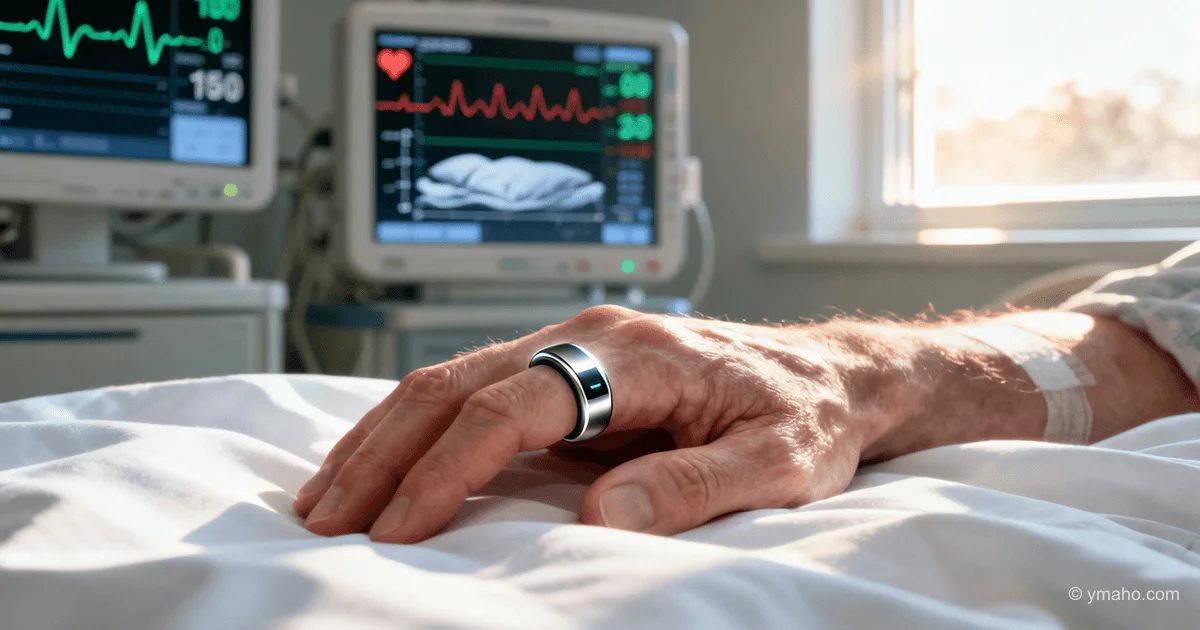
UCSF: 'Smart Ring' Accurately Predicted Pain Trajectory After Orthopedic Surgery
Researchers from the University of California, San Francisco received an award for a study in which continuous monitoring of heart rate variability and sleep using wearable devices predicted postoperative pain outcomes more accurately than standard episodic physician visits.
An analytical article on the UCSF study using a smart ring to predict postoperative pain will be presented according to the specified structure.
'Smart Rings' vs. Pain: How UCSF Wearables Turn Rehabilitation into Precision Science
When the OREF award winners were announced at the annual DOCSF digital orthopedics conference in San Francisco in late April 2026, many observers saw it merely as recognition of interest in artificial intelligence in medicine. The UCSF study on 'the potential of a smart ring to predict postoperative pain' represents something far more concrete: a demonstration of how a cheap consumer gadget can replace subjective physician assessments with an objective physiological model, changing the very concept of postoperative care.
The Core: What's Really Happening
The key challenge in orthopedic surgery is so-called 'poor pain alleviation.' It leads to delayed recovery, increased morbidity, and prolonged opioid use. For decades, physicians relied on episodic check-ups and asking patients to rate their pain on a scale of one to ten. The problem is that pain is subjective, and a doctor's visit every two weeks cannot keep up with the dynamics of the real condition.
Dr. Meir Marmor and his colleagues at the Orthopaedic Trauma Institute at UCSF used a smart ring to continuously monitor three key parameters: heart rate variability (HRV), sleep patterns, and activity levels. Data collected from 37 patients was processed using machine learning models. The result: the algorithm predicted adverse pain management outcomes with 70% accuracy and an AUC of 0.762.
This is not just 'another gadget.' It is a tool that reads the autonomic nervous system in real time. Decreased HRV and sleep fragmentation are not just signs of discomfort; they are markers of sympathetic nervous system hyperactivation, which directly affects pain threshold.
Timeline and Context
Marmor's work formed the basis for one of two awards presented on April 28, 2026, at the DOCSF conference—a global meeting focused on digital innovations in orthopedics, hosted by the UCSF Department of Orthopaedic Surgery in partnership with the Orthopaedic Research and Education Foundation.
The second study involved AI applications, but it is the work with the 'smart ring' that marks a shift toward predictive models operating in real time. This is particularly important given that UCSF is simultaneously studying expert opinions on the implementation of wearables, identifying issues such as data overload and workflow disruption.
Thus, the DOCSF award signals the technology's maturity: moving from experiments to integration into clinical practice.
Who Wins and Who Loses
Ambulatory surgical centers win. The ability to discharge a patient earlier, but with a 'smart ring' on their finger that predicts a pain crisis before it happens, saves on readmissions. In the US, where penalties for readmission can be enormous, this means direct savings of hundreds of thousands of dollars.
Oura Ring (likely but unnamed partner) wins. Although the UCSF press release does not name the brand, the technical specifications and design clearly point to Oura—the most well-known smart ring on the market. However, according to a 2024 study, BYOD (Bring Your Own Device) support, where patients use their own devices, faces compatibility issues. If Oura provides an API for clinics, they become an infrastructure company, not just a $299 gadget.
Manufacturers of classic pulse oximeters and fitness bands lose. A ring on the finger provides a much cleaner photoplethysmography signal than the wrist, where motion artifacts are rampant. Moreover, a patient with a fractured clavicle or wrist can put on a ring more easily than a band.
The lazy part of the medical community loses. The shift from asking 'how are you?' to analyzing HRV data requires new literacy. Conservative surgeons will resist the data stream they have no time to interpret.
What the Media Isn't Saying
First non-obvious insight: defeating opioids through cold data. The true driver of the UCSF study is not patient comfort, but the fight against the opioid storm. If a physician can present objective biometric data to an insurance company or regulator proving that pain is controlled, the need for long-term oxycodone prescriptions disappears. This is a legal shield for the doctor and savings for the healthcare system.
Second non-obvious insight: the 'blind spot' problem immediately after surgery. A 2024 study and a 2026 expert study point to the issue of data exclusion. 'Thirty percent of patients we could not recruit did not have a compatible smartphone,' noted the qualitative analysis. The 'smart ring' is useless for an elderly patient with a flip phone, creating a risk of digital inequality in access to quality pain management.
Third non-obvious point: competition with computer vision. UCSF expert analysis shows that the future lies in multimodal approaches. The smart ring reads 'internal' state, but it does not see limping or improper biomechanics. Computer vision systems (Kinect, smartphone cameras) can assess gait. UCSF's next step is to combine 'internal' and 'external' into a single model.
Forecast: Next 30 Days
Mid-May to mid-June 2026. Expect a wave of interest from insurance companies (like UnitedHealthcare or Anthem) wanting to test the UCSF model to reduce opioid payouts. Pilot launch of monitoring programs in several California clinics.
June 2026. Marmor's research group will present long-term follow-up data: does predicting pain trajectory with the ring affect the rate of pain chronification 3 months after surgery.
Forecast: Next 90 Days
July-August 2026. Publication of an expanded protocol in a high-impact journal (likely Journal of Medical Internet Research or NPJ Digital Medicine). Emphasis will be on multimodality: ring data plus gait analysis from a smartphone camera, as indicated in the UCSF technology review.
September 2026. The FDA, seeing explosive growth in AI use in orthopedics, may issue updated guidance on regulating pain prediction algorithms as Software as a Medical Device (SaMD). The UCSF model with 70% accuracy is unlikely to gain approval as a standalone diagnostic tool, but as a Clinical Decision Support System (CDSS), it is already mature for implementation.
Strategic conclusion: UCSF is shifting the paradigm of orthopedic pain from reactive ('it hurts—call the doctor') to proactive. The smart ring becomes a 'guardian' that sees an impending pain crisis before the patient realizes it. But the main battle will not be in the gadget market, but in insurance offices: if UCSF sensor data becomes grounds for shortening painkiller compensation periods, the industry will change forever.
— Editorial Team









