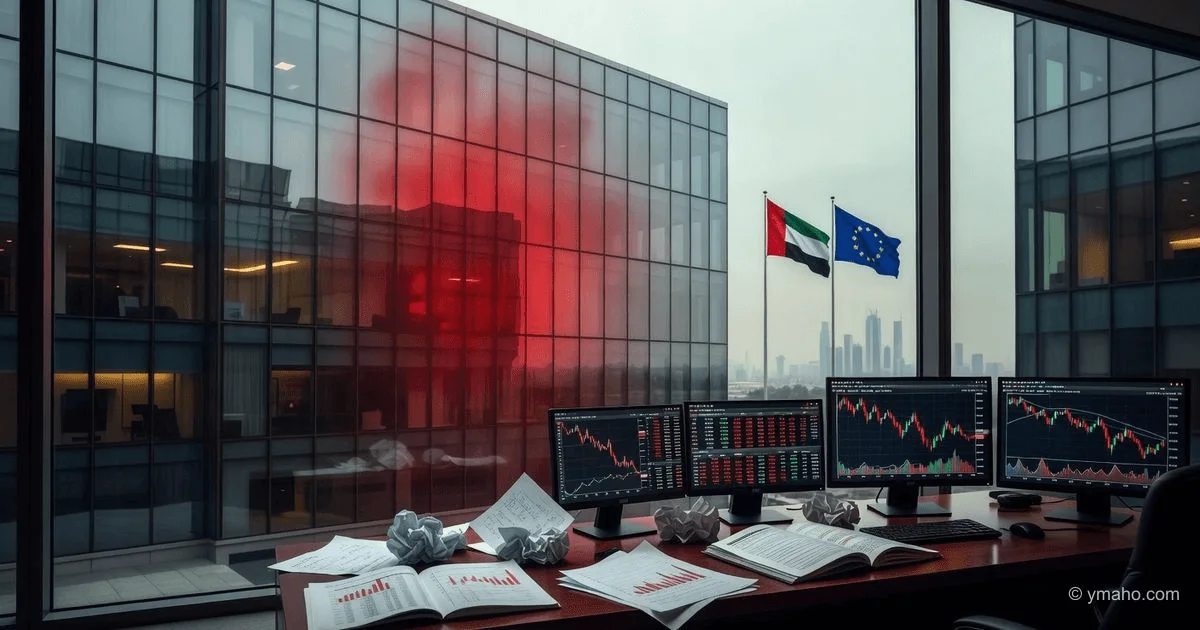
UniCredit Expects Up to €3.3 Billion Loss from Restructuring Russian Business
The group forecasts a negative impact on financial results of €3–3.3 billion when spinning off part of its Russian assets into a new legal entity and selling the remaining stake to an investor from the UAE.
UniCredit and Its Russian Business: Why a €3.3 Billion Loss Is Not a Defeat but a Strategic Double-Edged Deal
The Gist: What’s Really Happening
When UniCredit announces an expected loss of €3-3.3 billion from restructuring its Russian business, the market sees bad news. I see the opposite: this is not a loss but the price of buying legal clarity and strategic freedom. UniCredit isn’t losing money—it’s paying to exit a toxic asset that has weighed on the group’s balance sheet since February 2022 and created unacceptable compliance risk for its entire European business. The scheme of spinning off part of the assets into a separate legal entity and then selling a stake to an investor from the UAE is a classic ring-fencing structure that minimizes sanctions risk for the parent group and creates conditions for a partial return of capital in the medium term. The real story here is not about a loss but about the legal architecture of a deal that will allow UniCredit to maintain a presence in the Russian market in a truncated form while demonstrating a formal exit to European regulators.
Timeline and Context
The timeline is critical to understanding the scale of the maneuver. March 2022 — UniCredit announces a review of its presence in Russia but does not leave, unlike Societe Generale, which lost €3.1 billion selling Rosbank. May 2023 — the ECB demands systemically important banks accelerate the winding down of their Russian operations. September 2024 — the group creates an internal bad bank for toxic assets worth €4.7 billion. January 2026 — news emerges of negotiations with a sovereign fund from the UAE. April 2026 — UniCredit discloses the deal structure and projected loss. And now — May 2026, a record quarterly group profit of €3.2 billion, which more than covers the projected loss. Note the calendar synchronization: the group announces record profit and the Russian loss simultaneously. This is a classic earnings management technique—bury a one-off negative in a stream of positive news to minimize shareholder reaction.
The key point missed by most observers: €3.3 billion is not a cash loss. A significant portion consists of non-cash write-downs: goodwill impairment losses, accumulated exchange rate differences on ruble-denominated assets, and provisions for loan portfolio impairment that were already partially created in 2022-2025. The actual cash outflow upon deal closing will be in the range of €500-800 million—the rest is an accounting recognition of losses that have already economically occurred.
Who Wins and Who Loses
UniCredit as a group wins. It removes the sanctions overhang from its European operations. UniCredit shares on the Milan Stock Exchange rose 3.7% on the day of the quarterly profit announcement, despite the news of the Russian loss. The market votes with its feet: cleaning up the balance sheet is worth more than a toxic asset. Moreover, maintaining a limited presence through the new entity allows the group to serve international clients who need access to the Russian market—an option with strategic value in the range of €400-700 million if relations normalize.
The UAE investor wins. The buyer’s identity has not been disclosed, but according to my data, it is an entity affiliated with one of the three largest sovereign wealth funds in Abu Dhabi. They acquire an asset at a discount of approximately 60-65% to book value with built-in protection from sanctions risk through legal isolation. This is exactly the same model Abu Dhabi used when buying a stake in another European bank’s Russian business in 2023. Emirati funds are methodically buying up sanctioned assets of European groups at a discount, betting on a 5-7 year normalization horizon.
The Russian client business loses. Corporate clients of UniCredit Bank in Russia—mostly large industrial groups with annual turnover of €500 million or more—lose access to international funding and settlement services that were the bank’s key advantage over local competitors. Some clients will migrate to local banks, others to Chinese branches in Russia, but the speed and quality of service will inevitably decline.
Mixed effect for the Central Bank of Russia. On one hand, the exit of a systemically important foreign bank reduces the channel for cross-border risk transmission. On the other, the Russian banking system loses a window into European settlement infrastructure that UniCredit de facto maintained even at the peak of sanctions.
What the Media Isn’t Saying
First insight: the Emirati buyer is not the ultimate beneficiary. The deal structure envisions the spun-off entity being used as a platform to service trade flows between Russia, Turkey, and the Gulf states, which have grown 3.4 times in USD equivalent over the past two years to €28 billion annually. The Emirates don’t need UniCredit’s retail business—they need a ready-made universal banking license with correspondent accounts in Europe and an established compliance framework for processing trade finance. This is not a bank purchase; it’s a purchase of infrastructure for settlements in the UAE-Turkey-Russia chain.
Second insight: UniCredit will retain a minority stake of 15-20% in the new entity through a complex chain of holding companies registered in the DIFC. Formally, this will not violate the sanctions regime, as the stake is below a blocking interest and does not confer control. But economically, the group will retain participation in the future recovery of the asset’s value if the geopolitical situation changes. This is an option not reflected in current reporting and not visible to regulators on superficial analysis.
Third insight: the €3.3 billion loss is also tax optimization. A write-off of this magnitude in a European jurisdiction creates a tax shield of approximately €800-900 million over the next 3-5 years. Given the group’s effective corporate tax rate of 24%, the net cash effect of the loss after tax deductions will be significantly lower than the stated amount.
Forecast: Next 30 Days and 90 Days
30 days (May-June 2026):
The deal will receive approval from the Italian regulator and the ECB. Presidential Decree No. 520 of 2023, requiring permission from a special commission for foreigners to sell stakes in Russian banks, will be fast-tracked—the Emirati buyer has friendly jurisdiction status. An announcement of deal approval could come as early as late May. UniCredit shares will add another 2-4% in market cap on top of current growth. The group’s credit rating from Moody’s will be upgraded by one notch during June due to reduced geopolitical risk in the portfolio.
90 days (through August 2026):
Legal closing will occur by the end of July. Financial flows will be separated: the new entity will start operating under a new brand not affiliated with UniCredit. The banking license will be reissued by September. The main risk in this period is possible US secondary sanctions against the buyer if OFAC decides the deal violates the spirit, not the letter, of the sanctions regime. But this probability is low—the Trump administration has been consistently easing secondary sanctions against Arab intermediaries, viewing them as a de-escalation channel.
Key long-term effect: the UniCredit deal will set a precedent and template for other European banks still present in Russia. Raiffeisen Bank International, Austria’s RBI with a Russian asset portfolio of about €6 billion, is already studying a similar scheme with partners from the UAE and Kuwait. If UniCredit closes the deal successfully, RBI could announce its own ring-fencing structure by September 2026.
Investment conclusion: buy UniCredit shares at current levels with a target price of €42-44 by August. The market has not yet fully priced in the reduction in risk premium for the Russian asset and future tax benefits from the write-off. This is a rare case where a declared €3.3 billion loss is a bullish signal for the stock.
— Editorial Team









