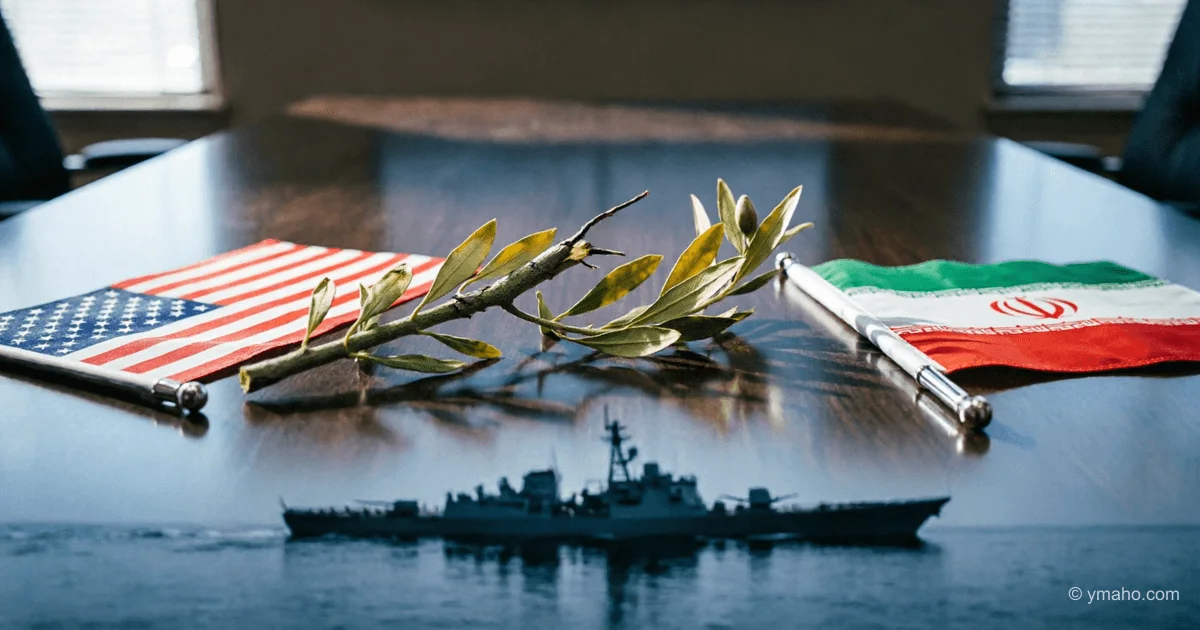
Doubts About the US-Iran Ceasefire Holding
US President Donald Trump refused to answer whether the truce with Iran was still in effect, amid missile strikes on the UAE. Diplomatic negotiations mediated by Pakistan have reached a deadlock.
End of the ceasefire or brinkmanship: Why did Trump refuse to confirm the truce with Iran?
Introduction
On May 4, 2026, US President Donald Trump left the international community in a state of extreme uncertainty by refusing to directly answer whether the ceasefire with Iran was still in effect. Against the backdrop of exchanges of fire in the Strait of Hormuz, missile attacks on the UAE, and a fire at the oil port of Fujairah, the American leader's evasive response signaled a deep crisis in the diplomatic process. This situation is not merely an episode of information warfare; it reflects a fundamental shift in the logic of the conflict, where military tools are increasingly displacing negotiation mechanisms, and the public rhetoric of leaders becomes an extension of hostilities.
Event Details and Timeline
The incident that drew journalists' attention occurred on May 4, when conservative radio host Hugh Hewitt asked Trump a direct question: "Is the ceasefire with Iran over, and could strikes resume?" The president's answer was deliberately evasive: "Well, I can't tell you that. If I answered that question, you'd say this guy isn't smart enough to be president." Hours earlier, in an interview with Fox News, Trump warned Iranian forces that they would be "wiped off the face of the earth" if they attempted to attack American ships, while simultaneously insisting that the war was "militarily... essentially over."
This contradiction—between dire warnings and claims that the war is over—reflects the White House's dual strategy. Trump is trying to demonstrate resolve while leaving room for diplomatic maneuver.
The timeline of events leading up to this moment is crucial. The ceasefire, brokered by Pakistan, came into effect on April 8, 2026. However, the first round of direct talks in Islamabad ended without results. In late April, Iran presented a 14-point peace proposal, including an end to the conflict on all fronts, regulation of shipping through the Strait of Hormuz, lifting the naval blockade, withdrawal of US troops, and postponing discussion of the nuclear program until after the hot phase of the conflict.
Trump's reaction to these proposals was sharply negative: "I can't imagine it will be acceptable, since they haven't paid a high enough price for what they've done to humanity and the whole world over the last 47 years." Washington continued to insist on including the nuclear program on the immediate negotiation agenda, demanding that Iran give up more than 400 kg of highly enriched uranium. Tehran, in turn, categorically refused to discuss nuclear issues until the end of hostilities and the lifting of the blockade.
Iranian Foreign Ministry spokesman Ismail Baghai stated that analyzing the US response message received through Pakistani mediators would be difficult due to the "excessive appetites" and "unreasonable demands" of the American side. By May 3, a senior Iranian military commander openly stated that "the resumption of conflict between Iran and the US is likely."
Impact and Significance
Trump's refusal to confirm the ceasefire has serious consequences for the entire system of international relations. First, it effectively blurs the very concept of a ceasefire as a legally binding state. If a head of state publicly refuses to determine whether his country is at peace or war with another power, it sets a precedent of legal uncertainty on an unprecedented scale.
Second, Trump's actions undermine Pakistan's mediation efforts. Islamabad invested significant diplomatic capital in organizing the negotiation process, but Washington's demonstrative disregard for the ceasefire format calls into question the effectiveness of any future mediation initiatives.
Third, the US president's evasive stance has become a catalyst for escalation. On May 4 itself, direct clashes occurred in the Strait of Hormuz: Iran fired warning shots at American ships, and CENTCOM reported the destruction of six Iranian boats. Simultaneously, a missile strike was carried out on the port of Fujairah in the UAE, causing a fire in the petrochemical zone. These events confirm that the diplomatic deadlock is directly translating into military confrontation.
The economic dimension deserves special attention. Against the backdrop of escalation, Brent crude oil prices reached $113 per barrel, and war risk insurance premiums for shipowners rose to levels comparable to peaks during previous Middle East crises. The prolongation of the conflict threatens a global recession and undermines central banks' efforts to curb inflation.
Reactions of Key Players
Tehran's position, despite the military actions, remains emphatically diplomatic. Iranian Foreign Minister Abbas Araghchi stated that "peace talks mediated by Pakistan are ongoing" and warned the US and UAE against "being dragged into the swamp of ill-wishers." His characterization of Operation "Project Freedom" as "Project Deadlock" reflects Iran's strategy: demonstrating readiness for diplomacy while simultaneously increasing military pressure.
Pakistani mediators, according to CNN, believe that "a fair deal is within reach, and now it all depends on Tehran's response." However, this assessment looks increasingly unrealistic amid mutual shelling. CNN sources also report that Trump is considering resuming strikes on Iran and is instructing the military to prepare relevant scenarios.
The domestic political situation in the US also influences the president's position. Trump criticized opinion polls showing a decline in public support for the military operation, calling them "fake." The administration also stated that the president does not need congressional approval to continue hostilities, as the ceasefire "paused the clock" for compliance with legal requirements. This legal conflict creates an additional node of tension between the executive and legislative branches.
Analysts at Eurasia Group are skeptical about the prospects for a breakthrough: "Disagreements are not the cause of the current deadlock, as the Trump administration indicates. Negotiations are moving slowly because Iran's leadership seeks to gain leverage and a better offer from the US."
Forecast and Conclusions
The situation surrounding the US-Iran ceasefire has entered its most dangerous phase since the start of the conflict. Trump's evasive stance, combined with the escalation of military actions, indicates that the White House is deliberately blurring the line between peace and war, keeping maximum freedom of action.
In the short term, the most likely scenario is further escalation while maintaining the appearance of a diplomatic process. The continuation of Operation "Project Freedom" will inevitably lead to new clashes and possibly direct casualties among US military personnel or civilian vessels, which could trigger a full-scale resumption of hostilities.
The key obstacle to a diplomatic settlement remains the issue of Iran's nuclear program. As long as Washington insists on its inclusion in the immediate negotiation agenda and Tehran categorically refuses to discuss it until the blockade is lifted, there is virtually no room for compromise.
As CNN sources warn, "both sides are prepared for a potential return to hostilities if they cannot agree on peace terms." Trump's refusal to directly answer the question about the status of the ceasefire is not a random slip but a deliberate signal: the US president reserves the right to act without regard to previously reached agreements. Under these conditions, predicting de-escalation would be unwarranted optimism. The Persian Gulf remains a powder keg, and the match held to it is already burning out.
— Editorial Team









