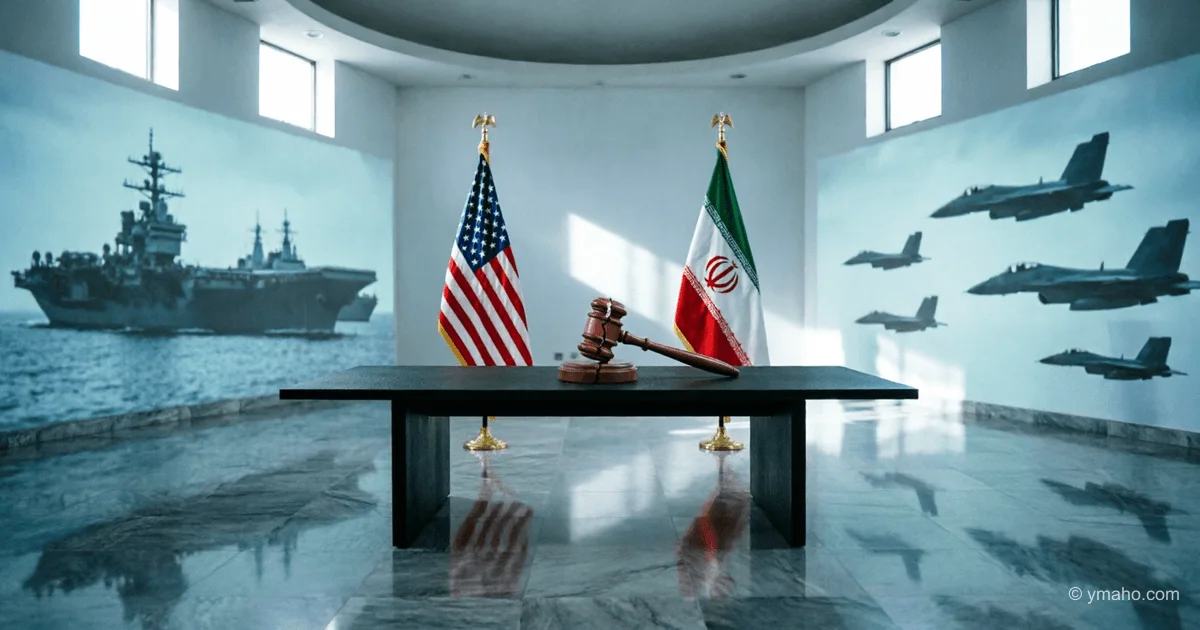
US-Iran Talks Hit Deadlock, Sides Return to Rhetoric of Military Threats
The diplomatic process between Washington and Tehran is completely blocked. The White House is discussing the possibility of resuming hostilities in the coming days if no breakthrough occurs, while Iran has stated it will not return to the negotiating table until the naval blockade is lifted.
Analytical article: 'Neither War Nor Peace' — Why the Failure of US-Iran Talks Leaves No Choice
After nearly two weeks of a fragile ceasefire that kept the world on edge, the diplomatic process between Washington and Tehran has finally reached a dead end. The first and so far only high-level direct talks, held on April 11 in Islamabad with Pakistan's mediation, ended inconclusively after 21 hours of discussions. Since then, the sides have not only failed to move closer to a compromise but have regressed, exchanging ultimatums and military threats. According to The Wall Street Journal, the White House is seriously discussing the possibility of resuming limited strikes on Iran in the coming days, while Tehran has stated it will not return to the negotiating table until the naval blockade is fully lifted. The world is frozen in anticipation: either a diplomatic miracle or a new, even more destructive wave of escalation.
Event Details and Timeline
The direct talks in Islamabad on April 11, 2026, were supposed to be a turning point. The US delegation was led by Vice President JD Vance, and the Iranian delegation by Parliament Speaker Mohammad Bagher Ghalibaf. Following the meeting, Vance stated that "the inability to reach an agreement is far worse news for Tehran than for Washington" and that the core issue is simple: whether Iran is ready to give a principled commitment not to develop nuclear weapons.
The Iranian side cited the main stumbling block as "lack of trust in Washington." Specific disagreements include the fate of uranium enriched to 60%, reparations, firm guarantees against future aggression, and a control mechanism for the Strait of Hormuz.
Immediately after the talks failed, President Trump announced the start of a naval blockade of the Strait of Hormuz on April 13, threatening to destroy any Iranian vessels approaching the blockade zone. At the same time, a two-week ceasefire agreement was reached until April 22.
When the ceasefire expired, Trump unilaterally extended it, stating that there is "no time frame" for ending the war. However, the very phrasing "I'm in no hurry" was perceived by Tehran not as a goodwill gesture but as confirmation that the blockade remains. The Iranian Foreign Ministry announced that it does not plan a new round of talks until the blockade is lifted.
Impact and Significance
The diplomatic deadlock has three key consequences.
1. Economic pressure is mounting. The blockade of the strait continues, oil prices remain in the range of $100–120 per barrel, and strategic reserves are being depleted daily. According to intelligence, clearing the strait of mines after a possible peace agreement could take up to six months — meaning that even with a diplomatic breakthrough, the energy crisis will not end quickly.
2. Military escalation is becoming increasingly likely. CNN reports that US military planners are developing scenarios for new strikes on Iran, including the destruction of civilian infrastructure, energy facilities, and targeted assassinations of Iranian officials. Israeli Defense Minister Israel Katz, in turn, threatened to "return Iran to the Stone Age" by destroying key energy facilities and the country's economic infrastructure.
3. Regional destabilization is deepening. The conflict has already spilled over into Kuwait (drone attacks from Iraq), and the Houthis in Yemen may step up their attacks on the Red Sea. At risk would be not just 20% of the world's oil (Strait of Hormuz) but up to 32% if the Red Sea is also blocked.
Reactions of Key Players
The US is in a state of internal division. On one hand, Trump publicly declares his commitment to diplomacy and extends the ceasefire. On the other, his administration has imposed a harsh blockade, seized Iranian tankers in the Indian Ocean, and is developing plans for new strikes. As military analyst Mikhail Khodaryonok notes, the US "has not lost a single battle but has still failed the operation": strategic goals — regime change and Iran's capitulation — have not been achieved.
Iran is using a "not a step back" tactic. Tehran demands the full lifting of the blockade as a precondition for any talks. At the same time, the military wing demonstrates control over the strait through ship seizures and mine-laying in the channel. As Ghalibaf stated: "They have not achieved their goals through military aggression and will not achieve them through intimidation. The only way is recognition of the Iranian people's rights."
Pakistan is trying to maintain its role as mediator, urgently organizing a new round of talks in Islamabad. However, so far neither side has expressed willingness to return to the table.
European countries are stepping up their own diplomatic efforts. France and the UK are discussing a "multinational peace mission" to resume the strait's operation — separately from the US. Russia, in turn, has offered to take custody of Iran's enriched uranium as part of a future agreement.
Forecast and Conclusions
The situation of "neither war nor peace" cannot last indefinitely. Either diplomacy will yield results, or an incident will trigger a new round of hostilities.
Scenario 1 — 'Forced Diplomacy' (40% probability): Under pressure from international mediators (Pakistan, Russia, Oman) and the internal economic crisis, both sides agree to a compromise. A possible "exit formula": Iran opens the strait in exchange for a partial lifting of the blockade and international oversight of its nuclear program. However, deep mistrust makes this scenario difficult.
Scenario 2 — 'New Escalation' (50% probability): A military incident occurs in the strait (an attack on a US ship or another ship seizure with casualties). The US carries out limited strikes (as discussed in the WSJ), and Iran responds with missile attacks on allied bases. Oil prices skyrocket to $150–180.
Scenario 3 — 'Full-Scale War' (10% probability): The US and Israel launch massive strikes on Iranian infrastructure, including energy facilities. Iran responds with a total blockade of the strait and attacks on Gulf states. A global recession is inevitable.
Conclusion: The failure of the talks is not just a diplomatic setback. It is a marker that the sides are not yet ready for peace. Trump, by extending the ceasefire, is buying time but not solving the problem. Iran, by refusing dialogue under blockade, is betting on exhausting the US. In this high-stakes game, the loser could be the entire world. The coming days will be critical: either diplomacy works a miracle, or the Strait of Hormuz becomes the epicenter of a new, even more destructive phase of the conflict.
— Editorial Team









