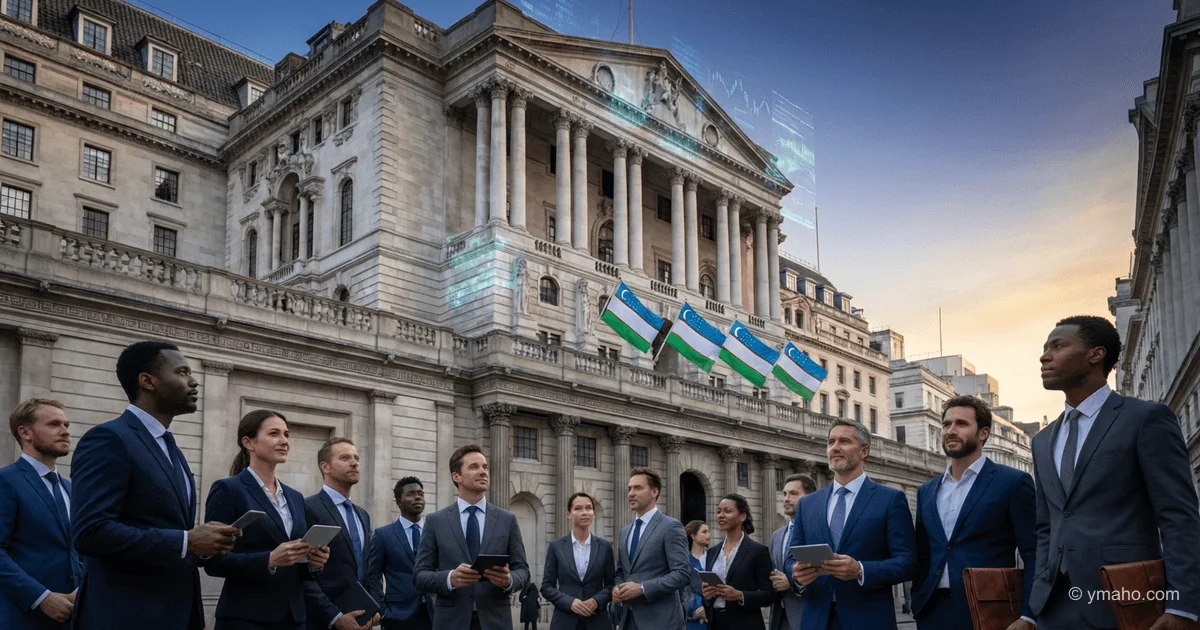
Uzbekistan's IPO in London Attracts BlackRock and Other Global Funds
The National Investment Fund of Uzbekistan successfully conducted the country's first-ever IPO on the London and Tashkent stock exchanges, attracting major investors including BlackRock and Franklin Templeton.
Here is a detailed analytical piece written from an industry insider's perspective, adhering to all currency and style requirements.
Uzbekistan's IPO: Why BlackRock Invested $300 Million in a Country Once Called a 'Frontier'
The Essence: What's Really Happening
The successful placement of UzNIF on the London Stock Exchange is not just the first international IPO in Uzbekistan's history. It is a test of whether the entire Central Asian region can transition from the 'exotic risks' category to 'structural opportunities' in the portfolios of global institutional investors.
The market sees the raised amount of $603.6 million (with potential to reach $692 million if the over-allotment option is exercised). I see a marker of breaking years of isolation. Uzbekistan placed 31% of the capital of a fund representing 13 strategic state-owned enterprises—from airline Uzbekistan Airways (25%) to the national power grid (40%) and operator Uzbektelecom (30%). This is equivalent to selling part of the state's sovereignty over the economy in exchange for global market trust. The deal size of $603 million at a GDR price of $25 per receipt, corresponding to 64,700 shares, seems modest by global standards, but it is the largest IPO on the LSE since 2021.
The key signal is not the price but the deal structure. The fund has been handed over to Franklin Templeton, a US company with $1.4 trillion under management and experience with the Proprietatea fund in Romania. Uzbekistan voluntarily agreed to external control over assets to remove concerns about political interference. This is the non-obvious deal: the sovereign trades control for capital.
Timeline and Context
December 2024: By decree of President Shavkat Mirziyoyev, UzNIF is created with total assets of $2.44 billion. The fund consolidates minority stakes in 13 state-owned companies in strategic sectors: energy, transport, telecommunications, and banking.
May 2025: Franklin Templeton opens an office in Tashkent and receives management authority over the fund. Formal preparation for the placement begins.
Late April 2026: The IPO price range is announced, and the order book opens. International demand reaches $2.9 billion—over 160 institutional investors submit bids.
May 13, 2026: Conditional GDR trading begins on the LSE under tickers UZNF and UZ20.
May 18, 2026: Unconditional admission to trading; a ceremony at the LSE with the participation of exchange CEO Julia Hoggett and head of the presidential administration of Uzbekistan Saida Mirziyoyeva. Simultaneously, trading begins on the Tashkent Stock Exchange (TSE).
In a year and a half, Uzbekistan went from a decree to live trading on the LSE—anomalously fast for a market where IPOs usually take 3-5 years to prepare. This indicates political will at the highest level.
Who Wins and Who Loses
Winners:
- Global institutional investors. BlackRock, Franklin Resources, Redwheel, and the Allan & Gill Gray Foundation became anchor investors, securing $300 million in GDRs. They gained a diversified entry into Uzbekistan's economy at a discount of about 20% to net asset value ($1.95 billion market cap vs. $2.44 billion NAV). This discount is a premium for country risk, but if governance improves, it will narrow, yielding a 20-25% revaluation just from spread compression.
- Franklin Templeton. The company earns management fees, but more importantly, it gains pioneer status for opening Central Asia to the global market. CEO Jenny Johnson confirmed at the ceremony that demand exceeded supply by more than four times. This sets a precedent for mandates to manage similar structures in other countries in the region.
- Uzbek retail investors. They received a 5% discount to the placement price (4.41 soum vs. 4.65 soum per share) for purchases up to 12 billion soum (about $994,000). Such a mechanism—rare for international IPOs—stimulates local participation and builds an internal investment culture.
Losers:
- Secondary market buyers. The order book was oversubscribed four times with demand of $2.9 billion. A significant portion of institutional demand went unsatisfied. Once GDRs begin unconditional trading, a scramble for shares will likely push prices above fair levels. Those who missed allocation will buy at higher prices.
- Uzbekistan's competitors in Central Asia. Kazakhstan has positioned itself as the region's financial hub for decades, but it was Uzbekistan that conducted the first international IPO. Astana loses its monopoly on the status of 'the only civilized market' in the eyes of foreign investors.
- Old elites in state-owned companies. Entering the fund's perimeter with an external manager means forced transparency. Disclosure of reports, audits under international standards, accountability to an independent board—all this limits the freedom of management accustomed to operating without regard for minority shareholders.
What the Media Isn't Saying
Insider One: Franklin Templeton is testing a model proven in Romania on a more complex market.
Marius Dan, CEO of Central Asia and Country Head Romania at Templeton Global Investments, directly stated that investors familiar with the Fondul Proprietatea story in Romania specifically entered UzNIF. Fondul Proprietatea was created to compensate victims of nationalization under Ceaușescu, then transformed into a market instrument. Franklin Templeton managed it for 15 years, navigating from chaos to dividends and transparency. Now the same team is applying the same playbook to Uzbekistan. This is not a frontier adventure but a cold calculation to replicate the Romanian scenario.
Insider Two: The placement of 31% of shares is not the end goal but the foundation for six new IPOs.
Franklin Templeton has already announced plans to list six of the largest assets from the UzNIF portfolio within the next three years. This means the current placement is just the first step. Investors are buying not just a stake in the fund but an option on future listings of Uzbekistan Airways, Uzbektelecom, and other companies. Essentially, UzNIF is an 'incubator fund' preparing assets for independent market entry.
Insider Three: Uzbekistan is creating an international financial center, and the LSE is interested.
Saida Mirziyoyeva discussed the creation of the Tashkent International Financial Center with Jenny Johnson. The London Stock Exchange, losing listings after Brexit, sees Uzbekistan as a new source of issuers. This is a strategic partnership: London gets a flow of placements from Central Asia, and Uzbekistan gains institutional expertise and access to the global capital pool. British investments in the republic's economy have already exceeded $1 billion.
Fourth Point: The 'anchor effect' for the entire region.
Former Prime Minister of Kyrgyzstan Joomart Otorbayev called the IPO a 'defining moment for Central Asia.' The logic is simple: if Uzbekistan successfully placed, why can't Kazakhstan, Kyrgyzstan, or Tajikistan follow suit? Regional projects like Kambarata HPP-1 or Rogun HPP could gain access to international financing through similar structures.
Forecast: Next 30 Days and 90 Days
30-Day Horizon (until June 18, 2026).
The next month will determine the success of the placement. The over-allotment option (15% of the international tranche, about 3.5 million GDRs) must be exercised within 30 days of the start of conditional trading. If Jefferies exercises the option, the total deal size will reach $692 million—a signal of sustained demand. Secondary trading will show volatility in the range of $24-27 per GDR: those who didn't get allocation will buy, while speculators will take quick profits. An important marker is the appearance of new investors who did not participate in the IPO. If the register expands, it confirms long-term interest.
90-Day Horizon (until August 17, 2026).
Summer 2026 will be a period of 'quiet accumulation.' The 180-day lock-up for the company, government, and management means that until mid-November 2026, large insider sales are excluded. During this time, Franklin Templeton will begin publishing regular reports on the portfolio companies, and the market will get its first data on asset quality. If the reports confirm revenue growth and improved governance, the discount to NAV will start to narrow, and the fund's market cap could grow to $2.2-2.3 billion by the end of 2026.
The key catalyst on the 90-day horizon is the announcement of the first of six planned IPOs of portfolio companies. If Franklin Templeton announces specific timelines, for example, for the listing of Uzbekistan Airways, it will attract a new wave of institutional interest and set a precedent for the entire region. Uzbekistan will transform from a 'one-off case' into a regular issuer. That—not the current placement—was Tashkent's strategic goal since the creation of UzNIF.
— Editorial Team









