Nature: Vagus Nerve Stimulation Reversed Age-Related Memory Lapses via the Gut-Brain Axis
Stanford scientists identified the bacterium Parabacteroides goldsteinii, whose metabolites disrupt hippocampal signaling, causing cognitive impairment; they showed that both inflammation suppression and vagus stimulation restore memory in aged individuals.
Vagus, Gut, and Memory: How a Stanford Discovery Rewrites the Textbooks of Aging Neurobiology
When Nature published a paper by Christoph Thaiss's group from Stanford and the Arc Institute on March 11, 2026, headlines instantly filled with variations on "scientists reversed age-related memory loss through the gut." But what happened behind the scenes of this publication—and what followed in the subsequent 60 days—is far more interesting than the paper itself. Because Thaiss and his colleagues didn't just find "another bacterium." They found a switch. And that switch is already in the hands of doctors.
The Essence: What's Really Happening
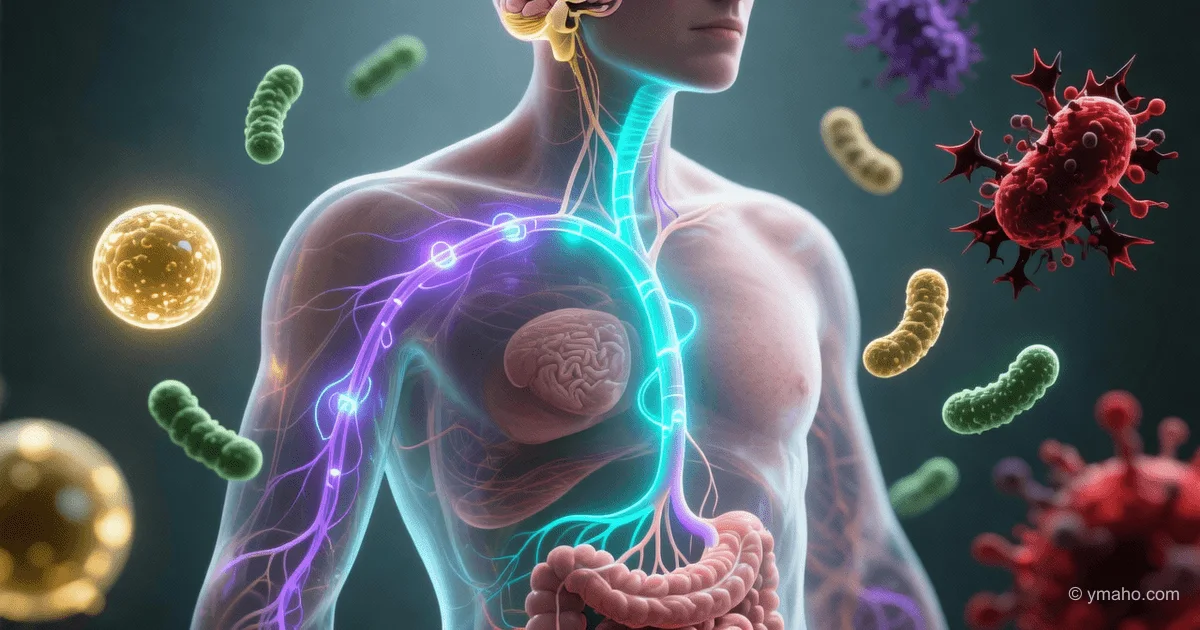
Formally, the study describes a three-step cascade: the bacterium Parabacteroides goldsteinii, whose population explodes with age, produces medium-chain fatty acids; these activate the GPR84 receptor on myeloid cells in the gut; the inflammatory response suppresses signal conduction along the vagus nerve, and the hippocampus—the center of memory formation—receives insufficient stimulation and stops functioning properly.
But the real story isn't about a bacterium or mice. The real story is that the timing of cognitive aging turned out not to be hardwired but actively regulated. Thaiss put it plainly: "The timeline of memory decline is not hardwired; it's actively modulated in the body." This is a tectonic shift in the neurobiology of aging. Just yesterday, we thought cognitive decline was an inevitable consequence of neuronal wear and tear. Today, we know that a peripheral organ—the gastrointestinal tract—can serve as a "remote control" for the brain.
The researchers demonstrated reversibility in three independent ways: broad-spectrum antibiotics restored memory in old mice; bacteriophages targeting P. goldsteinii reduced inflammation and restored cognitive function; chemical or electrical stimulation of the vagus nerve brought old animals back to young levels. Each of these approaches attacks the cascade at a different level—and each works.
Timeline and Context
The story didn't start in 2026. The concept of the gut-brain axis has been developed for decades, but until now it remained more correlational than causal. Scientists knew the microbiome changes with age. They knew that transplanting microbiota from young mice to old ones improves some cognitive measures. But no one could say: here is a specific bacterium, here is a specific metabolite, here is a specific receptor and neural pathway.
Thaiss and his colleagues started with a simple question: why do some people remain cognitively intact until 100, while others begin losing memory in their 50s-60s? The experimental design was audacious in its simplicity: young mice (2 months) were housed in the same cage as elderly ones (18 months). After a month, the young began failing cognitive tests—their microbiome had aged.
The breakthrough moment came when the researchers identified the specific culprit: Parabacteroides goldsteinii. The metabolic profile of this bacterium showed abnormally high production of medium-chain fatty acids, which through the GPR84 receptor trigger an inflammatory cascade specifically in gut myeloid cells, not in brain microglia. That was the point where hypothesis became mechanism.
Who Wins and Who Loses
The vagus nerve stimulation industry wins. This is the least obvious and most powerful effect of the publication. The FDA approved implantable vagus stimulators back in 1997 for epilepsy and in 2005 for resistant depression. Non-invasive devices—such as gammaCore (a handheld device applied to the neck)—received FDA clearance for migraine and cluster headaches in 2017. Now manufacturers have a completely new, potentially multi-billion dollar indication: age-associated cognitive decline. No other neurotechnology segment has received such scientific validation in the last five years.
GPR84 inhibitor researchers win. The GPR84 receptor is already in the focus of several pharma companies as a target for anti-inflammatory therapy. The study showed that the GPR84 inhibitor PBI-4050 restores memory in old mice. This opens the door for repositioning existing molecules for cognitive indications.
The entire concept of interoception wins—the brain's ability to perceive signals from internal organs. Thaiss introduced the concept of "interoceptive dysfunction" as a key mechanism of age-related cognitive decline. This is a new framework that unifies disparate observations about the link between metabolic health and cognitive function into a single model.
The neurocentrism paradigm loses. The study deals a serious blow to the notion that cognitive aging is exclusively an intra-brain process. If the gut controls the hippocampus, then brain protection strategies must start in the gastrointestinal tract—this will redistribute research budgets and regulatory attention.
Skeptics of the gut-brain axis lose. A publication in Nature with causal demonstration of all chain links—from a specific bacterium to specific behavior—closes the debate on whether the microbiome is a clinically relevant target for cognitive health. It is. Period.
What the Media Isn't Saying
First non-obvious insight: the vagus stimulation that reversed memory loss is a "sledgehammer," not a scalpel. Thaiss himself publicly warned that existing devices activate the entire nerve bundle, whereas cognitive therapy will require tools targeting specific neuron subtypes. This means current equipment is a proof of concept, not a finished product. Investors rushing to buy shares of neurostimulator manufacturers risk overestimating the speed of translation.
Second non-obvious insight: the work identified a mouse line protected from cognitive decline—and this is a potential key to genetic therapy. The DBA/2J mouse line has a natural defect in the GPR84 receptor. These animals do not lose memory with age or upon colonization with P. goldsteinii. If human GPR84 polymorphisms affect Alzheimer's risk, we will have a genetically stratifiable population for therapy—literally "who needs it and who doesn't" at the DNA level.
Third non-obvious point: the study was funded with participation from Calico Life Sciences LLC—the biotech arm of Alphabet (Google), focused on aging. This is not neutral academic work. It is part of a systematic mapping of aging mechanisms by a corporation with a market cap of over $2 trillion.
Fourth non-obvious point: GLP-1 class drugs—the very Wegovy and Ozempic—are indirectly validated by this study as cognitive protectors in aging. The work showed that GLP-1 agonists stimulate the vagus nerve and improve memory in old mice. Novo Nordisk and Eli Lilly have gained an additional argument for expanding the indications of their blockbusters to age-associated cognitive impairment. This was not Thaiss's goal, but it is an inevitable consequence of his discovery.
Fifth non-obvious point: cephaloridine, an abandoned human antibiotic from the 1960s, may get a second life as an anti-aging agent. A parallel study by Meng Wang's group at HHMI Janelia showed that low-dose cephaloridine causes gut E. coli to produce colanic acid, extending the lifespan of C. elegans by 30%. Cephaloridine was withdrawn from clinical use due to poor absorption—but this property is now seen as an advantage: the drug stays in the gut and acts locally.
Forecast: Next 30 Days
Mid-May to mid-June 2026. At least two major reviews in Nature Reviews Neuroscience or Neuron commenting on Thaiss's work are expected. Key issues to be raised: reproducibility in female mice (so far the main work is on males) and specificity of P. goldsteinii effects against the background of the rest of the microbiome.
June 2026. Manufacturers of vagus nerve stimulation devices—LivaNova, electroCore (maker of gammaCore), Parasym—will announce research plans or partnerships in cognitive health. At least one company is expected to initiate a pilot human study using existing equipment.
Forecast: Next 90 Days
July 2026. Thaiss and his team are expected to present first data on the correlation between P. goldsteinii and cognitive status in humans. A human cohort study is already underway, and preliminary results may be ready for key summer conferences.
August 2026. The FDA will issue updated guidance on clinical trials for cognitive indications in aging. Thaiss's publication created a precedent for a "mechanistically justified reversible target," and the regulator will have to determine how to evaluate therapies targeting the gut-brain axis.
September 2026. Novo Nordisk, leveraging data on GLP-1-dependent vagus stimulation, may announce an expansion of the semaglutide clinical program to patients with mild cognitive impairment. The addressable market is roughly 50 million people in developed countries.
End of September 2026. The first independent meta-analysis of microbiome studies in Alzheimer's disease, including Thaiss's work, will be presented at CTAD (Clinical Trials on Alzheimer's Disease). The analysis is expected to confirm the role of bacterial inflammatory metabolites as an independent risk factor for cognitive decline.
The main strategic takeaway: Thaiss's publication is not a period but an ellipsis. It opens a practical avenue for intervention, the hardware for which already exists and is FDA-approved for other indications. This is rare in aging neurobiology: usually decades pass between the discovery of a mechanism and the emergence of a tool for intervention. Here, the tool already exists. The question is who will first fund a clinical human study and prove that the mouse model translates to humans. When that happens—and I estimate a horizon of 24-36 months for first interim data—the market for vagus nerve stimulation devices could double, possibly triple.
Monetary estimate: the global neurostimulation device market in 2026 is about $12 billion, of which the vagus nerve stimulation segment is about $800 million. Potential expansion into cognitive indications in aging could add $3-5 billion to this market within five years. And that's not counting the pharmaceutical segment of GPR84 inhibitors, which is currently too small for precise estimation but could become multi-billion.
— Editorial Team









