Why Greenhouse Vegetables Are Suddenly Getting Cheaper: Market Lessons for Consumers
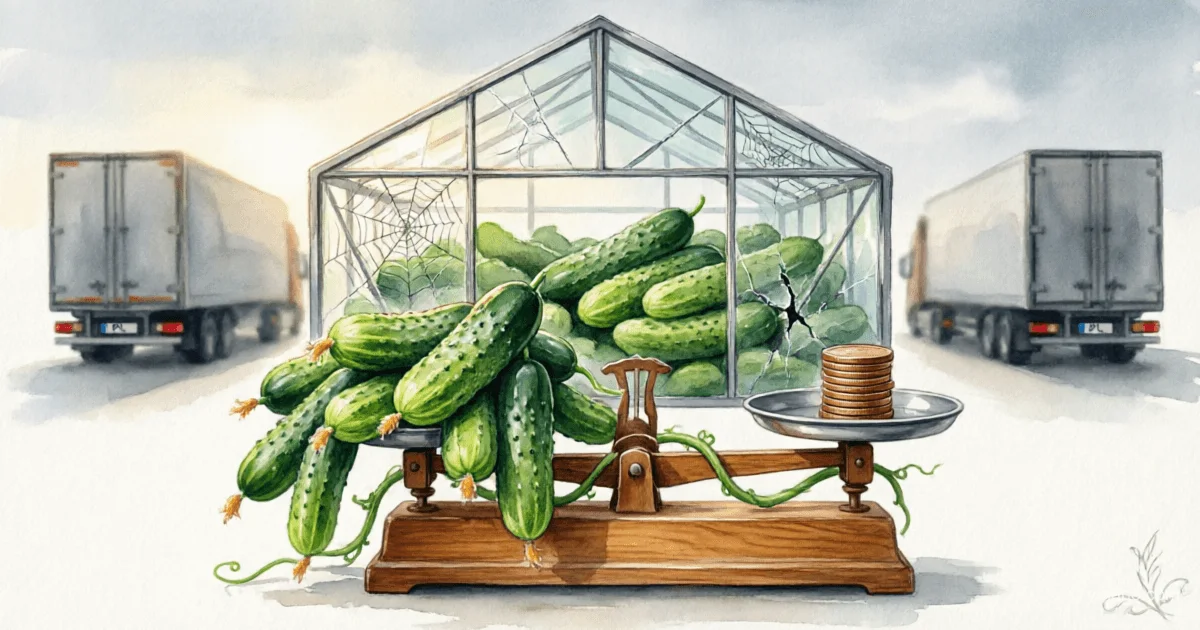
Ukrainian greenhouse complexes this week are shipping cucumbers at 90–145 hryvnias per kilogram—21% less than just seven days ago. The reason is simple and mirrors classic market dynamics: supply has sharply increased while demand remains unchanged. Greenhouses have reached the peak of their seasonal "harvest window" (as farmers call the collection of ripe produce), and warehouses are filling up faster than stores can sell the goods.
To prevent spoilage, producers are forced to slash prices. Imagine you baked too much bread for dinner: to avoid it going stale, you’d give some away cheaper—or even for free—to neighbors. The same logic applies in agribusiness, only at industrial scale and with strict shelf-life constraints.
Import factor and competition from Poland
The situation is intensified by active imports from neighboring Poland. Importers had already built up large stocks of Polish cucumbers last week. Now, to free up cold storage space for new shipments, they’re lowering prices to 70 hryvnias per kilogram. This creates direct pressure on local farmers.
Open trade corridors within the region function like connected vessels: if one country develops a surplus, it quickly flows into neighboring markets, balancing supply but forcing local producers to adjust to foreign price levels. Still, despite the current drop, cucumbers remain on average 15% more expensive than a year ago. This serves as a reminder that short-term discounts don’t erase the broader trend of rising food costs driven by logistics, energy for heating greenhouses, and fertilizer prices.
Key takeaways
- Greenhouse complexes reduced wholesale prices by 21% in one week due to overflowing warehouses and steady demand.
- Polish imports are actively undercutting the market, offering cucumbers at 70 UAH/kg to quickly clear older stock.
- Despite seasonal decline, annual inflation for this vegetable category remains positive (+15%).
- Price dynamics clearly show how local harvests and cross-border trade instantly affect supermarket shelves.
Global context: why this matters beyond farmers
The early-vegetable market is a precise indicator of the entire food supply chain’s health. Greenhouse farming critically depends on energy costs (gas and electricity for heating and lighting) and mineral fertilizers, whose prices are set on global commodity exchanges. When the local market becomes flooded with produce, it temporarily masks deeper structural expenses.
For international traders and analysts, such fluctuations signal how quickly regional logistics routes are recovering and how efficiently cross-border trade operates. If imports easily replace local products, it means customs and transport barriers are minimal. In the long term, this stabilizes prices for consumers—but requires local farmers to improve energy efficiency and cost optimization to stay competitive in an open market.
What this means for ordinary people
Seasonal vegetables are now more affordable, but don’t expect these low prices to last. The market will rebalance quickly once excess stock is sold off, and underlying energy and logistics costs will push prices back toward the annual average. For household budgets, this is a good opportunity to diversify meals—but not a reason to change long-term shopping habits.
— Editorial Team









