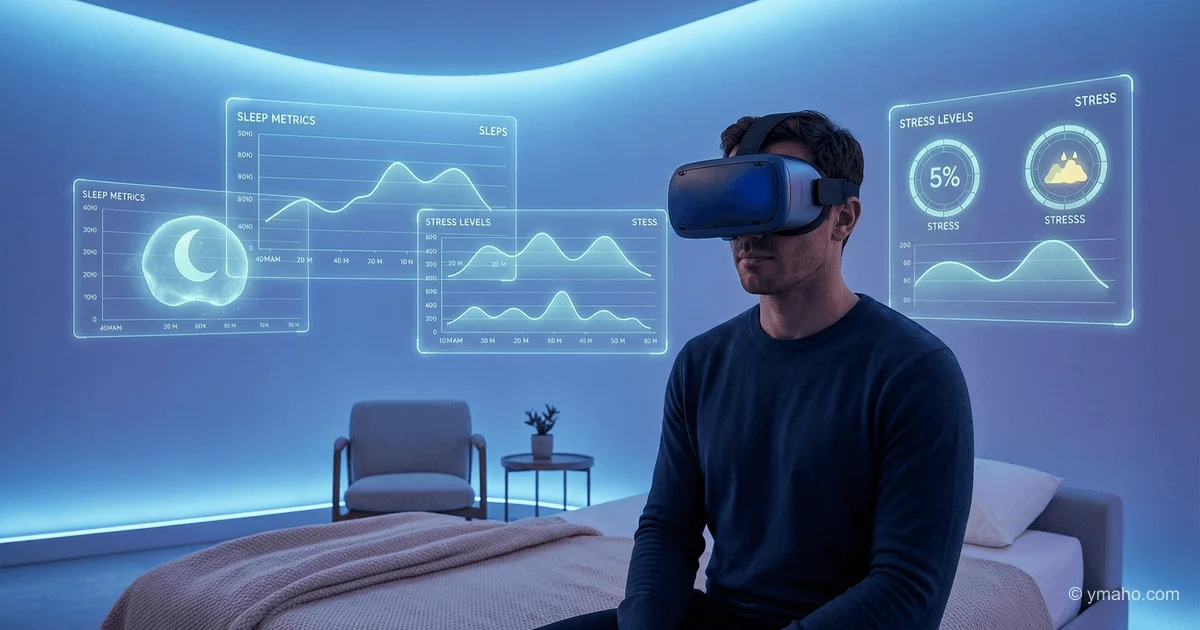
VR Therapy and 'Smart Balance': How Wellness Has Changed in 2026
The industry is moving from rigid restrictions to personalized, data-driven care. Demand is growing for sleep tourism, digital detox, and stress management using adaptogens in day and night cycles.
Therapy in a headset and sleep for $2,000: Why wellness-2026 smells of desperation, not care
The Gist: What's Really Happening
The news about VR therapy, sleep tourism, and cycle-based adaptogens is being sold as a renaissance of mindful self-care. "The industry is moving from rigid restrictions to personalized, data-driven care" — it sounds progressive. In reality, this isn't care but its simulacrum: a market that has learned to profit from people's inability to handle basic biological functions without external technological support.
When an adult pays $2,000 a night to get a good night's sleep, that's not wellness. It's a symptom of profound dysfunction. And the fact that the media packages this symptom in the glossy wrapper of "smart balance" is the clearest sign that the industry has reached its logical limit: products designed to relieve stress have themselves become a source of stress.
The VR therapy market is growing at an alarming rate: $1.87 billion in 2025, $2.24 billion in 2026, projected $4.59 billion by 2030 at a CAGR of 19.9%. This means more and more people will put on headsets to cope with the anxiety created by the same technological environment. A self-sustaining funnel: digitalization breeds stress, and VR therapy treats it. Business wins twice.
Timeline and Context: How We Got to a Point Where Sleep Is Bought for Money
The trend has been brewing for years, but it became institutionalized only by spring 2026. Several key turning points.
First — the pandemic (2020–2021). The mass shift to remote work blurred the boundaries between work and personal time. Sleep disturbances, initially recorded as a "temporary phenomenon," became chronic. The CDC declared sleep deprivation a public health epidemic: about one-third of adults and children in the US are systematically sleep-deprived. This created an ideal foundation for commercializing sleep as a service.
Second — the adaptogen boom (2023–2025). Ashwagandha, rhodiola, magnesium, taurine — the list of substances promising to "relieve stress" grew exponentially. By 2026, studies like TECOS are already testing adaptogen combinations — 27 grams of plant protein with 500 mg of ashwagandha and 300 mg of rhodiola daily to improve sleep quality in people with disorders. The market has moved from "try herbal tea" to "here's a clinically tested, double-blind protocol."
Third — April–May 2026. Articles about sleep tourism exploded in the media. Equinox Hotels with their Sleep Lab at $2,000 a night is just the tip of the iceberg. Falkensteiner Balance Resort in Austria offers a Digital Detox Retreat with a psychotherapist and stress management coach from €979. Japanese Hoshino Resort hotels launched a "digital detox" program with tactile practices and reading paper books for about $690 for two days. 74% of travelers in 2026 demand personalization, and 41% travel for mental well-being.
Fourth — right now, May 2026. The supplement market through the practitioner channel (doctors, nutritionists, wellness coaches) reaches $6 billion. Analysts at Front Row note a trend toward "self-optimization": consumers no longer just want to "look good" — they want to "optimize sleep," "calibrate the microbiome," "tune cognitive functions." Health has become an interface that needs tweaking, and the wellness industry is happy to provide the tools — VR headsets, sensor beds, adaptogen stacks.
Who Wins and Who Loses
On the surface, it's all idyllic. It seems everyone in the chain wins.
VR equipment manufacturers. With a CAGR of 19.9% and a horizon of $4.59 billion by 2030, this is a clear and growing segment. AppliedVR, Limbix, Psylaris, XRHealth, and dozens of other players are carving out niches from mental health to physical rehabilitation.
Hotel chains. Sleep tourism is valued at $600 billion globally. A mid-range hotel with 150 rooms can add over $1 million in annual revenue simply by selling "room attributes" (early check-in, late check-out, personalized sleep packages). Six-figure sums for what used to be a complimentary amenity.
Adaptogen manufacturers and the practitioner channel. The supplement market through this channel reaches $6 billion, growing 6% in 2026. Everything related to "sleep," "stress," and "hormonal balance" is moving into the premium segment. KSM-66 ashwagandha, rhodiola, liposomal magnesium — these are no longer sold as dietary supplements but as "protocols" with scientific backing.
The losers are the mass consumer and the very idea of wellness. The paradox is that the wave of "personalization" turns health into an elite commodity. Quality sleep, stress management, digital detox — basic biological needs — become paid options. Those who cannot afford a $2,000 room, VR therapy, or a $300-an-hour nutritionist consultation remain in the "unoptimized" zone. Wellness-2026 creates a two-tier system: the "optimized" and everyone else.
Also losing are those who believe in solving problems on their own. The industry persistently broadcasts: you can't handle it alone. You need a coach, a wearable device, a protocol, a tracker, a VR session. This is radically opposite to what wellness was 20 years ago — a movement for human autonomy in health matters. Today's "smart balance" is a balance that is adjusted for you, for your money.
What the Media Isn't Saying
First non-obvious insight: sleep tourism doesn't cure insomnia — it monetizes it. Dr. Matthew Walker, creator of the Sleep Lab at Equinox Hotels, honestly admits in the podcast Today, Explained: even a carefully designed "scientific" room won't cure chronic insomnia. "A sleep vacation is not a solution for those with serious disorders," he says. But marketing presents it as such. And the guest who paid $2,000 continues to not sleep at home — only now they know they're "sleeping wrong," which adds to their anxiety.
A reporter who tested the Sleep Lab spent the evening performing a two-hour ritual: breathing exercises, color therapy, meditations, bodywork yoga, stretching, herbal tea, cherry juice for melatonin, a steam bath. Who in real life has two hours to prepare for sleep? No one. But the business is built on this: create an unattainable standard and sell attempts to get closer to it.
Second insight: the adaptogen arms race has no scientific finish line. The TECOS study, started in November 2025 and completed in December 2025, tests a combination of plant protein, ashwagandha, and rhodiola. But note the dates: results registered on ClinicalTrials in March 2026. The market is already selling these combinations without waiting for peer-reviewed publication. The mere presence of a study in the NCT database becomes a marketing tool: "clinically tested" only means it was tested, not that it's proven effective.
Third insight — the main one. Wellness-2026 is not about health. It's about managing anxiety. 52% of new products in the segment include "unique ingredient pairs" aimed at creating a feeling of care, safety, and "edibility." Consumer literacy is rising: searches for NAD+ have skyrocketed 7,904%, for PDRN 4,230%, for creatine for women 352%. But behind this is not rational choice, but an attempt to control the uncontrollable. The higher the anxiety in the world, the deeper consumers dive into biohacking. This isn't wellness; it's a coping mechanism wrapped in the language of science.
Fourth insight: the practitioner channel creates a closed loop. The supplement market through doctors and coaches reaches $6 billion. Consumers come for "personalization" and get a product marketed through a gatekeeper — a doctor or nutritionist often affiliated with the brand. This doesn't reduce information noise; it adds a new layer of intermediaries between a person and their body. The industry creates dependence on expertise while simultaneously convincing consumers that they are "optimizing themselves."
Forecast: Next 30 Days and 90 Days
30 days (by June 7, 2026). The summer season will boost demand for retreat packages. Hotel chains will ramp up advertising for Digital Detox and Sleep Retreat programs. VR therapy will get an additional boost from summer mental health tech conferences — expect announcements of new funding rounds for startups in this niche. The practitioner channel will continue growing through the launch of "summer protocols" — detox programs, sleep optimization, circadian rhythm-based hormonal support.
Key risk: a wave of disappointment among early mass users of sleep tourism. Those who bought the $2,000 room and didn't cure their insomnia will start posting critical reviews. Media will pick up the theme of "sleep tourism: miracle or myth?" — the first investigations will appear by mid-June.
90 days (by August 7, 2026). By the end of summer, we'll see a narrative correction. The term "optimization" will begin to be replaced by "balance" and "recovery" — Front Row warns that the cultural cycle will swing back toward embracing imperfection. But the infrastructure is already in place. The VR market won't slow down. The practitioner channel will reach $6.2 billion. Sleep tourism will become a standard option in the luxury travel segment.
The first regulatory signals will appear: doctors will start publicly warning about the risks of "adaptogen stacks" without individual diagnostics. Major wellness brands will launch campaigns "against optimization" — but it will be the same optimization, just in a new package: "optimize your non-optimization."
Final conclusion: wellness-2026 is a market that sells a break from oneself. VR therapy treats anxiety created by the digital environment. Sleep tourism sells sleep to those who have forgotten how to sleep due to overloads created by the same productivity industry. Adaptogens promise "stress management" in a world where stress levels only rise. This is not a circle of care. It's a closed loop of profit extraction — and the worse we cope with basic bodily functions, the more expensive the help we are sold.
— Editorial Team









