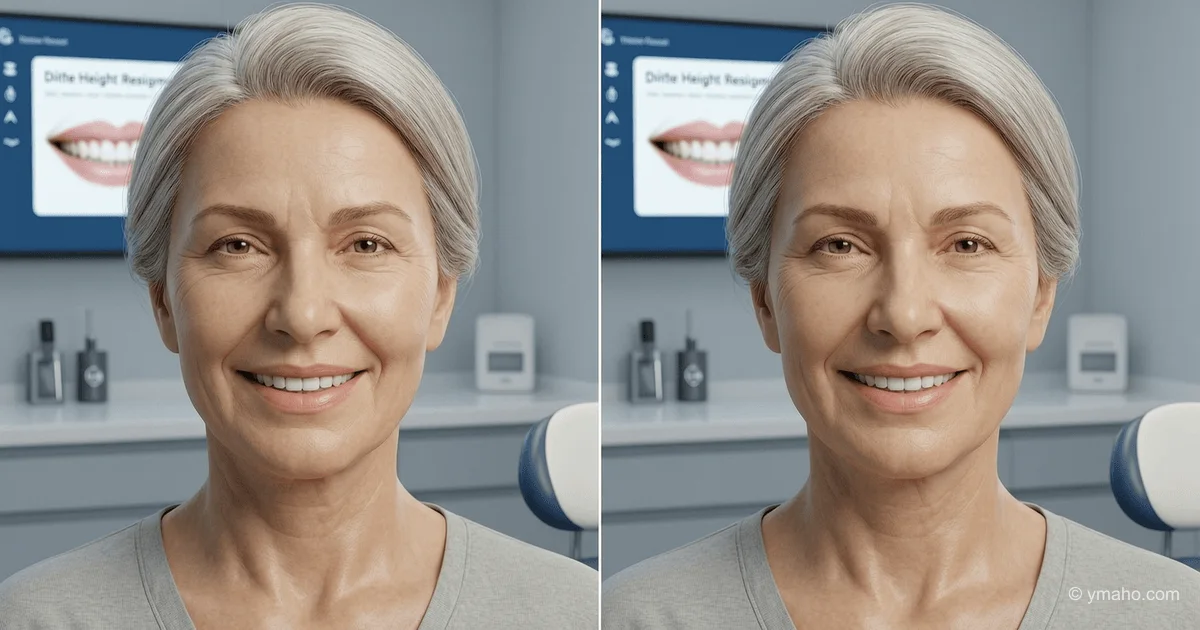
Wellness Trend 2026: Bite Height Restoration as an Anti-Aging Strategy
Aesthetic medicine is shifting focus to the anatomical foundation: orthodontists' work on bite height is becoming part of anti-aging therapy, as teeth serve as the framework for facial soft tissues, and their wear accelerates external aging.
The Bite as an Asset: Why Dentistry Is Taking Over the Anti-Aging Market and What It Means for the Beauty Industry
The Essence: What Is Really Happening
What the media presents as a "2026 wellness trend" is actually a market redistribution in aesthetic medicine. Dentistry is no longer about cavities and fillings. It is encroaching on the territory of cosmetology, plastic surgery, and anti-aging therapy, with an argument that is hard to dispute: teeth are the face's framework, and no filler can compensate for its collapse.
The aesthetic dentistry market is growing at a double-digit CAGR. In 2025, its volume was $44.16 billion, in 2026 it will reach $49.73 billion, and by 2030 it is projected to grow to $82.16 billion—with a compound annual growth rate of 13.4%. For comparison, this is several times faster than the growth of the injectable cosmetics market. Cosmetologists, who five years ago worked in isolation from dentists, are now massively sending clients for consultations with orthodontists—if the cause of a reduced lower third of the face lies in the bite, fillers are powerless.
A clinical case from Dental Economics in January 2026 is a textbook example. A 57-year-old patient with chronic bruxism had her vertical dimension of occlusion increased by 3.5 mm, followed by correction to 4.5 mm, resulting in "complete facial rejuvenation rehabilitation." It wasn't just a prettier smile—the architecture of the lower third of the face changed without a single botulinum toxin injection. And this is where the most underestimated market shift of 2026 lies.
Timeline and Context
The trend had been brewing for several years but became institutionalized in the first half of 2026. In January, the Journal of Korean Academy of Prosthodontics published a paper detailing protocols for assessing occlusal vertical dimension—a metric that previously interested only prosthodontists but is now becoming a key parameter in anti-aging diagnostics. In March 2026, RBC published an article titled "Anti-Aging Goes Beyond Boundaries: The Role of Dentistry in Modern Aesthetics," where Natalya Zhitomirskaya, a prosthodontist with 25 years of experience, formulated a new interdisciplinary approach: dentistry and cosmetology are increasingly working in tandem to avoid visual facial imbalance.
In April 2026, Kommersant released a review of aesthetic dentistry trends, where Konstantin Ronkin, President of the Boston Institute of Aesthetic Medicine, directly stated: "The main trend of the coming decade will be anti-aging dentistry, and the clinic of the future will resemble a longevity space." Around the same time, the CareQuest Institute published a forecast: the global longevity market will reach $8 trillion by 2030, and dentistry is vying for a significant share of that pie.
Simultaneously, the digital smile design market grew from $1.56 billion in 2025 to $1.83 billion in 2026 and is projected to reach $3.42 billion by 2030, with a CAGR of 17%. This is an infrastructural marker: the industry is massively investing not in procedures per se, but in tools for planning outcomes that are understandable to the patient before treatment begins. AI-driven smile design is already preferred by 69.7% of patients.
Who Wins and Who Loses
Winners are orthodontists and prosthodontists who, five years ago, were not perceived as players in the anti-aging market. Now they have a new type of client—affluent patients aged 50+ who come not to treat teeth but to "restore their face." The price tags are corresponding: full mouth reconstruction with All-on-4 implants for both jaws costs $40,000–$80,000+ in the US. By other estimates, the upper limit reaches $90,000–$100,000 for complex cases with bone grafting. Individual procedures—placing Nobel Biocare or Straumann implants—cost $3,000–$5,000 per unit. For comparison, an annual course of injections from a cosmetologist rarely exceeds $5,000–$7,000.
The market is already responding to the price gap in its own way: American patients are flocking to Vietnam, where the same All-on-4 procedure on Nobel Biocare costs $12,000–$16,000 for both jaws—savings of up to $38,000–$42,000 per treatment course. The dental tourism segment is an indirect beneficiary, with its growth in 2026 measured in double digits.
Digital equipment manufacturers also win. The dental software market grew by 17.3% year-over-year, and intraoral scanners and CAD/CAM systems are becoming mandatory clinic standards. Clear aligner manufacturers are another beneficiary: braces are losing ground, and aligners are perceived as an "invisible" anti-aging tool.
Losers are cosmetologists who have not yet built partnerships with dentists. Filler manufacturers also lose: if the problem truly lies in tooth wear and reduced bite height, no amount of hyaluronic acid will provide a lasting result. Insurance companies lose because the line between "medically necessary" and "cosmetic" treatment is becoming increasingly blurred, and patients demand coverage for procedures that insurers previously classified as aesthetic.
The Russian market, according to doctors' observations, shows even higher patient demands for aesthetics than the European market: "Where a European would overlook nuances, our client's requirements for quality and aesthetics are much higher." This means the Russian anti-aging dentistry segment will grow faster than the European one.
What the Media Are Not Saying
The first non-obvious insight: bite height restoration as an anti-aging strategy is a response not to a medical problem but to an economic one. The cosmetology market is nearing saturation: consumers are tired of endless injections, and their effect is temporary. Dental rehabilitation provides results for 15–20 years—and this is the main competitive advantage that is not explicitly stated. For the patient, this means paying $60,000 once and "closing the issue" for two decades. For the cosmetologist, it means losing a client for the same period. That is why the cosmetology lobby hardly comments on this trend publicly.
The second insight concerns numbers that the media avoid. Reduced bite height is not just an "age-related change." It is a cascade process triggered by bruxism (teeth grinding), and bruxism, in turn, is often a consequence of chronic stress. In other words, the industry has found a way to monetize the consequences of the global anxiety epidemic: stress destroys teeth, teeth change the face, the patient pays $50,000 for restoration. Psychological stress becomes the main driver of the dental anti-aging market.
The third insight: AI-driven smile design, which the media romanticize as "personalization," actually solves the problem of making a decision on a large bill. When a patient sees a 3D simulation of their face before treatment, the conversion to procedure sharply increases, and price objections decrease. The digital smile design market is growing not because it improves clinical outcomes, but because it sells. $1.83 billion in 2026—that is a market for marketing tools disguised as medical technologies.
Forecast: Next 30 Days and 90 Days
30 days (by June 7, 2026). The topic of anti-aging dentistry will receive an additional boost from the publication of semi-annual reports from implant manufacturers. Straumann and Nobel Biocare, whose products dominate the premium segment of $45,000–$70,000 for full reconstruction, will likely show revenue growth of 8–12%, sparking a wave of articles in business media. Clinics operating in the "dentistry + anti-aging" segment will ramp up social media marketing with an emphasis on visual "before and after" transformations. The first "anti-aging checkup" packages will appear, combining consultations with a prosthodontist and a cosmetologist in one visit.
90 days (by August 7, 2026). A wave of collaborations between dental clinics and cosmetology centers will begin. The first interdisciplinary "face + smile" protocols will be formalized as educational courses for doctors. The dental tourism market, driven by high US prices, will continue to grow—Vietnam, Thailand, and Turkey will strengthen their positions as destinations for full mouth rehabilitation, offering savings of $25,000–$55,000. Major cosmetology brands will likely start negotiations to acquire dental chains to avoid losing departing clients. And the term "bite height" will firmly enter the anti-aging marketing lexicon alongside "collagen" and "hyaluronic acid."
The final conclusion: dentistry ceases to be a narrow medical specialty and becomes a key player in the longevity market. This is the most underestimated shift in the beauty industry in 2026. And those who understand this now will profit from it for the next ten years—while everyone else continues to inject fillers into a face that needs not volume, but a foundation.
— Editorial Team









