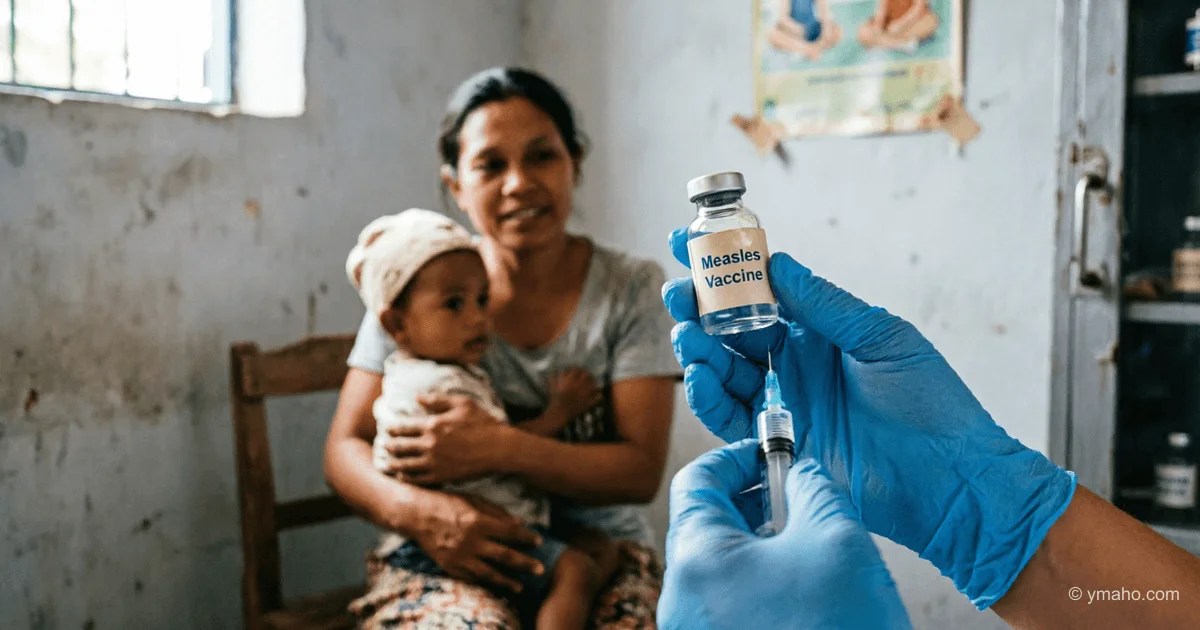
WHO Approves New Monovalent Measles Vaccine
The new vaccine (PT Biofarma/Biological E. Ltd) received WHO prequalification in January 2026 to expand access and combat outbreaks.
Monovalent Measles Vaccine from BioE/PT BioFarma: Strengthening Global Immunity
Introduction
In January 2026, the World Health Organization (WHO) made an announcement critical to the global fight against one of the world's most contagious infections. The organization added a new monovalent measles vaccine — "Measles Vaccine (Live) (Attenuated, Freeze-Dried)" — to its list of prequalified vaccines. This step, formally a technical decision by a regulatory body, is in fact a response to a growing crisis: after the COVID-19 pandemic, the world has faced an unprecedented rise in measles cases, which exploits even the smallest gaps in population immunity.
The new product is manufactured through a technological partnership between two leading pharmaceutical producers from the Global South. Indonesia's PT BioFarma (Persero) supplies the substance — a live attenuated (weakened) culture of the measles virus. India's Biological E. Limited (BioE) handles the final production stages: filling, packaging, and quality control. The vaccine is available in two formats — 5-dose and 10-dose vials — and has a shelf life of 24 months when stored in a standard refrigerator (2 to 8 degrees Celsius).
This event marks not just an addition to the WHO arsenal, but an attempt to catch up and prevent a catastrophe whose scale is only beginning to be understood. In 2026, measles — a disease that has been preventable since the 1960s — has once again become the number one global threat to child health.
Event Details and Timeline
Context: Shortage and Global Outbreak
To understand the significance of the WHO's January decision (press release published February 3, 2026), one must look at the incidence statistics. 2025 and 2026 have become a "black mark" for epidemiologists.
According to the Global Virus Network (GVN) as of April 2026, over 1,700 measles cases have been reported in the US alone across more than 30 states. This figure follows the highest annual rate in 30 years recorded in 2025. Doctors are sounding the alarm: the United States is on the verge of losing its measles-free status, which it achieved in 2000.
In Europe, the situation is no less alarming. Romania is experiencing major outbreaks, and the UK has already lost its measles-free status due to declining vaccination rates. In London, according to the NHS, MMR (measles, mumps, rubella) vaccination coverage has dropped to a critical 65% in some areas, far below the 95% needed for herd immunity. In Asia, Japan is reporting record highs in 7 years, and Bangladesh is experiencing exponential increases in child mortality.
Experts attribute this "renaissance" of the virus primarily to the consequences of the COVID-19 pandemic. Medical resources were redirected to fight the coronavirus, leading to disruptions in routine childhood immunization worldwide. Additional factors include geopolitical conflicts, migration, and a sharp rise in "vaccine skepticism" fueled by misinformation on social media.
Birth of the Vaccine: An Indonesian-Indian Duo
Right now, the world is in dire need of vaccines. This is where the new player enters. The BioE/PT BioFarma product is a monovalent vaccine (measles only), unlike the widely used MMR trivalent vaccine (measles, mumps, rubella).
The WHO prequalification decision is a "seal of quality" for international procurement organizations such as UNICEF and Gavi, the Vaccine Alliance. Now, low- and middle-income countries can purchase this product knowing it meets the strictest safety and efficacy standards.
Key Product Details:
- Technology: Live attenuated vaccine (lyophilized — dry powder for reconstitution).
- Manufacturers: PT BioFarma (Indonesia) — substance, Biological E. (India) — filling.
- Purpose: Measles prevention, specific catch-up immunization, and outbreak response.
- Significance: This is the third monovalent vaccine in the WHO arsenal, reducing risks of shortage and monopolization.
Technological Sovereignty of the Global South
An important chronological detail is that in 2026, Biological E. also received WHO prequalification for the production of a new oral polio vaccine (nOPV2). This turns the Indian manufacturer into a key player in global health, demonstrating a shift in production capacity from Western corporations to developing countries. India and Indonesia are taking responsibility for supplying vaccines to "Global South" countries, which is critical given the tense geopolitical climate and protectionism.
Impact and Significance
For Healthcare: Closing "Immunity Gaps"
The main impact of this event is eliminating the shortage of choice. Having a third supplier creates a sustainable supply chain. In the event of an outbreak, countries will no longer have to queue for a single life-saving option. They can now respond quickly.
"Immunity gap" is not just a medical term; it represents millions of unvaccinated children. Measles is so contagious (reproduction number R0 = 12–18) that 95% vaccination coverage is needed to stop its spread. Where this threshold is not met, the virus finds a victim. The new vaccine is supplied precisely to these points for catch-up campaigns.
Moreover, the vaccine is especially important for older children and adults who may need a booster. In the US, for example, cases are occurring among unvaccinated students and migrants.
For Society: Preventing "Immune Amnesia"
For society, the significance goes beyond preventing rash and fever. The measles virus is unique in that it causes "immune amnesia". It erases the cellular memory of other infections the body has previously encountered. A child who recovers from measles becomes defenseless for years against pneumonia, diarrhea, and other diseases they could easily fight off before infection.
Thus, every measles outbreak leads to a secondary increase in mortality from other seemingly unrelated causes. Vaccination against measles is vaccination against a whole range of infections. The emergence of a new, affordable vaccination tool is a strategic victory in the fight against child mortality overall.
Reactions of Key Players
Currently, the WHO, as the initiator of prequalification, expresses cautious optimism. The official press release emphasizes that this is a step towards "ensuring sufficient supply and broader access for countries to vaccinate children."
Virology experts united in the GVN comment on the situation with growing concern. Dr. William Moss from the Johns Hopkins Vaccine Center (GVN) stated: "What we are seeing now is not a vaccine failure, but a failure of the systems and trust needed for its consistent application." He emphasizes that the vaccine exists and works — the problem has always been in organizing supply and access.
Analysts also note that prequalification occurs against the backdrop of significant political changes in the US. The Trump administration (in power since 2025) expresses skepticism about global health programs, creating a risk of funding cuts for Gavi and UNICEF. In this context, the emergence of the Indonesian-Indian vaccine serves as a kind of "safety net." If the US reduces aid, the world will have access to an independent source of vaccines produced in Asia at a predictably low price.
Forecast and Conclusions
Immediate Outlook
Vaccinating the world against measles is a race against time. Misinformation continues to spread, the political situation remains unstable, and migration flows show no signs of abating. In such an environment, vaccine filling must be as massive as possible.
Biological E. has extensive experience in scaling up (they produce billions of doses annually for other products). It is predicted that this vaccine will quickly carve out a niche in African and Asian markets, where hot climates require strict adherence to the cold chain (storage at +2..+8 is easier than deep freezing for mRNA vaccines, which is another advantage).
Place in the Global Security System
The prequalification of this specific vaccine is a reminder that global health resilience is built on production diversification. The era when a few Western factories supplied the entire world with vaccines is fading. It is being replaced by a multipolar model where Indonesia and India become "global pharmacies."
However, as ORF expert Lakshmi Ramakrishnan notes, countries must combat vaccine distrust. If people refuse to get vaccinated, even the largest stockpile of doses won't help. The news about the vaccine is an industrial success, but mass production must go hand in hand with mass education.
Bottom line: The vaccine from PT BioFarma/Biological E does not represent a scientific revolution. It represents a logistical and political revolution. It makes life accessible for children in the poorest countries where measles is once again rampant. For 2026, this is a ray of hope against a backdrop of alarming incidence statistics, showing that the global security system is not yet broken but capable of adapting and surviving.
— Editorial Team









