Arthur Hayes: Why Money Printing Is Bitcoin's Main Growth Driver
When central banks start actively 'printing' money, the price of Bitcoin almost always rises. This isn't magic—it's simple logic: the more money in the system, the higher the demand for assets that store it. Former BitMEX CEO Arthur Hayes reminded everyone of this amid a lull in the crypto market and uncertainty surrounding Federal Reserve decisions.
What's Happening Now?
According to Hayes, the market has stalled in a 'no-trade zone,' with participants waiting for a clear signal from the U.S. Federal Reserve. Economic data remains mixed: on one hand, inflation is gradually easing, while on the other, there's no clarity on when the Fed will begin cutting interest rates. Without this trigger, traders prefer not to take risks.
Hayes highlighted two major risks that could change everything:
- Deflationary shock from AI: The widespread adoption of artificial intelligence could accelerate automation, lead to rising unemployment, and weaken consumer demand. This would put pressure on banks and financial institutions.
- Geopolitical escalation, especially around the Strait of Hormuz and Iran. Any conflict in this region could undermine confidence in the U.S. dollar as the global reserve currency.
Why Is Money Printing More Important Than Interest Rates?
Many believe that interest rates are the key factor for Bitcoin. But Hayes insists that the total amount of liquidity in the global financial system is far more important. Even if interest rates remain high, if governments continue to increase the money supply—such as to cover budget deficits—it creates ideal conditions for alternative assets to grow.
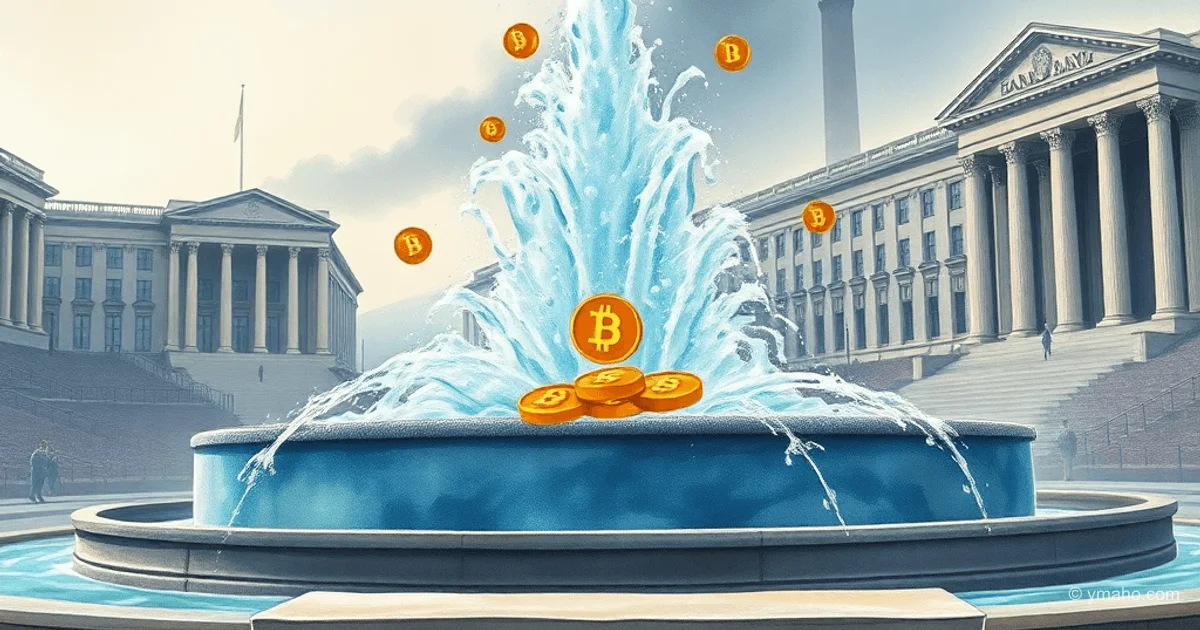
Imagine the economy as a swimming pool and money as water. If fresh water keeps flowing into the pool (money printing), the water level rises. Assets like Bitcoin and gold are like balls floating on the surface—they simply can't help but rise.
How Does the Market React During Stress?
Hayes noted an interesting pattern: during acute crises, the crypto market initially falls. Why? Because many investors sell off whatever they can to cover losses or meet margin calls. This is known as a 'liquidity crunch.'
But just a few days or weeks later, once signs emerge that central banks are ready to inject money into the economy, Bitcoin begins to recover rapidly—and often surges even higher than before the crisis.
What Does This Mean for Ordinary People?
Even if you don't trade cryptocurrencies daily, it's still worth understanding one simple principle: Bitcoin often rises when the traditional financial system loses stability. This isn't an invitation to buy; rather, it's a cue to keep an eye on two things:
- Decisions made by the Federal Reserve and other major central banks.
- The geopolitical situation, particularly in oil-producing regions.
When these factors point toward a future increase in the money supply—even without rate cuts—Bitcoin may become one of the main beneficiaries.
Key Takeaways:
- Bitcoin's price doesn't depend directly on interest rates, but on the overall amount of money in the economy.
- Geopolitical conflicts and technological shifts (such as AI) could speed up the transition to alternative assets.
- In crises, Bitcoin initially drops, but it often bounces back even stronger.
- Arthur Hayes links BTC's future growth to Fed actions and the Middle East situation.
- The U.S. dollar could weaken if countries start actively diversifying their reserves.
— Editorial Team









