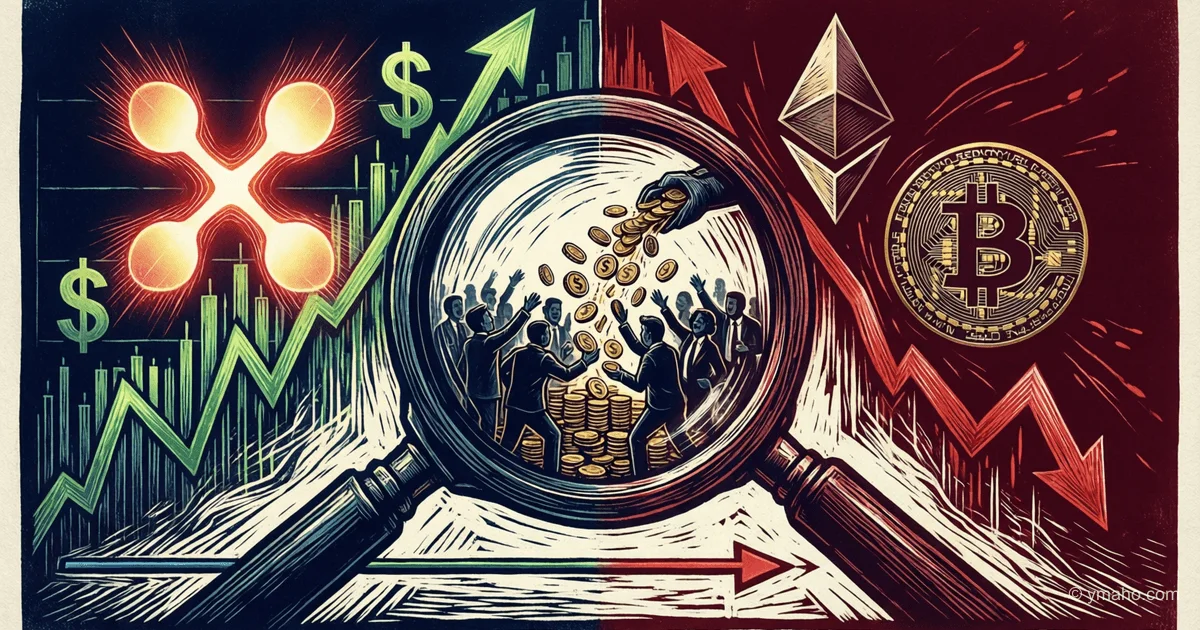
XRP Funds Grow Amid Outflows from Bitcoin and Ether ETFs
CoinDesk analysts note a capital shift: while investors withdraw money from the largest crypto funds, XRP-linked products show steady inflows for the eighth consecutive session. This occurs as the market seeks new growth drivers after the recent correction.
XRP-ETF: $42 Million In, Price Out
Retail has been pouring money into XRP for eight straight sessions. Institutions are exiting Bitcoin and Ether. But XRP is stuck. The divergence between flows and price has reached absurdity. What does the market see that we don't?
[The Gist]: What's Really Happening
The official narrative: "investors are rotating from Bitcoin to XRP." The numbers look good: XRP-ETFs attracted $42 million in a week, while Bitcoin-ETFs lost $1.4 billion. ETH-ETFs saw a $209 million outflow.
But dig deeper, and the story falls apart.
First, the scale. $42 million vs. $1.4 billion is a 1:33 ratio. There's no "rotation." This isn't capital leaving BTC for XRP. It's capital leaving the crypto market as a whole, with XRP simply falling slower.
Second, the nature of inflows. 84% of XRP-ETF inflows come from retail investors, not institutions. Large asset managers barely touch XRP—they're waiting for the CLARITY Act to pass, which will define the asset's regulatory status.
"Insider view": what we're seeing isn't rotation, but a retail safe haven. Investors who can't (or won't) exit crypto entirely are shifting into XRP because it:
- Is listed in ETFs (legal for US accounts)
- Has lower correlation with NASDAQ than Bitcoin
- Has a specific use case (cross-border payments)
But the key point is that retail isn't buying XRP. Retail is buying the story that "smart money" is buying XRP. This is a self-sustaining narrative that fuels inflows but doesn't move the price.
Timeline and Context
May 14, 2026 — peak inflows into XRP-ETFs: $18.52 million in a single day. On the same day, the Senate Banking Committee advanced the CLARITY Act with a 15-9 vote.
May 15, 2026 — another $10.87 million.
May 16-22, 2026 — inflows slow: $8.88 million in the last session. Total for the week: about $42 million. Alternative data for the week before May 16 shows even $60.5 million—a 2026 record.
May 20, 2026 — the XRP network recorded the creation of 4,300 new wallets in 24 hours—the fourth-largest spike in 2026. Daily active addresses rose from about 32,000 to 43,520.
May 23, 2026 — XRP trades around $1.31-$1.37, down 7.2% over seven days. Inflows continue, price falls.
May 27, 2026 — the XRPL Foundation will launch the fixCleanup3_1_3 ledger update with improvements for NFTs, vaults, and lending protocols.
Market backdrop:
- Bitcoin fell below $75,000 for the first time since April.
- Institutional investors on Binance are reducing XRP positions.
- XRP's 365-day MVRV is around -35% (average holder at a loss).
Who Wins and Who Loses
Winners: retail investors who got in early. 84% of inflows are retail. Those who bought XRP in April-May are roughly breakeven or slightly up. But that's not a "win"—it's survival.
Winners: XRP-ETF issuers. Seven funds now manage $1.15-$1.39 billion in assets, holding nearly 898 million XRP tokens in custody. That's about 1.34% of total supply. Fees accrue regardless of price.
Winners: market makers, who profit from volatility and spreads when retail panics or FOMOs.
Losers: Bitcoin and Ether holders. They've locked in losses—especially those who entered ETFs in April-May 2026. Bitcoin lost 4.8% in a week.
Losers: "patient" XRP holders who waited for a rally that never came. ETF inflows are there, on-chain activity is rising, but the price is flat. Their opportunity costs are mounting.
Losers: institutions that stayed on the sidelines. They missed potential upside if the CLARITY Act passes. But they also didn't lose money on the current consolidation.
Paradoxically, XRP-ETFs with $42 million in inflows show worse performance than Bitcoin-ETFs with outflows. Bitcoin fell 4.8% in a week, XRP fell 7.2%. Money comes in, price drops. That's a classic sign that sellers are more active than buyers—despite all the headlines.
What the Media Isn't Saying
Non-obvious insight #1: Inflows into XRP-ETFs don't lead to price increases because 84% of those inflows are retail, and retail doesn't move the market.
84% is a figure Bloomberg Intelligence published based on cumulative data. What does it mean? Institutions (pension funds, hedge funds, asset managers) are barely participating. They're waiting for the CLARITY Act.
Retail, on the other hand, consists of thousands of small purchases. They create a "floor" under the price but can't break through resistance. Resistance at $1.45-$1.46 is defended by a "sell wall" of about 1.16 billion tokens.
Until institutions enter (and they will only after a regulatory signal), XRP will remain range-bound. $42 million in retail money is a drop in the ocean compared to the volumes needed to break $1.46.
Non-obvious insight #2: MVRV at -35% is not an "opportunity"—it's a "trap for altcoins in a bear market."
Santiment reports that XRP's 365-day MVRV is around -35%. That means the average holder who bought XRP a year ago is down by a third. The 30-day MVRV is around -3%.
In theory, a low MVRV is a buy signal ("blood in the streets"). In practice, in 2026, it works differently.
Why? Because the overall trend for altcoins is bearish. Bitcoin dominates, altcoin share is falling. A low MVRV in such an environment means not a "bottom" but a "prolonged consolidation with risk of further decline." Altcoins can stay in the red for months without showing signs of reversal.
"Blood in the streets" is a good signal when the market is generally bullish. Right now, the market is generally bearish (risk aversion, geopolitics, high rates). In such an environment, a low MVRV is the norm, not an anomaly.
Non-obvious insight #3: The technical "falling wedge" pattern and SuperTrend at $1.3296 are a bull trap.
Analysts see a "falling wedge" on XRP's chart and talk about upside potential. But the SuperTrend has turned bearish at $1.3296. All four exponential moving averages (EMAs) are above the current price.
A wedge is a pattern that only works with a breakout confirmation. Without a breakout, it's just consolidation in a downtrend.
Where is XRP now? Squeezed between support at $1.32-$1.34 and resistance at $1.40-$1.46. A break below $1.32 opens the path to $1.25. A break above $1.46 gives a chance to rise toward $1.55.
Without a breakout, XRP is in "limbo," which could last for weeks.
Forecast: Next 30 Days and 90 Days
Next 30 days (until June 24, 2026): Key date is May 27, 2026, when the XRPL Foundation launches the ledger update. The update adds lending features, NFT improvements, and vault enhancements.
If the update goes smoothly and draws attention to technical improvements, XRP might attempt to break $1.40. But a serious breakout above $1.46 is unlikely without CLARITY Act news.
Base case: XRP stays in the $1.30-$1.45 range. Volatility will be high, but no directional move. ETF inflows will continue steadily, but at $5-10 million per day, not $18 million. Retail will tire of waiting for "the moon" and start locking in losses or rotating into other assets.
Risk: If Bitcoin breaks support at $74,000 (and it's already at $74,617 as of May 23), XRP could follow to $1.20-$1.25, despite ETF inflows. XRP's correlation with Bitcoin is 0.75-0.84, and it can't be ignored.
Next 90 days (until August 24, 2026): Everything hinges on the CLARITY Act. The bill passed committee; now it needs full Senate votes.
Scenario A (CLARITY Act passes, 50-60% probability): Standard Chartered forecasts XRP at $8 by year-end. That's an optimistic scenario, but it takes time. In the first 30-60 days after passage, we'll see institutional capital inflows, and XRP could rise to $1.80-$2.50.
Scenario B (CLARITY Act stalls in Senate until fall): XRP stays in the $1.20-$1.60 range. ETF inflows slow (retail gets tired of waiting). The asset will trade as a "disappointed altcoin," losing market share to Solana or other alternatives.
Scenario C (bill rejected, 10-15% probability): Sharp drop in XRP to $0.80-$1.00. Liquidation of long positions. ETF inflows turn to outflows. This is unlikely but catastrophic.
My forecast: Over the next 90 days, XRP will move in a $1.25-$1.80 corridor. A breakout above $1.80 is only possible after a clear signal on the CLARITY Act. Until then, any rally is a short squeeze, not a new trend.
Editorial Forecast
- Asset: XRP / Direction: Sideways with a bias toward the lower bound in the next 48-72 hours.
- Key levels: Resistance — $1.40 (unbroken for weeks). Support — $1.32-$1.34. A break below $1.32 opens the path to $1.25. Ceiling under any positive catalyst — $1.46.
- Confidence level: Medium.
- Main risk to forecast: An unexpected announcement of progress on the CLARITY Act (or rumors of a Senate vote date) could trigger a sharp "pump" above $1.45 within hours, breaking the current technical picture. Also, the XRPL update on May 27 — if the market interprets it as a "bullish narrative" (decentralized lending on XRP), it could provide short-term momentum regardless of fundamental factors.
— Editorial Team









