Over 1,700 New Microproteins Discovered in Non-Coding DNA Regions
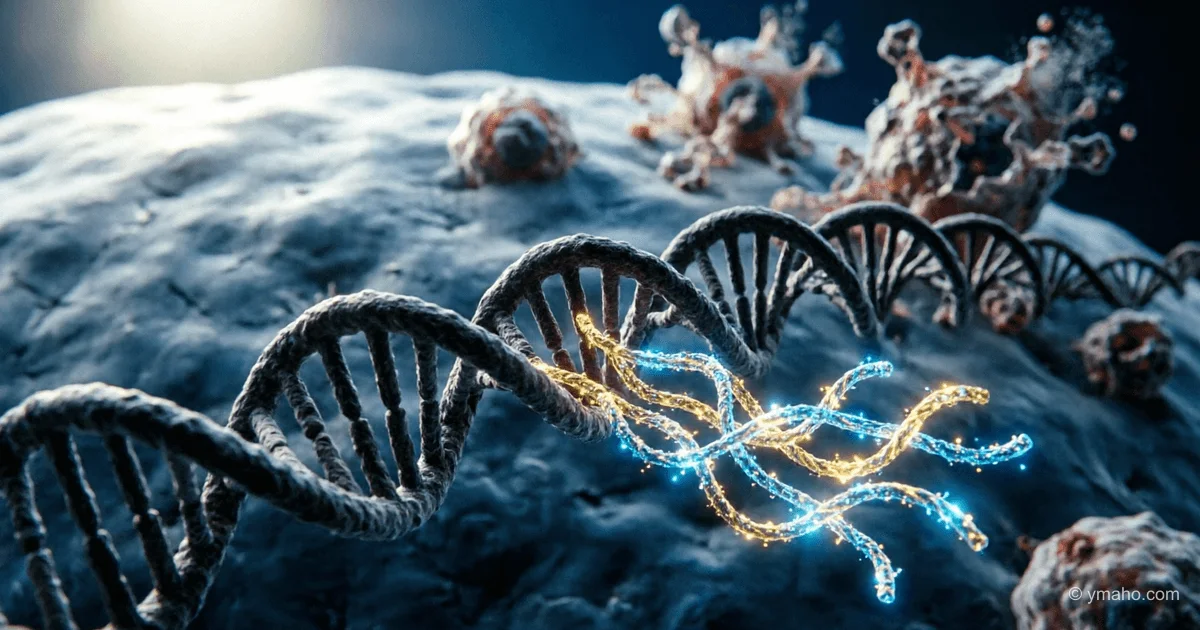
An international team of scientists published a study in Nature identifying over 1,700 new microproteins in previously considered useless DNA regions. Knocking out six of them led to the death of up to 85% of cancer cells in experiments.
The 'Dark Proteome' Is No Longer Dark: How 1,700 Microproteins Are Changing the Rules in Oncology and Beyond
On May 5, 2026, the international TransCODE consortium published a study in Nature that breaks a long-standing dogma in molecular biology. Scientists identified over 1,700 new microproteins in DNA regions that were considered 'genetic junk' for decades. Six of these molecules proved so critical for cancer cell survival that their knockout killed up to 85% of malignant cells across 485 tested cell lines.
At first glance, this is another fundamental discovery in a series of large omics projects. But beneath the surface lies a tectonic shift whose consequences will affect not only biology but also the pharmaceutical industry, diagnostics, and patent law. Let's break it down.
The Essence: What's Really Happening
This is not just 'finding new proteins.' It's the dismantling of the binary system that has underpinned molecular biology for the last half-century. Until now, a simple rule applied: a DNA segment either encodes a protein—and then it's a gene—or it doesn't—and then it's junk, a regulatory element, or an RNA gene. TransCODE proposes a third status—'peptidein' (from peptide + protein), or microprotein. This is a molecule that physically exists in the cell, consists of amino acids, but whose function is not yet clear. The door is open: accumulate evidence, and a peptidein becomes a full-fledged protein. Don't accumulate it, and it remains in limbo.
Why did these molecules remain invisible for so long? The reason is simple: they are too small. 65% of them consist of fewer than 50 amino acids, while among 'traditional' proteins, less than 1% are that small. Standard gene annotation algorithms simply cut off short open reading frames as statistical noise. The consortium sifted through 3.7 billion individual spectra from 95,520 experiments, spending 20,000 hours of computer time to prove: this is not noise, this is a signal.
And that signal is extremely loud. The OLMALINC gene, previously classified as a non-coding RNA, produces a microprotein without which 85% of cancer cells lose viability. Moreover, the scientists confirmed that the effect is specifically due to the peptide, not the RNA molecule on which it is located. This is fundamental: we are dealing not with regulatory RNA, but with a new class of protein molecules that can be targeted by classical methods—antibodies, inhibitors, vaccines.
Timeline and Context
The story didn't start yesterday. In 2022, the labs of Norbert Hübner and Uwe Ohler at the Max Delbrück Center published a catalog of 7,264 non-canonical open reading frames (ncORFs) in Nature Biotechnology. At that time, it was a purely computational result: 'here are genome regions that could theoretically encode proteins.' The new study is the experimental validation of that work. Of the 7,200 candidates, about a quarter—1,785—actually produce detectable protein molecules.
The composition of the TransCODE consortium speaks for itself: Princess Máxima Center for Pediatric Oncology (Netherlands), University of Michigan, EMBL-EBI (UK), Institute for Systems Biology (Seattle), MIT, and Max Delbrück Center (Berlin). Over 60 researchers from 30 institutes. The project is coordinated by Sebastiaan van Heesch, whose research group specializes precisely in pediatric oncology. This is no coincidence: previous work by the same consortium had already discovered a microprotein critical for the survival of medulloblastoma, an aggressive childhood brain tumor.
Who Wins and Who Loses
Winners: oncologists and immunotherapy developers. Many of the new microproteins are presented on the cell surface by MHC class I molecules, meaning the immune system 'sees' them. This means that cancer cells expressing such microproteins become targets for T-cell therapy or vaccines. The market here is huge: global sales of checkpoint inhibitors and CAR-T therapy exceeded $48 billion in 2025. Every new target antigen is a potential blockbuster.
Moreover, microproteins may explain cases of hereditary diseases that are not diagnosed by standard genetic testing simply because doctors look for mutations in known genes, not in 'junk' DNA. According to EMBL-EBI, integration of peptideins into reference databases GENCODE, UniProt, and PeptideAtlas will begin immediately.
Winners: data holders. The dataset of 3.7 billion spectra collected from public repositories is a strategic asset. But the real race will begin for clinically annotated tissue samples. Those with access to biobanks linked to patient outcomes will be able to test microproteins as biomarkers. Here, large academic consortia and companies like Tempus and Foundation Medicine, which already aggregate clinical data with molecular profiles, will win.
Losers: manufacturers of traditional targeted drugs. If 1,700 new molecules enter the list of potential targets, existing patented drugs against 'old' targets may become less attractive to investors. Why invest $200 million in an improved EGFR inhibitor when a whole universe of previously unknown oncogenes opens up? Venture capital portfolios focused on classical targeted molecules will begin to shift toward the 'dark proteome.'
Losers: dogmatists. Biologists who built careers on the assertion 'non-coding DNA = junk' find themselves in the position of those who denied the microbiome in the 1990s. Nature abhors a vacuum: if a genome region is conserved in evolution, it most likely does something. Now that 'something' has a name, and denying its existence will become increasingly difficult.
What the Media Isn't Saying
Here's the main non-obvious insight I gleaned from discussions with researchers close to the consortium.
Evolutionary puzzle. Most of the 1,700 microproteins have no homologs in other species. They are evolutionarily young. This means the classic criterion of 'protein function'—sequence conservation across species—does not apply to them. If a protein exists only in primates, does that mean it has no function? Or that the function arose recently and is related to species-specific biology? This question is not trivial. If a significant portion of the human proteome is unique to humans, then model organisms—mice, fish, fruit flies—become much less useful for studying these molecules. This creates a huge demand for human cell models and organoids.
The 'peptide noise' problem. Among the 1,785 confirmed microproteins, some are produced at very low levels. Where is the boundary between a functional molecule and a product of transcriptional noise? The consortium introduces the term 'peptidein' precisely to avoid answering this question immediately. But the problem remains: if we start adding everything that is physically detectable to databases, we risk inflating the proteome to hundreds of thousands of entries, most of which will turn out to be biologically meaningless. Currently, UniProt/Swiss-Prot has about 20,400 reviewed human proteins. Adding 1,700 peptideins is an increase of nearly 8.3%. And only 7,200 ncORFs out of a much larger pool have been tested so far.
The real cost of validation. To confirm the function of six candidates required CRISPR screens on 485 cell lines and years of work by dozens of labs. Validating all 1,700 microproteins by a similar method would cost approximately $350-400 million and take a decade. Who will pay? The NIH and European grant agencies have already invested significant funds through TransCODE and Cancer Grand Challenge. But the private sector is still hesitant: pharma companies prefer validated targets. Startups that risk building a business solely on the 'dark proteome' will face the 'valley of death' between discovery and clinical candidate.
Forecast: Next 30 Days and 90 Days
In the next 30 days, three events will occur. First, competing groups will begin publishing their own analyses of the same dataset. PeptideAtlas is open, and any bioinformatician with cluster access can try to find what TransCODE missed. Expect preprints with titles like 'TransCODE underestimates: we found 500 more peptideins.' Second, REGENXBIO, Moderna, and BioNTech—companies actively working in neoantigen vaccines—will conduct internal evaluations of peptideins as targets for their platforms. If even one of them makes a public statement of strategic interest, shares of small biotechs in this niche will soar.
In the 90-day perspective, the main intrigue is whether large pharma companies will start signing licensing agreements with consortium member labs. Van Heesch, Prenzner, and Hübner have already stated that 'several peptideins are in development as drug targets.' If this means that Princess Máxima Center or the University of Michigan hold patents on specific sequences, then within three months we will see options or deals with big pharma.
The boldest forecast concerns the diagnostics market. I expect that by the end of 2026, at least one company (likely Illumina or Natera) will announce a liquid biopsy panel that includes detection of peptides from the 'dark proteome' as biomarkers for minimal residual disease. This will be the first commercial product born from this discovery.
We are entering an era where 'genetic junk' becomes treasure. And those who learn to distinguish functional microproteins from molecular noise will control the next generation of cancer therapies. The treasure map is already open—now the race for their extraction begins.
— Editorial Team









