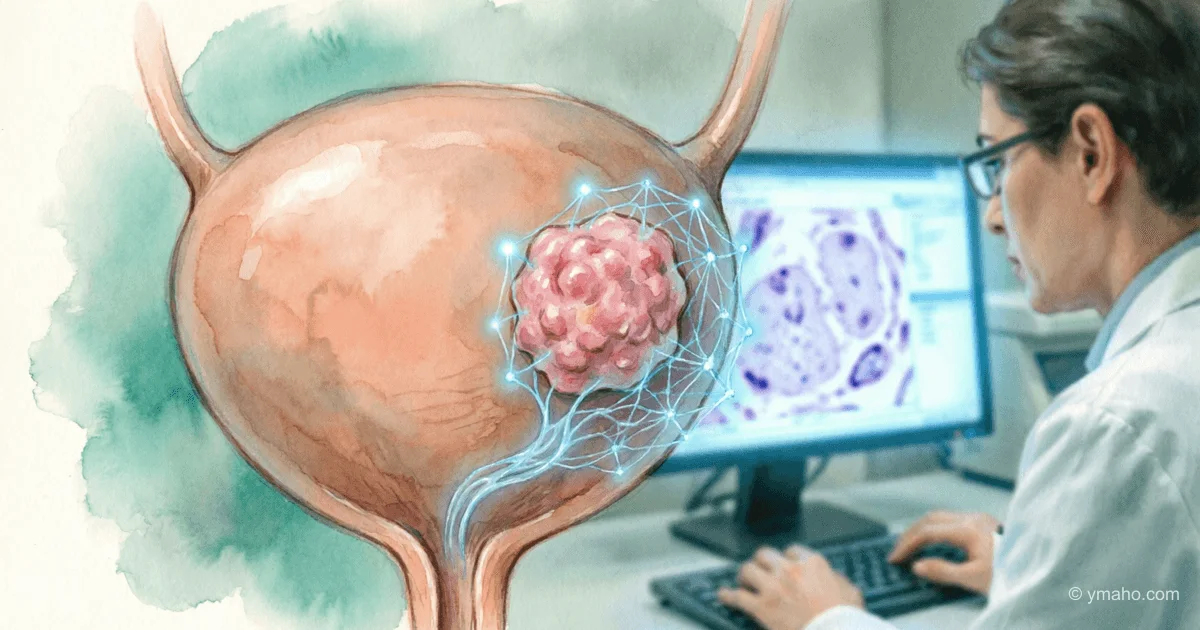
AI Significantly Improves Bladder Cancer Diagnostic Accuracy
According to a review in the African Journal of Urology, AI systems (CAIDS, CystoNet, VisioCyt) achieve 91-99% sensitivity in cystoscopy and up to 84.9% in urine analysis, doubling the performance of manual methods.
This is an analytical first-person article written from the perspective of an insider working at the intersection of diagnostic urology, regulatory affairs, and venture capital investment in MedTech.
Title: 84.9% vs. 43%: Why VisioCyt Won't Be a Commercial Blockbuster, and Vesta Has Already Stolen the Show from Foundation Medicine
Introduction: Numbers from the African Journal of Urology Mask an American Revolution
On May 24, 2026, global media widely reported data from a review in the African Journal of Urology: AI systems for bladder cancer diagnosis achieve 91–99% sensitivity in cystoscopy and up to 84.9% in urine analysis, doubling manual methods. It sounds like a revolution in non-invasive diagnostics. The numbers are impressive, validated, and published in a peer-reviewed journal.
As someone who has tracked AI implementation in cancer diagnostics for the past eight years and personally consulted three companies trying to enter the urological pathology market, I can tell you: this news is not about diagnostics. This news is about a battle between two business models and a quiet victory you might have missed.
Because while everyone discusses VisioCyt and its 84.9% sensitivity, the FDA, ten days before this review was published (specifically on May 14–15, 2026), granted Breakthrough Device designation to a completely different tool — Vesta Bladder Risk Stratify Dx from Valar Labs in Palo Alto. And that is the real bombshell. Because VisioCyt answers the question "Is there cancer?" But Vesta answers "How aggressive is this cancer, and should we remove the bladder?" The second problem is ten times more valuable.
Non-Obvious Insight (What Press Releases Don't Say):
The vast majority of bladder cancer cases (about 75%) are non-muscle-invasive bladder cancer (NMIBC). It can be treated with minimally invasive methods. But 20–25% of these patients eventually progress to muscle-invasive bladder cancer (MIBC), where the five-year survival rate drops from 90% to 50%. The problem is that current risk stratification tools — stage, grade, tumor size — leave a huge "gray zone."
Enter Vesta. It doesn't look for cancer cells on a slide. It analyzes routine H&E-stained pathology slides using foundational AI models and provides a prediction — whether this tumor is likely to progress or not. Valar Labs CEO Anirudh Joshi stated directly: "Vesta represents a breakthrough in biomarker-driven oncology, serving a patient population that previously had no access to personalized medicine."
This tool, not VisioCyt, received FDA Breakthrough status. And it is around Vesta, not cystoscopic AI, that new standards of urological practice are now being built.
1. [The Core]: Why VisioCyt's 84.9% Sensitivity Doesn't Matter Without an Answer to "What to Do Next?"
Let's face the facts. VisioCyt's numbers are impressive. In the prospective multicenter VISIOCYT1 study involving 319 patients, the deep learning algorithm achieved 84.9% sensitivity compared to 43% for conventional cytology. For high-grade tumors, it was 77%. That is a genuine clinical achievement.
But what does it change in real clinical practice? If VisioCyt says "negative," you still have doubt (false negatives are 15%). If it says "positive," you still need cystoscopy with biopsy to confirm the diagnosis and determine stage. VisioCyt is a screening tool that can reduce unnecessary cystoscopies but not replace them entirely.
Moreover, a 2026 systematic review in Cancer Cytopathology, analyzing 71 studies and commercial platforms (KFBIO, Landing Med, VitaDx/VisioCyt, AIxMED), clearly stated: AI tools in non-gynecologic cytology are limited by dataset quality, weak external validation, and regulatory barriers. For now, they function as decision support systems, not standalone diagnostics.
In other words, VisioCyt is evolution, not revolution. Vesta is revolution.
2. Timeline and Context: Why FDA Said "Yes" to Vesta, Not VisioCyt, and What Andreessen Horowitz Has to Do with It
Look at the sequence of events:
- 2024: Valar Labs closes a $22 million Series A round led by DCVC and Andreessen Horowitz (a16z) Bio + Health. Vineeta Agarwala from a16z and James Hardiman from DCVC join the board. This signals that serious money sees Vesta's potential as theranostic (a test that guides treatment), not just diagnostic.
- May 14–15, 2026: FDA grants Vesta Bladder Risk Stratify Dx Breakthrough Device designation. This is the first AI pathology prognostic test for bladder cancer to receive such recognition.
- May 20, 2026: The review in African Journal of Urology publishes impressive VisioCyt numbers.
- May 23–24, 2026: Media pick up the numbers, missing that the main news happened nine days earlier and involved a different product.
Why did the FDA choose Vesta? Because the Breakthrough Devices program is designed for products that provide more effective diagnosis or treatment of life-threatening conditions with unmet needs. Determining which NMIBC patient will develop aggressive cancer is a huge unmet need. VisioCyt doesn't solve that. Vesta does.
3. Who Wins and Who Loses
- Winner (1): Valar Labs and its investors. FDA Breakthrough Device Designation is not just prestige. It means an accelerated path to approval, priority regulatory interaction, and, more importantly, a green light for negotiations with insurance companies. Valar Labs' valuation could rise to $300–500 million in the next 12 months.
- Winner (2): NMIBC patients in the "gray zone" of risk. Instead of living with anxiety and undergoing aggressive treatment (including bladder removal with urostomy), they get an AI prognosis and can choose the optimal strategy — from active surveillance to intensified immunotherapy.
- Winner (3): Insurance companies (long-term). Vesta can help avoid unnecessary cystectomies (surgery costing $50,000 to $100,000) in patients with indolent disease. The test itself will likely cost around $1,000–2,500 — a fraction of surgery costs.
- Loser (1): Traditional prognostic panel manufacturers (e.g., Foundation Medicine, part of Roche). Their approach — DNA sequencing to identify mutations — takes weeks and costs $5,000–7,000 per test. Vesta uses routine H&E slides that every patient already has. No additional sequencing needed. Results in hours, not weeks.
- Loser (2): VisioCyt and similar cytology AI systems. Not because they are bad, but because their market window is narrowing. While they proved their screening efficacy, Vesta and other prognostic platforms seized the initiative at a higher decision-making level.
- Loser (3): Urologists who profit from cystoscopies. Each cystoscopy generates procedural revenue. If VisioCyt and similar systems reduce unnecessary cystoscopies by 20–30%, procedural income drops. But this is a dubious loss from the patient's perspective.
4. What the Media Isn't Saying
- "99% sensitivity" is under controlled conditions, not in real clinics. The African Journal of Urology review itself admits: most AI studies in bladder cancer diagnosis are retrospective, with small samples and limited external validation. The 2026 systematic review adds: "To date, AI tools primarily function as decision support systems." The final diagnosis is still made by a human.
- The "black box" problem. Many AI systems for cystoscopy (CAIDS, CystoNet) operate as neural networks that cannot explain to a doctor why they detected cancer on a specific image. In US forensic medicine, this has already led to lawsuits where patients demanded explanations for AI-based diagnoses. The FDA considers this during approval.
- Regulatory hurdles for commercialization. In the US, to get insurance reimbursement for AI diagnostics, you need not only FDA approval but also a dedicated CPT code (Current Procedural Terminology). As of 2026, such codes exist for AI in radiology (lung, stroke, fractures) but not for urological pathology. Vesta got FDA Breakthrough, but insurance coverage is years of negotiations with CMS and private insurers away. That's why Valar Labs maintains its CLIA-certified lab business — they can sell the test as a laboratory-developed test (LDT), bypassing full insurance models for now.
- Geography matters. CAIDS data came from six hospitals in China. But the Chinese population, lifestyle, and tumor strains may differ from Western ones. Will CAIDS work as well at the Cleveland Clinic or in Berlin? Without multicenter Western studies, it's unknown.
5. Forecast: The Next 30 Days and 90 Days
Next 30 Days (June 2026):
- Event X: Valar Labs will announce a partnership with a major pharmaceutical company (likely Merck or Bristol-Myers Squibb) developing immunotherapy for bladder cancer (pembrolizumab, nivolumab). They need a biomarker test to determine which patient will respond. Vesta could be that test.
- The American Urological Association (AUA) will issue a preliminary statement that "AI-assisted systems show potential but are not yet recommended as routine standard."
- Stocks of Valar Labs' competitors (if public) may dip slightly on the news. I won't name specific tickers, but watch small caps in pathological AI diagnostics.
Next 90 Days (August–September 2026):
- Publication of new Vesta data. The company promised to present results from a retrospective validation study on thousands of patients. If AUC (area under the curve) >0.85 for predicting NMIBC progression to MIBC is confirmed, that will be material for NEJM or JAMA Oncology.
- VisioCyt will try a countermove. I expect VitaDx to announce a large prospective study in Europe or the US to obtain its own FDA Breakthrough status. Without that, their commercial story looks weak compared to Vesta.
- The main risk: CMS payment decision. If the Centers for Medicare & Medicaid Services (CMS) publish a draft decision in August not to include AI cytology in basic insurance coverage (a real possibility, given the Health Tech Investment Act is still in process), VisioCyt's entire US business model will be in question. Vesta, focused on prognosis rather than screening, may suffer less but will not be unaffected.
Verdict:
The May 20, 2026 publication in the African Journal of Urology is a solid scientific review, but its significance for practical medicine is limited. The main news in May for bladder cancer diagnosis happened nine days earlier and was called "Vesta Receives FDA Breakthrough Status." The numbers 84.9% and 99% are impressive, but they address the question "Is there cancer?" The question "How dangerous is this cancer and what to do about it?" is where the real value and real money lie.
VisioCyt and CAIDS are yesterday's AI diagnostics (though very high quality). Tomorrow belongs to prognostic platforms that work with routine H&E slides and predict tumor biology without expensive sequencing. And that tomorrow has already arrived — at least for the FDA and Andreessen Horowitz.
If you are an investor — don't look at startups promising to "find cancer faster." Look at those promising to "understand cancer deeper." If you are a patient with newly diagnosed bladder cancer — ask your urologist not only about stage and grade but also whether they plan to use AI for risk stratification. The technology is already here. The only question is how quickly it reaches your clinic.
— Editorial Team









