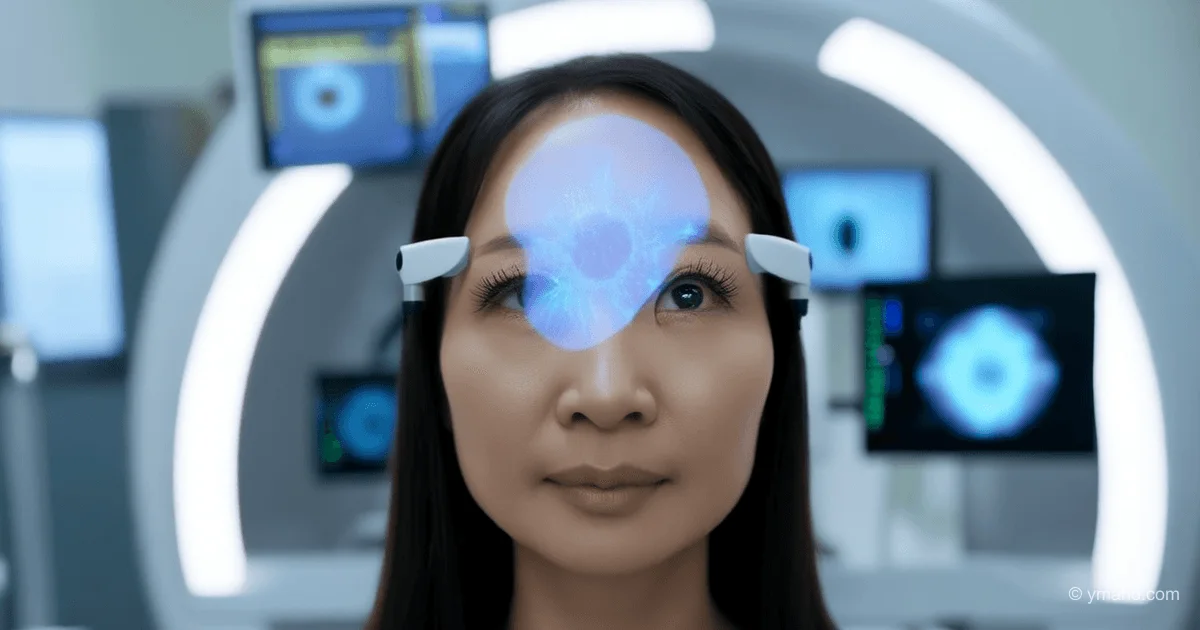
AI Eye Scanner Developed in Qatar for Early Diagnosis of Dementia and Parkinson's Disease
Corneal confocal microscopy (CCM) technology with AI analysis detects nerve damage in the eye that correlates with neurodegenerative changes in the brain. The scan takes minutes and can predict diseases years before symptoms appear.
The eye as a window to the dying brain: why Rayaz Malik's scanner is the final blow to lumbar puncture
The essence: what is really happening
Professor Rayaz Malik from Weill Cornell Medicine – Qatar has officially presented CCM (Corneal Confocal Microscopy) technology with integrated AI, which diagnoses dementia, Parkinson's disease, multiple sclerosis, and even autism from a corneal image – in minutes and without a single puncture. The media present this as a "convenient diagnostic tool of the future." That is a half-truth. The real tectonic shift is elsewhere: Malik has stated for the first time that AI can distinguish specific diseases based on the pattern of corneal nerve damage, rather than just detecting "neurodegeneration yes or no." This is a transition from a non-specific biomarker to differential diagnosis – and that changes everything.
The development is backed by 25 years of work and 591 peer-reviewed publications. Malik is a global figure: h-index 107, ranked third in the world for diabetic and peripheral neuropathy by ScholarGPS 2025. When such a person says the technology is ready for prime time, it is not startup hype. It is a signal that the scientific foundation has reached critical mass.
Timeline and context
CCM as a method for imaging corneal nerves has existed for decades – ophthalmologists have used it to diagnose corneal diseases. The idea of looking through the cornea into the brain is based on a simple fact: corneal nerves are the most accessible part of the peripheral nervous system for observation, and their damage correlates with degeneration in the central nervous system.
1980s–2000s – technology exists as an ophthalmological tool.
2008–2014 – Malik, working at the University of Manchester, begins systematically investigating CCM as a biomarker for neurodegeneration.
2014 – move to Weill Cornell Medicine – Qatar. The location change is critical: Qatar is willing to invest billions in biotech to buy scientific power status.
2023–2025 – Research.com ranks Malik first in medicine in Qatar. ScholarGPS in 2024 ranks him third in the world for diabetic neuropathy.
2025, July – submission of a systematic review by Oreskovic et al. to the British Journal of Ophthalmology.
2026, January 28 – publication of the review: 50 studies, including 13 on Parkinson's, 11 on multiple sclerosis, 3 on Alzheimer's. The main metrics – CNFL (Corneal Nerve Fiber Length) and CNFD (Corneal Nerve Fiber Density) – are consistently reduced in most neurodegenerative diseases.
2026, May 13 – Al Jazeera interview and press release: Malik publicly states for the first time that AI can distinguish dementia from diabetic neuropathy and autism based on corneal nerves.
Who wins and who loses
Winners.
Weill Cornell Medicine – Qatar and personally Rayaz Malik. He gains the status of the person who pushed CCM from an academic niche to mainstream diagnostics. The patent portfolio for the AI algorithm is held by Weill Cornell. Commercialization involves licensing to global networks of ophthalmology clinics – each of which already has ophthalmological equipment. No capital expenditure on a new fleet of devices.
The State of Qatar. The technology is named Noor Ai-Ain – "Light of the Eye." This is not a medical term; it is cultural branding. Qatar gets a flagship scientific product that can be presented as proof of return on investment in R&D.
Patients with suspected neurodegeneration. Today, the diagnostic pathway for suspected Alzheimer's disease involves a lumbar puncture (cerebrospinal fluid for biomarkers) or expensive PET imaging (about $5,000 per scan). CCM takes minutes and causes no discomfort.
Healthcare systems with limited budgets. CCM uses existing ophthalmological equipment. For a country like India or Indonesia, this means neurological screening can be deployed in ophthalmology offices without billion-dollar investments in scanners.
Losers.
Manufacturers of radiopharmaceuticals for PET diagnosis of Alzheimer's (Amyvid, Vizamyl, Neuraceq). Each dose costs thousands of USD. If CCM becomes a first-line screening tool, the need for PET will be reduced to cases with ambiguous results.
Private MRI centers. A significant share of MRI scans today are ordered to rule out neurodegenerative causes of cognitive impairment. CCM will not replace MRI, but it could take the position of a primary filter – meaning a loss of patient flow.
Old-school neurologists. Malik's technology shifts primary diagnosis of neurodegeneration either to the ophthalmologist or to an automated AI assistant. This is a decentralization of neurological diagnosis, and it will face resistance from the professional community.
What the media are not saying
Insight #1: The systematic review in the British Journal of Ophthalmology revealed a problem that no one discusses publicly – the evidence base for CCM in Alzheimer's disease is still weak.
50 studies included in the review. Parkinson's – 13. Multiple sclerosis – 11. Strokes – 7. Post-COVID neuropathy – 5. ALS – 4. Alzheimer's – only 3. Three studies. This is not a mistake; it is the real state of affairs: CCM shows good results for diseases with pronounced peripheral neuropathy, but for purely central neurodegeneration, evidence is still scarce.
Malik knows this – and that is precisely why AI differentiation between diseases becomes his main bet. If there were enough data on Alzheimer's, the headlines would sound different. For now, the technology is strongest for Parkinson's.
Insight #2: Malik is targeting not the clinical market, but FDA qualification as a surrogate endpoint for clinical trials.
In his own abstract for a recent presentation, it is stated directly: "The case for CCM is sufficiently compelling to argue for its inclusion as a Food and Drug Administration endpoint in clinical trials of peripheral and central neurodegenerative diseases."
This is a key pivot. Malik is not building a business selling scanners to ophthalmologists. He is building a tool for pharmaceutical companies that need objective, fast, and reproducible endpoints for clinical trials. Biogen, Eisai, Roche are pouring billions into developing Alzheimer's therapies and desperately need biomarkers that can show treatment efficacy in months, not years of follow-up. CCM with AI quantitative assessment of corneal nerve regeneration is an ideal candidate for this role.
Insight #3: The technology uses existing equipment – and that radically changes the economics of adoption.
Unlike PET scanners costing $2–3 million or MRI machines costing $1–1.5 million, a confocal microscope already sits in any major ophthalmology clinic. The hardware cost of implementing CCM as a diagnostic tool is zero. Only software and training are needed. This is what Malik means when he says CCM "can be done in the clinic." This means scaling the technology could happen not in a decade, but in 2–3 years.
Forecast: next 30 days and 90 days
Days 1–30 (mid-May to mid-June 2026):
The Al Jazeera interview will trigger a cascade of requests from major media. CNN Health, BBC Medical, possibly a Nature News & Views piece. Malik will become a globally recognized figure outside the medical community.
Weill Cornell Medicine – Qatar will initiate negotiations with ophthalmological equipment manufacturers (Carl Zeiss Meditec, Heidelberg Engineering) about pre-installing the AI module on new confocal microscope models. The deal price – likely royalties in the range of 5–10% of the device cost.
Competitors – primarily groups working on retinal imaging for Alzheimer's diagnosis (NeuroVision, Optina Diagnostics) – will issue their own press releases, emphasizing that their technology directly visualizes the retina as an extension of the CNS, not corneal nerves.
Days 31–90 (June – August 2026):
A preprint will appear with independent validation of Malik's AI algorithm on an external dataset – likely from a group at Moorfields Eye Hospital (London), with whom Malik has already collaborated (Axel Petzold and Scott Hau are co-authors of the January review).
The FDA will receive an application for Breakthrough Device Designation. Given that CCM in Malik's hands already has 25 years of evidence base and a review of 50 studies, the path to approval in the US is shorter than for most AI devices.
Pharmaceutical companies conducting clinical trials for Parkinson's disease therapies (Cerevel, Annovis Bio) will request pilot protocols including CCM as a secondary endpoint. If CCM shows sensitivity to therapeutic effect faster than clinical scales, the technology's value will skyrocket.
An international consortium for standardizing CCM protocols will be announced. The lack of standardization is the main criticism of the systematic review. Without it, the FDA cannot approve CCM as a registration endpoint. Malik, as the leading global expert, will lead this effort.
Historical parallel: in the 1980s, measuring intraocular pressure for glaucoma diagnosis was a niche procedure. Today, a tonometer sits in every ophthalmology office. CCM with AI is on the same trajectory – from research tool to routine screening. The difference is this: glaucoma threatens vision. Neurodegeneration threatens personhood. And if Malik is right, in ten years a visit to the ophthalmologist will tell you not only about your eye health, but also about what is happening deep in your brain. Noor Ai-Ain – Light of the Eye – the name is chosen accurately.
— Editorial Team









