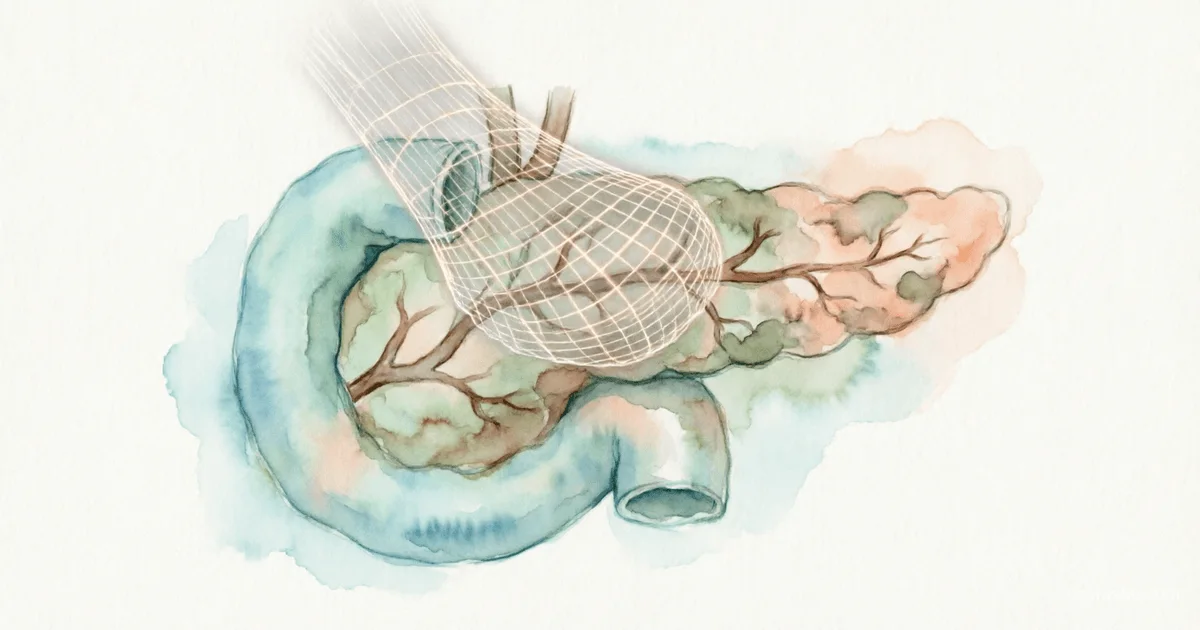
Mayo Clinic AI Model Triples Early Detection of Pancreatic Cancer
The REDMOD model, developed by Mayo Clinic and described in the journal Gut, detects tumor signs invisible to radiologists on CT scans up to 475 days before standard diagnosis. The technology boosts detection sensitivity to 73% and has already launched its first clinical trial in the US.
Mayo Clinic's development of the REDMOD model is not just another "AI that sees cancer before the doctor." It is the first validated system that shifts pancreatic cancer from a "late-diagnosed death sentence" to a disease amenable to screening on routine equipment already installed in thousands of clinics. While headlines focus on the "doubling of sensitivity" numbers, the real shift is at the level of the diagnostic business model: the model requires no new equipment, special scanning protocols, or manual annotation—it automatically analyzes standard abdominal CT scans.
The Core: Not Tumor Detection, but Interception at the "Zero Phenotype" Stage
Formally, the work was published on April 28, 2026, in Gut by a group led by Sovanlal Mukherjee and Ajit Goenka. The key result: on an independent test set, REDMOD identified 73% of patients who later developed pancreatic ductal adenocarcinoma, with a median lead time of 475 days before clinical diagnosis. Radiologists reviewing the same scans showed a sensitivity of 38.9%. For cases with a lag of more than two years, the gap is even more dramatic—68% versus 23%.
However, the essence is not superiority over humans, but what the model actually finds. 90% of the features used are filtered radiomic features after wavelet transformations. In other words, REDMOD captures not micro-nodules that the radiologist "missed," but changes in tissue texture at a level fundamentally inaccessible to human perception. This is effectively a "stage 0" tumor, where there is no morphological substrate, only a disruption of local intensity gradients and multiscale textural anomalies.
Timeline and Context
The story began long before the April publication. Mayo Clinic has invested for several years in the Precure initiative—a program aimed at predicting and preventing disease before symptoms appear. REDMOD is not their first AI project, but it is the first to reach the stage of a prospective clinical trial, AI-PACED.
The context is set by survival statistics: the five-year survival rate for pancreatic ductal adenocarcinoma in the US is about 13% overall and 8% for adenocarcinoma. More than 85% of patients are diagnosed at a stage when the tumor is already inoperable. By 2030, pancreatic cancer is projected to become the second leading cause of cancer-related death in the US.
The technical foundation is radiomics, a discipline that extracts hundreds of quantitative features from medical images. From an initial pool of 968 characteristics, the model selected 40, with three machine learning algorithms working in an ensemble. Importantly, training was done on multi-institutional data—scans collected from several hospitals, using different scanners and protocols. This means that the domain shift problem, which has killed dozens of medical AI startups, is at least partially mitigated here.
Who Wins and Who Loses
Winners: The first group is Mayo Clinic itself, which consolidates its status as a center of excellence for AI radiomics. Its own press release from April 28, 2026, presents REDMOD as part of a Clinical Impact strategy aimed at accelerating the translation of discoveries into practice. The second group is CT equipment manufacturers, especially Siemens Healthineers and GE HealthCare. If the model works on standard scans, the value of every installed scanner increases: it becomes a screening tool without additional investment. The third group is high-risk patients, primarily people over 60 with new-onset diabetes and weight loss, whose risk of developing PDA is 20 times higher than the general population. For them, REDMOD is the first real chance for detection before the inoperable stage.
Losers: Developers of liquid biopsy, who have invested millions of dollars in tests for circulating tumor DNA for early detection. REDMOD uses existing scans, no blood draw, no lab logistics, and zero marginal cost per analysis. If the model shows comparable or better sensitivity in prospective trials, the economic rationale for expensive blood-based tests will be seriously undermined. Second are insurance companies: early detection creates a wave of new patients requiring surgery and chemotherapy, which in the short term increases costs, even if it saves lives in the long run.
What the Media Isn't Saying
The first blind spot is specificity. REDMOD showed a specificity of 81.1%. This means nearly 19% false positive results. When scaled to a population undergoing routine abdominal CT for other reasons, the number of false positives will be enormous. Each such case leads to unnecessary biopsy, endoscopic ultrasound, or repeat scanning. The cost of a false positive cascade ranges from $5,000 to $15,000 per patient. The healthcare system must be prepared to absorb these costs.
The second point: the study acknowledges that the sample was not ethnically diverse. This is critical because radiomic signatures of tissue texture may depend on population characteristics—stromal percentage, pancreatic fat infiltration, prevalence of chronic pancreatitis in the population. REDMOD, trained predominantly on data from white patients in Minnesota, may lose sensitivity when applied, say, in Southeast Asia.
The third and most important unspoken point: the regulatory vacuum. The MHRA in the UK has still not published a specialized framework for AI medical devices, promised in 2026. The FDA in the US has more mature procedures, but even there, the status of an AI model as a "screening device" versus a "decision support tool" is not definitively determined. REDMOD is formally a retrospective validation, and Mayo Clinic honestly warns that "prospective validation is paramount." But pressure from patient advocacy groups will increase, and the FDA may find itself in a situation where it has to approve the technology before an ideal RCT is completed.
Forecast: The Next 30 Days and 90 Days
In the next 30 days, I expect enrollment to begin in AI-PACED, the prospective study announced by Mayo Clinic. Simultaneously, at least one major cancer network on the level of MD Anderson or Memorial Sloan Kettering will announce plans to validate REDMOD on its own retrospective data. The publication in Gut with multi-institutional validation data already provides them with a methodological template.
In the 90-day perspective: the FDA will likely release a discussion paper on the status of radiomics-based detection models as a class. This will not be a guideline, but a signal to the market—prepare for regulation. At the same time, I expect at least two venture-funded startups to announce the development of competing models targeting "stage 0" of other tumors—likely ovarian and cholangiocarcinoma, where the same problem of invisibility at early stages exists.
The main forecast: REDMOD will become a precedent that changes the very concept of screening. Today, screening requires a separate visit, separate equipment, and a population program. The Mayo model shows that screening can be "passive"—every routine abdominal CT, done for any reason, is automatically analyzed by AI for early cancer signatures. With 80 million CT scans per year in the US alone, this means creating the largest opportunistic screening network in medical history with zero additional data collection costs. The market that grows from this will be measured not in millions, but in billions of dollars.
— Editorial Team









