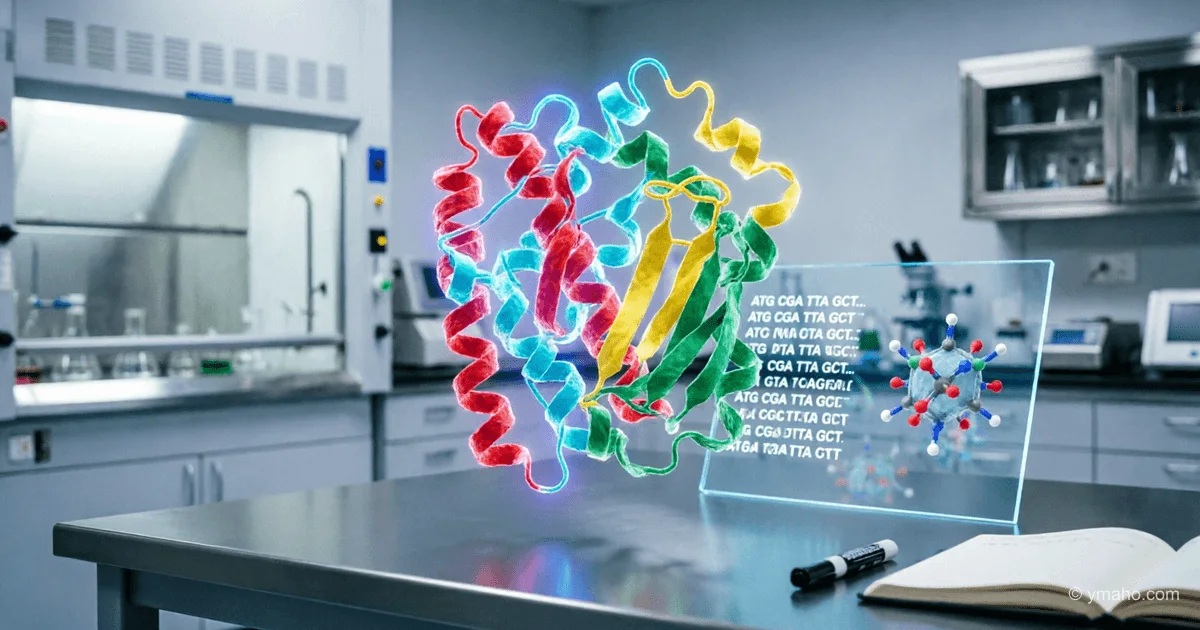
First-ever application of artificial intelligence to predict the structure of all known proteins (AlphaFold DB)
Google DeepMind and EMBL-EBI have populated a database with over 200 million predicted protein structures, radically accelerating drug development and understanding of disease molecular mechanisms.
Introduction
In 2020, at the CASP14 conference (Critical Assessment of protein Structure Prediction), an event occurred that biologists and pharmacologists had awaited for nearly half a century. Google DeepMind's AlphaFold 2 predicted the three-dimensional structure of proteins from their amino acid sequences with accuracy comparable to experimental methods. This was hailed as "solving the 50-year protein problem."
Two years later, in July 2022, DeepMind and the European Bioinformatics Institute EMBL-EBI took the next step, no less significant than the scientific victory itself. They opened free access to the AlphaFold Protein Structure Database (AlphaFold DB), containing over 200 million predicted protein structures—virtually all proteins known to science from the UniProt catalog.
In 2024, the breakthrough was crowned with the Nobel Prize in Chemistry, awarded to Demis Hassabis and John Jumper. And already in 2025–2026, the world witnessed how structure predictions are turning into real drugs entering clinical trials. This article is about how a single database radically changed the landscape of biomedical science.
Event Details and Timeline
Stage 1: Revolution in Prediction (2020)
At CASP14, AlphaFold 2 achieved a median GDT score (a measure of prediction accuracy) above 90%, which experts considered equivalent to experimental resolution. This meant that from now on, a protein structure could be determined in hours instead of months or years of lab work.
Stage 2: Database Creation (2021–2022)
In 2021, DeepMind and EMBL-EBI launched the first version of AlphaFold DB, containing 350,000 structures for 20 biologically significant organisms. The second release expanded the collection to nearly a million models.
The key moment came on July 28, 2022. EMBL-EBI announced a release that increased the database from less than a million to 214,684,311 predicted three-dimensional structures. As EMBL-EBI Deputy Director Ewan Birney said then: "From today, the database has expanded from one million to over 200 million structures, covering almost the entire UniProt."
Stage 3: AlphaFold 3 and Beyond (2024–2025)
In May 2024, DeepMind and Isomorphic Labs released AlphaFold 3. The new system went beyond single proteins—it learned to predict the structure of complexes of DNA, RNA, ions, ligands, and post-translational modifications. In the PoseBusters test (assessing protein-ligand binding accuracy), AlphaFold 3 showed a 50% improvement over the best traditional methods.
Stage 4: Recognition and First Drugs (2024–2026)
In October 2024, Hassabis and Jumper received the Nobel Prize. And in April 2026, at the WIRED Health conference, Isomorphic Labs President Max Jaderberg announced: the company is preparing the first AI-designed drugs for human clinical trials.
Impact and Significance
For the Scientific World
AlphaFold DB changed the very way structural biologists work:
- Scale: Over 3 million researchers from 190 countries have used the database, including over a million scientists from low- and middle-income countries.
- Speed of Discovery: Researchers using AlphaFold are 40% more active in publishing new experimental structures, and these structures are more often in previously unexplored areas.
- Citation Impact: Papers related to AlphaFold are cited in clinical articles twice as often as typical structural biology works.
Examples of real-world applications are impressive:
- In Europe, AlphaFold helped understand the structure of the Vitellogenin protein in honeybees—this is used in programs to save endangered populations.
- For years, scientists could not obtain the structure of apolipoprotein B100, a key protein of "bad" cholesterol (LDL). AlphaFold 2 revealed its complex "cellular" shape, giving pharmacologists an atomic blueprint for creating new therapies against atherosclerosis.
- Turkish undergraduate students, with no prior training in structural biology, learned from AlphaFold tutorials and subsequently published 15 scientific papers.
For the Pharmaceutical Industry
AlphaFold became a catalyst for drug discovery:
- About 40% of new structures deposited in the Protein Data Bank (PDB) from 2024 to 2025 were obtained using AI methods.
- Isomorphic Labs, a spin-off from DeepMind, raised $600 million in investments and formed partnerships with Eli Lilly and Novartis.
- A proprietary engine, IsoDDE, was developed, which the company claims more than doubles the accuracy of AlphaFold 3 in drug design.
For Society
The main promise of AlphaFold is accelerating the creation of drugs for hard-to-treat diseases. "The molecules we designed are highly effective, can be taken in lower doses, and have fewer side effects," said Jaderberg. Isomorphic Labs' mission, stated as "solve all diseases," no longer seems like science fiction.
However, researchers from the University of Illinois warn: "AlphaFold predicts structure, but not protein function or its behavior in a living cell. No AI-based drugs have been created yet; from idea to clinic is a long road."
Reactions of Key Players
Google DeepMind and the Scientific Community. For DeepMind, this became the main proof that AI can drive fundamental science. The team continues to develop related models: AlphaMissense and AlphaGenome for mutation analysis, AlphaProteo for designing protein binders against cancer and diabetes.
Publishers and Databases. Paradoxically, the success of AlphaFold DB created a "data aging" problem. Since the database has not been updated since 2022, while the UniProt library continues to be edited and refined, discrepancies have arisen. By June 2025, out of 20,504 human structures in AlphaFold DB, 631 contradicted the current UniProt entry. For mouse, discrepancies were 2.4%, and for zebrafish, nearly 43% due to a massive proteome cleanup. The journal Nature Structural & Molecular Biology directly warns: researchers need to check the latest sequence versions.
Critics. American scientist Sarfraz Niazi in several publications (including one accepted by Nature) argues that the Nobel Prize for AlphaFold 2 was awarded prematurely. In his view, the model cannot predict the structure for a completely new amino acid sequence and does not reflect protein dynamics under physiological conditions. Although many colleagues dispute the categorical nature of his conclusions, the very fact of the debate underscores that AI in biology is only at the beginning of its journey.
Forecast and Conclusions
What we have as of 2026:
- A database of 200+ million structures, changing the approach to solving problems from agriculture to cardiology.
- A Nobel Prize legitimizing AI as a full-fledged method in chemistry and biology.
- The first AI-designed molecules preparing for human trials.
Main Challenges:
- Database Update. AlphaFold DB needs a version 2.0 with real-time synchronization with UniProt, otherwise the resource's value will decline.
- From Prediction to Drug. The percentage of AI designs that will pass all three phases of clinical trials is still unknown. History knows many promising technologies that crashed against the reality of the human body.
- Dynamics and Multiple States. AlphaFold 3 still struggles with predicting conformational transitions of proteins and may "hallucinate" in unstructured regions.
Conclusion: AlphaFold DB is not the end of structural biology, but its new beginning. Experiments (crystallography, NMR, cryo-electron microscopy) have not disappeared. On the contrary, in 2025–2026, the PDB is seeing a record number of new experimentally confirmed structures—partly because AI helps biologists choose the most promising targets. What we are experiencing is not the replacement of the lab by the computer, but the multiplication of human intelligence by machine capabilities. And if Isomorphic Labs' forecasts are correct, in the next 5–10 years we will see the first drugs born from digital predictions.
— Editorial Team









