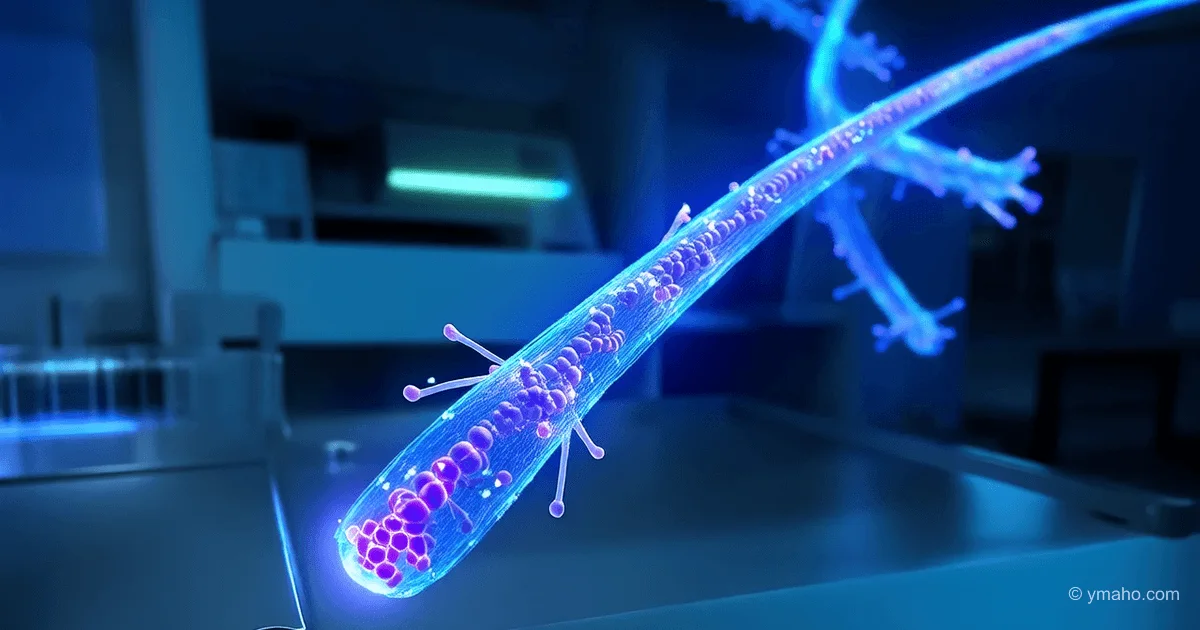
Artificial Neurons Created with Signals Identical to Biological Ones
Engineers at Northwestern University have, for the first time, printed artificial neurons based on nanomaterials that generate electrical signals indistinguishable from real ones in shape and timing. In an experiment, living mouse brain tissue perceived these signals as its own, marking a breakthrough for brain-computer interfaces and neuroprosthetics.
Artificial neurons have spoken to a living brain: why Northwestern University's breakthrough divides neurotechnology history into 'before' and 'after'
On April 15, 2026, the journal Nature Nanotechnology published a paper that had been awaited for a decade. Professor Mark Hersam and his team at Northwestern University created printed artificial neurons that not only mimic the brain's electrical activity—they directly activate living neurons in mouse cerebellar tissue. I have been following this field since 2016, and I can say: this is a qualitative leap that changes the game not only for neuroprosthetics but for the entire computing industry.
The Essence: What Is Really Happening
Until now, there was a fundamental gap between the world of electronics and the world of biological neurons. Electronic devices generated signals that the brain perceived as crude external interference rather than natural communication. Hersam put it most clearly: 'Other labs have tried to create artificial neurons from organic materials, and they spiked too slowly. Or they used metal oxides—too fast.'
The Northwestern team hit the sweet spot. Their devices operate in the same temporal range as biological neurons—the shape and duration of spikes match natural ones. But that's not the main point. The main point is that they 'spoke' to living tissue. When the printed neurons sent signals into mouse cerebellar slices, living neurons responded. This was confirmed by Professor of Neurobiology Indira Raman, who provided the biological part of the experiment.
The technological foundation looks like this: ink made from nanoflakes of molybdenum disulfide and graphene is deposited onto a flexible polymer substrate using aerosol jet printing. The key innovation is the partial decomposition of the stabilizing polymer. Previously, engineers completely removed it after fabrication, considering it a contaminant. Hersam turned this 'flaw' into a mechanism: the polymer decomposes unevenly when current is passed, forming a conductive filament that constricts current into a narrow channel. The channel switches spontaneously, generating sharp voltage spikes identical to action potentials.
Thanks to this, a single printed neuron reproduces a wide range of signals: single spikes, continuous firing, burst activity. This does not require millions of transistors—just two devices and a few basic components.
Timeline and Context
The story did not start in April 2026. Hersam—Walter P. Murphy Professor of Materials Science, Chair of the Department of Materials Science and Engineering at the McCormick School of Engineering, and Director of the Center for Materials Science and Engineering—had been working on this for a decade. His co-author is Vinod Sangwan, a research associate professor. The neurobiological expertise came from Raman, the Bill and Gayle Cook Professor of Neurobiology.
A preprint appeared in late 2025. By February-March 2026, the scientific community was actively discussing the results at conferences. The official publication occurred on April 15, 2026.
In parallel, a context developed that made this work explosive. In March 2026, major AI companies announced plans to build gigawatt-scale data centers with their own nuclear power plants. Hersam directly addressed this reality: 'It's hard to imagine a next-generation data center requiring 100 nuclear reactors. Moreover, gigawatts mean gigawatts of heat. Cooling data centers creates a colossal strain on water resources.'
At that moment, the issue of energy efficiency in computing ceased to be academic and became economic. The brain performs computations five orders of magnitude more energy-efficiently than any digital computer. Artificial neurons that replicate this efficiency become not just a scientific curiosity but a potential solution to a problem worth $500 billion—that is the projected global energy budget for data centers by 2030.
Who Wins and Who Loses
Winners:
Northwestern University and Hersam personally gain priority in a field that will define neurotechnology for decades. Patent applications have already been filed, and institutional investors are beginning to eye spin-off companies.
The neuroprosthetics industry gets a platform that solves its fundamental problem: existing implants—for restoring hearing, vision, motor functions—communicate with the brain in a 'foreign' language. Northwestern's printed neurons speak the same language. This means less rejection, higher resolution, and the possibility of restoring functions currently unavailable. The neuroprosthetics market was valued at $7.2 billion in 2025—its growth will accelerate.
Companies investing in neuromorphic computing—Intel (Loihi), IBM (TrueNorth)—gain a new technological vector. Their current chips are built on silicon transistors that mimic spikes in software. Hersam's printed neurons offer a hardware alternative that could reduce energy consumption by orders of magnitude.
Losers:
Traditional AI processor manufacturers—NVIDIA, AMD, Google (TPU). Their architectures are fundamentally inefficient compared to the brain, and Hersam's breakthrough highlights this inefficiency. In the short term, there is no threat—commercial neuromorphic chips are years away. But the direction is set, and investors are beginning to reassess long-term bets.
Conventional neuroimplant manufacturers—if they do not adapt Northwestern's technology, their devices with primitive signaling schemes will become obsolete within 7-10 years.
What the Media Isn't Saying
Insight one: the polymer magic is an empirical breakthrough, not a theoretical one.
Most outlets paraphrased the Northwestern press release but missed the essence of the discovery from a materials physics perspective. Hersam used a process that engineers had considered a defect for decades—incomplete removal of the stabilizing polymer from conductive inks—and turned it into a controlled mechanism for spike generation. This is not the result of theoretical prediction; it is an experimental finding that most labs simply overlooked because they burned off the polymer completely. The lesson here is simple: in nanoelectronics, a 'defect' can be the key to functionality if you look not at what 'interferes' but at what happens under non-equilibrium conditions.
Insight two: artificial neurons are not yet artificial intelligence, but they are already artificial neural tissue.
The media often conflate two topics: energy-efficient computing for AI and direct communication with the biological brain. These are different markets. For AI, printed neurons are a potentially revolutionary 'hardware' that could perform tasks with energy consumption comparable to the brain. For neuroprosthetics, they are a fundamentally new class of brain-computer interfaces that not only read signals but embed into neural networks in their language. Both directions will develop in parallel, but commercialization in neuroprosthetics will come sooner—the FDA is more favorable to medical devices than to new computing architectures.
Insight three: the problem of long-term stability.
Professor of Bioelectronics at the University of Bordeaux, Timothy Levi, who was not involved in the study, noted a crucial nuance that barely made headlines: 'We can control them for short times, but we cannot yet control them for long.' Artificial neurons are not yet ready for permanent implantation into the human brain. Their long-term stability, biocompatibility with the immune system, risks of inflammation—all remain unexplored. The path to clinical application will take at least 10-15 years, and unforeseen obstacles may arise along the way.
Insight four: artificial neurons are not enough.
Hersam himself pointed out the 'boundary problem': 'We have a series of devices that mimic different elements of the brain, but we need to integrate them into circuits that achieve full functionality.' Artificial synapses—connections between neurons—have not yet been created in a comparable form. Without them, it is impossible to build a full neuromorphic network. It's like having words but not knowing the grammar of the language. The next big challenge is integrating printed neurons into functional networks via artificial synapses.
Forecast: Next 30 Days and 90 Days
30 days (by mid-June 2026):
First independent labs will reproduce the Northwestern method. The main question is how stable the partial polymer decomposition is under different conditions and with different inks. If reproducibility is confirmed, this will become the number one sensation in the materials science community.
Scientific journals will begin publishing comments and editorials. Nature Electronics will likely release a review of the technology's prospects for neuromorphic computing. Science may publish a policy forum on ethical aspects of direct electronic interfaces with neural tissue.
Grant agencies NSF and DARPA will respond by increasing funding for neuromorphic computing programs. I expect an announcement of $20-30 million allocated for reproducing and developing the technology at 3-5 centers.
90 days (by mid-August 2026):
First commercial negotiations between Northwestern and major technology companies. Intel, IBM, possibly Neuralink—all will seek to license the technology or enter into joint research agreements. Potential deal values range from $50-100 million depending on the scope of rights.
In academia, integration of printed neurons with other elements will begin. Experiments with living neural cultures, where artificial neurons act as pacemakers for damaged networks. If such experiments show the possibility of restoring synchronization in pathological rhythms (e.g., in epilepsy), this will be a major step toward clinical application.
DARPA will likely announce a program for rapid commercialization of printed neurons for military neuroprosthetics—restoring function in veterans with traumatic brain injuries.
Structural forecast for 3-5 years:
Hersam's technology will split the development of neuroelectronics into two branches: traditional silicon implants, which will continue to be used in the short term, and a new generation of flexible printed devices that will penetrate the market as the long-term stability problem is solved.
The neuromorphic computing market could reach $15 billion by 2030 if printed neurons become the basis for scalable production of energy-efficient chips. But there is a risk that the technology remains a laboratory achievement for another decade—everything depends on solving the integration problem into functional networks.
For a patient with deafness, blindness, or paralysis in 2036, this 2026 work will mean what the invention of the transistor at Bell Labs meant for a smartphone owner. And for the AI industry, gasping from energy costs, printed neurons are not an alternative but the only path to sustainable scaling. The question is not whether the transition to neuromorphic computing will happen, but how many nuclear reactors we will have built before it does.
— Editorial Team









