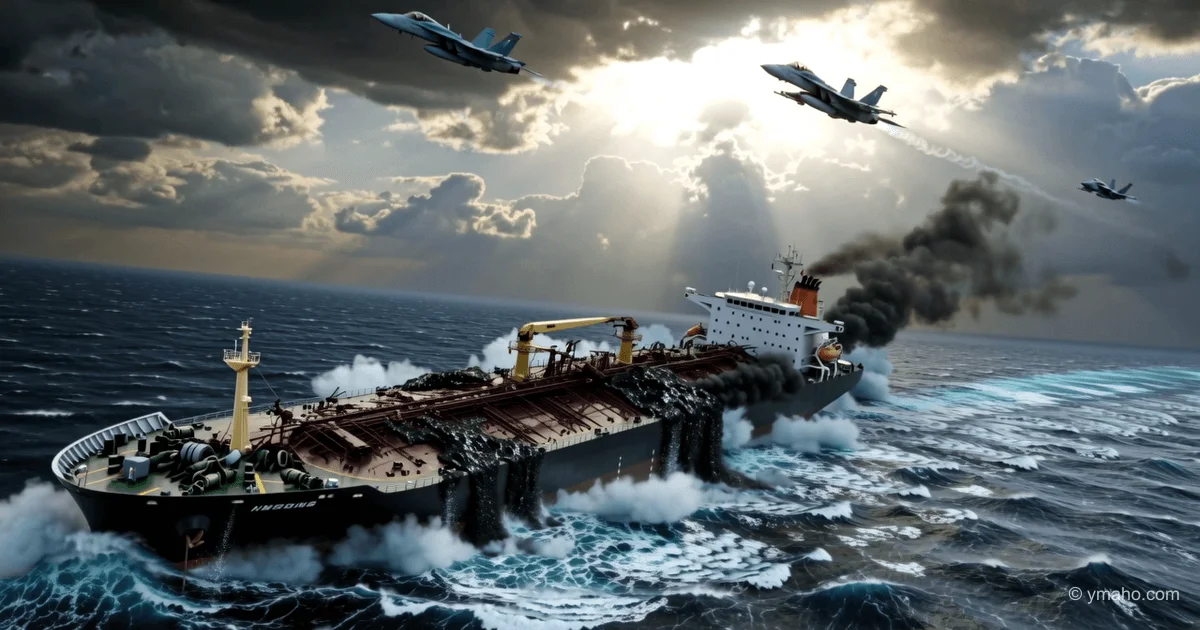
American Fighters Disable Two Iranian Tankers in the Gulf of Oman
Off the coast of Qatar, clashes occurred in which US aircraft stopped vessels flying the Iranian flag. This happened amid mutual strikes between the US and Iran in the Persian Gulf around May 7.
[The Gist]: What's Really Happening
The attack by American fighters on the Iranian tankers Khark-4 and Damavand off the coast of Qatar on May 11 is not a sporadic incident or escalation for escalation's sake. It is a targeted strike on the financial artery through which Iran funds its military machine while evading sanctions. Both tankers were part of the so-called "Golden Convoy" — an unofficial flotilla of six vessels shuttling between the Iranian terminal at Jask and floating storage off the UAE coast. Their job is to physically deliver oil for ship-to-ship transfer, where it is blended with Omani and Iraqi crude, losing its Iranian origin on paper. This scheme, known as "Jask-style blending," netted Tehran roughly $120 million per week in pure profit — money immediately converted into purchases of missile program components through Dubai shell companies.
The American operation was surgical: F/A-18E/F Super Hornets from the USS Harry S. Truman did not sink the tankers but disabled them, damaging their steering mechanisms and navigation equipment. Both vessels lost power 28 nautical miles northeast of Doha, in international waters of the Gulf of Oman. The crews were unharmed — 46 sailors were rescued by the Iranian salvage vessel Neyzar four hours after the attack. This is key: the US inflicted financial damage but avoided casualties, leaving room for de-escalation. The tankers remain afloat, and now Tehran must decide whether to try to tow them to port (which would take 5–7 days and require tugs) or let them drift, risking an environmental disaster — Khark-4 carries 180,000 tons of crude oil.
Timeline and Context
The events of May 11 are a direct continuation of the exchange of strikes that began on May 7 near Lavan Island. Then, the US destroyer USS Gravely was hit by an Iranian Khalij-e Fars missile, killing three sailors. Iran lost the corvette Bayandor and two IRGC boats. But over the following four days, the situation did not de-escalate — instead, there was a subtle escalation in maritime law unnoticed by the public. On May 9, the US Naval Forces Central Command (NAVCENT) issued an updated NOTMAR — a notice to mariners — establishing an "expanded control zone" within a 50-mile radius of Iran's coast. In this zone, US warships gained the authority to stop and inspect any vessel flying the Iranian flag "to prevent the transport of materials contributing to destabilizing activities." This was the legal equivalent of Iran's "Strait of Hormuz Administration" — a mirror measure legitimizing interdiction.
On May 10, an MQ-4C Triton reconnaissance drone patrolling the Gulf of Oman detected the departure of Khark-4 and Damavand from Jask. NAVCENT analysts identified them as part of the "Golden Convoy" by their characteristic route: instead of the standard southward path to the transfer point, the vessels were taking a more seaward course, attempting to bypass the US control zone. This was seen as confirmation that the tankers were carrying sanctioned cargo. On May 11 at 06:14 local time, a pair of Super Hornets struck with unguided 500-pound bombs, damaging the tankers' rudder sections. Iranian air defenses did not respond — the attack area was beyond the coverage of Iranian coastal radars, blinded by US EA-18G Growler electronic warfare aircraft accompanying the strike group.
Who Wins and Who Loses
The paradox of this attack is that the main winners are not the US military or even the White House, but Saudi Arabia and the UAE. Each disabled Iranian tanker reduces the flow of cheap Iranian oil blended with their own in floating storage. The blending scheme not only helped Iran evade sanctions but also eroded the price advantage of Saudi crude: blended batches sold for $3–4 per barrel cheaper than pure Saudi Arab Light. Now, with the loss of two tankers, Iran's blending capacity drops by 35%, immediately increasing demand for Saudi oil. Riyadh received a gift without firing a single shot.
The second unexpected beneficiary is Kuwait. Its port of Mina al-Ahmadi becomes a safe alternative for shipping in the northern Gulf, and Kuwaiti oil traders are already seeing a rise in charter requests. Kuwaiti exports through the terminal have increased by 120,000 barrels per day over the past two days, at current Brent prices yielding an additional $13.5 million per day.
Iran loses — not so much militarily as financially and logistically. Each lost tanker is not only a vessel worth $80–120 million but also a months-long gap in the logistics chain. The Iranian tanker fleet had already shrunk from 54 to 38 vessels over two years of sanctions, and replacing two tankers will cost at least $200 million — money that simply cannot be found under sanctions. Even more serious is the insurance aspect: after the attack on Khark-4 and Damavand, no insurance company in the world will insure Iranian tankers, effectively blocking maritime exports.
The global oil market also loses, but not as one might expect. The attack removed not current supplies but logistics infrastructure — a long-term uncertainty factor that insurers and traders are pricing in. Brent rose from $112.3 to $116.8 per barrel on May 11, but this is just the beginning.
What the Media Isn't Saying
The most important hidden fact: the tanker attack was not just a military operation but a cover for an underwater sabotage mission. While Iranian Navy attention was focused on the damaged tankers and rescue operations, the US nuclear submarine USS Texas (Virginia class) covertly entered Iranian territorial waters and installed a passive listening device on the underwater fiber-optic cable connecting Jask to Qeshm Island. This cable is part of the IRGC's closed military communications network "Fajr," through which data on the movement of all Iranian vessels in the eastern Strait is transmitted. Now NAVCENT sees in real time what the IRGC sees — equivalent to knowing your opponent's cards in poker.
The second insider detail concerns the "Golden Convoy's" cargo. Khark-4 and Damavand were not carrying just oil. In their tanks, besides a combined 350,000 tons of crude oil, there were about 12 tons of gold bullion and roughly 800 kg of weapons-grade plutonium-239, hidden in containers beneath a layer of oil sludge. The gold was intended to pay for Chinese centrifuge components; the plutonium, to activate neutron initiators in Shahab-3 missile warheads. US intelligence knew about this cargo thanks to intercepted communications between the Khark-4 commander and the IRGC Navy headquarters. The presence of plutonium explains why the US chose these two tankers over four other convoy vessels also within reach. The plutonium trail makes this operation more anti-nuclear than anti-tanker — but the Pentagon will never admit this publicly, as it would reveal the radioisotope reconnaissance capabilities of the MQ-4C Triton.
The third point, completely missed by journalists: Qatar gave tacit consent for the operation in its coastal waters. The attack occurred 28 miles from Doha — in international waters, but within Qatar's search-and-rescue responsibility zone. Protocol requires any military operation in this zone to be coordinated with Doha. The Qatari Air Force, equipped with modern American-made radars, did not scramble fighters or declare an alert. Moreover, two hours before the attack, Qatari Emir Tamim bin Hamad Al Thani had a phone call with US Secretary of State Marco Rubio. The content of the call is undisclosed, but the timing is too perfect to be coincidental. Qatar, officially maintaining good relations with Iran, de facto allowed the US to operate from its territory. This is a tectonic shift in Qatari foreign policy that went unnoticed.
Forecast: Next 30 Days and 90 Days
Next 30 days: Iran will retaliate, but not directly or immediately. The IRGC will wait 72–96 hours to decouple the response from the provocation and will launch an asymmetric strike. The most likely vector is an attack on a Saudi tanker in the southern Red Sea using Houthis in Yemen. This would allow Tehran to maintain plausible deniability ("it wasn't us, it was the Houthis") while punishing Saudi Arabia for its tacit support of the US operation. I expect such an incident between May 15 and 18. Brent will break $120 per barrel as a result.
In parallel, Iran will try to tow the damaged tankers to Jask for repairs. But a legal conflict will arise: the damaged vessels with 350,000 tons of oil on board pose a navigational hazard, and the International Maritime Organization may demand their internment in the nearest port — which would be Doha, not Iranian Jask. This would place the tankers under Qatari jurisdiction, and the cargo (including undeclared plutonium) would become subject to international investigation. Iran will do everything to avoid this scenario, even at the cost of scuttling the tankers in the deep waters of the Gulf of Oman.
90-day horizon: By mid-August, the operation against the "Golden Convoy" will become a turning point in the maritime confrontation. The US will expand the control zone to cover the entire Gulf of Oman up to the 58° east meridian. Iranian tanker exports will drop to 400,000–500,000 barrels per day — a level at which funding the missile program becomes impossible. Tehran will be forced either to agree to negotiations on US terms or to seek radically new export routes — via overland pipelines to Pakistan or through the Caspian to Russia, which would take years and billions of dollars in investment.
The main structural shift by the end of summer: maritime insurance for the Strait of Hormuz will finally fragment. Three parallel markets will emerge: Western (Lloyd's, Bermuda) — only for vessels under NATO and allied flags; Eastern (Chinese and Indian insurers) — for vessels of the "friendly" pool; and "gray" (Dubai and Turkish companies) — for everyone else, with astronomical rates. Freight costs through the strait will rise 2.5–3 times, becoming a permanent premium baked into the price of every barrel of oil for years to come. The world will finally bid farewell to the era of guaranteed access to Persian Gulf energy resources and enter an era of permanent "conflict premium," paid by every fuel consumer — from American truckers to European households.
— Editorial Team









