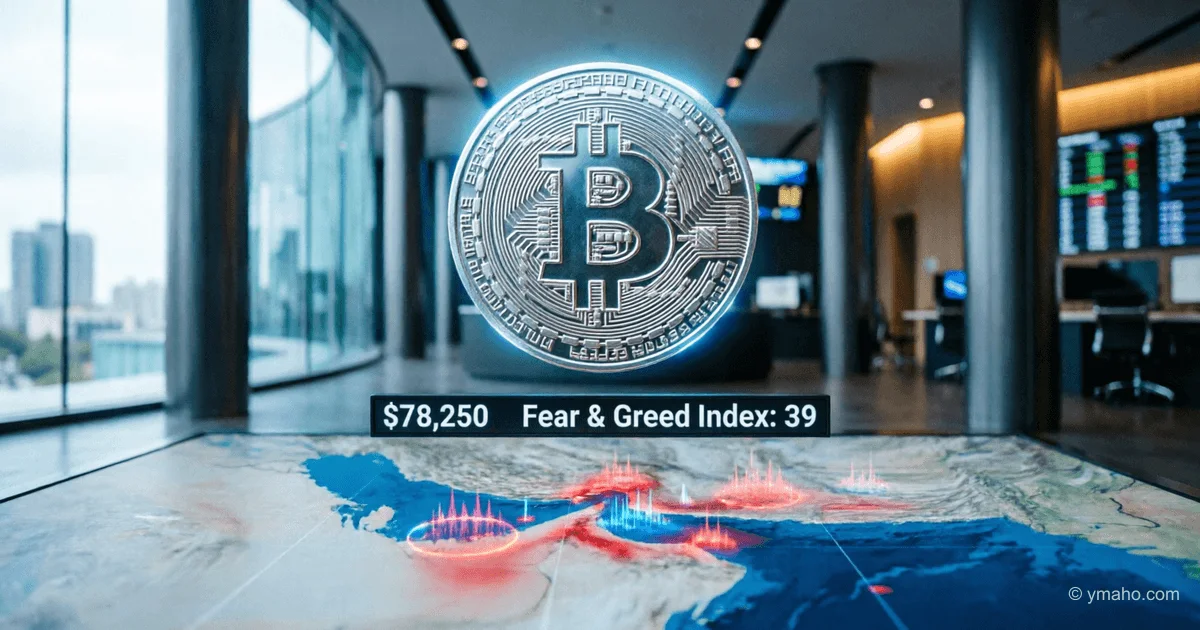
Crypto Market: Bitcoin Consolidates Below $78,000 Amid Geopolitical Tensions
BTC is trading around $78,250, showing weak upward momentum due to the escalation of the US-Iran conflict over the Strait of Hormuz. The Fear and Greed Index has dropped to 39 ('Fear') amid reduced risk appetite in global markets.
Bitcoin at a Crossroads: Geopolitical Fear vs. the 'Digital Gold' Narrative
Introduction
On April 24, 2026, the cryptocurrency market is frozen in tense anticipation. Bitcoin is trading in a narrow range around $78,250, showing almost zero daily movement, while the Fear and Greed Index has fallen to 39 points, corresponding to a state of 'Fear'. This stagnation occurs against the backdrop of one of the most dangerous escalations of the geopolitical situation in the Strait of Hormuz—a strategically vital energy channel through which about 20% of the world's oil supply passes.
The market finds itself in a classic 'risk-off' trap, with investors massively pulling capital out of volatile assets. However, Bitcoin's history also knows opposite examples: earlier this year, during the escalation of the conflict in February, the price of the first cryptocurrency crashed to $60,000—almost 25% below current levels. Today's situation requires deep analysis: is the current consolidation a sign of 'bear exhaustion' or just a pause before a new round of decline?
Event Details and Timeline
The timeline of recent days paints a picture of rapid escalation that caught markets off guard.
April 22, 2026 was a turning point. President Donald Trump, despite previous statements about extending the ceasefire with Iran, made a sharp announcement on his social network Truth Social: he ordered strikes on any vessels spotted laying mines in the Strait of Hormuz. This tough ultimatum came amid reports that Iran's Islamic Revolutionary Guard Corps (IRGC) had seized two container ships in the strait and opened fire on three other vessels in the area.
April 23 saw increased geopolitical pressure. Iran officially activated Tehran's air defense systems to intercept 'hostile targets', officially denying airstrikes but confirming readiness for defense. Talks between the US and Iran, which were supposed to take place in Oman, effectively 'stalled'—the parties could not reach a compromise even on secondary issues, let alone the nuclear program.
April 24, 2026—the current moment. The market is locked in a state of uncertainty. WTI crude continues its rally, rising above $96 per barrel (up more than 4% on the day), while US stock indices are in the red: the S&P 500 lost 0.41%, and the Nasdaq lost 0.89%. Bitcoin, which briefly broke above $79,000 the day before (an 11-week high), has pulled back and is now consolidating with minimal daily changes.
Impact and Significance (for the World / Industry / Society)
The escalation of the conflict in the Strait of Hormuz has a triple effect: macroeconomic, industry-specific, and socio-psychological.
For the world as a whole, the threat lies in an inflationary shock. Oil prices above $100 per barrel, which are forecast with further escalation, mean a resurgence of global inflation. This, in turn, forces central banks (primarily the Fed) to abandon plans to ease monetary policy. Investors are already pricing in a scenario where US rates remain high at least until the end of 2026. High rates are poison for Bitcoin, which does not generate cash flow and loses appeal compared to risk-free assets (e.g., Treasury bonds yielding 4-5%).
For the crypto industry, the current situation has exposed a fundamental contradiction. On one hand, Bitcoin is positioned as 'digital gold'—a safe-haven asset during turbulent times. On the other hand, its behavior over the past two years shows a high (though declining) correlation with the Nasdaq and other risky assets. In moments of liquidity crisis, investors sell what can be sold quickly—and Bitcoin, thanks to a developed ETF infrastructure and high liquidity, often ends up among the first assets to be hit.
This creates cognitive dissonance: Bitcoin rises when markets are calm (as investors seek returns) and falls when panic sets in (because investors need cash). Real gold, in contrast, has shown divergent dynamics in recent days—falling after a prolonged rise, indicating a complex reassessment of assets.
For society, it is important to understand that behind the market numbers lie real risks: a blockade of the strait could lead to disruptions in energy supplies and higher prices for fuel, gasoline, and electricity. Scammers have already begun exploiting the theme: reports have emerged of fraudsters posing as Iranian officials demanding ransoms in Bitcoin for 'safe passage' of ships through the strait.
Reaction of Key Players
The reaction of institutional and retail investors to the current crisis has been mixed, leading to consolidation rather than directional movement.
Institutional investors are split into two camps. Some (hedge funds, banks) are following the 'risk-off' playbook: reducing Bitcoin positions and shifting into the dollar and short-term US government bonds. However, there are also those who see opportunity in the panic:
- Strategy (the largest public Bitcoin holder) announced that between April 12 and 19, it acquired approximately $2.5 billion worth of Bitcoin, one of the largest single reserve additions in recent months. This signals to the market that 'whales' continue to accumulate despite the noise.
- Institutional flows into spot ETFs have slowed but not stopped. After record inflows in Q1 2026, there is now a pause, but no mass capital outflow from ETFs has been recorded.
Retail investors react more emotionally. The Fear and Greed Index fell from 46 to 39 in just a few days. On forums and social media, scenarios of a drop to $70,000 and even $65,000 are being discussed, fueling panic. However, trading volumes on spot markets remain moderate—indicating that most holders prefer to 'hold and watch' rather than panic-sell.
Miners have also shown restraint. Although the network hash rate remains stable, some small miners have started taking profits at $78,000, but large pools are not showing abnormal coin flows to exchanges.
Forecast and Conclusions
Assessing the current situation requires considering two alternative scenarios, with roughly equal probability.
Scenario A: Escalation and Liquidity Crisis (Probability: 45%)
If the conflict turns hot with direct military engagement and a prolonged blockade of the strait, Bitcoin could repeat the February scenario and crash to levels of $70,000–$65,000. The mechanism would be: oil > $110 → inflation > 4% → Fed maintains rates → liquidity tightens → forced sales (margin calls) affect crypto as well. Historical precedent: February 2026, when BTC fell to $60,000 precisely amid the Middle East war.
Scenario B: Stabilization and 'Geopolitical Premium' (Probability: 55%)
However, there is an alternative view shared by some analysts (e.g., experts from London Crypto Club and BitMEX founder Arthur Hayes). According to this view, any major military conflict involving the US leads to increased government spending and, consequently, the activation of the 'printing press'.
Expansion of the money supply (liquidity) is the main driver of Bitcoin's price—this factor explains up to 90% of BTC's long-term dynamics, as macro investor Raoul Pal notes. If the Fed begins to ease policy to finance military operations and service the growing national debt, Bitcoin could receive a powerful boost in the second half of 2026.
Conclusion for investors: The current consolidation period is not a time for panic or FOMO, but a moment for strategic analysis. The key indicators will not be news headlines, but the Fed's actions and the dollar's dynamics. Until the situation becomes clearer (e.g., completion of the second round of US-Iran talks), the optimal strategy is to reduce leverage and diversify between Bitcoin, gold, and cash.
As Ryan Lee from Bitget Research noted: 'The market is balancing between growth and correction scenarios, remaining extremely sensitive to external triggers.' In this uncertainty, the only guarantee is not a forecast, but adequate risk management.
— Editorial Team









