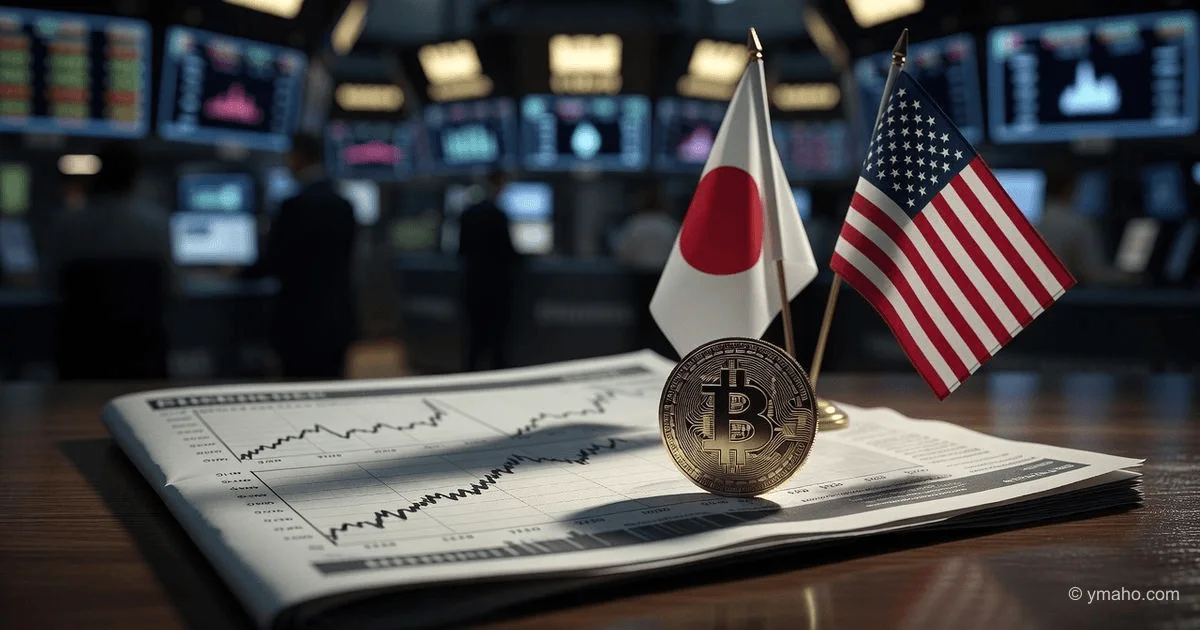
Bitcoin Surpasses $66,000 Amid Ceasefire and Historic Rate Hike by Bank of Japan
Markets rallied on news of a peace agreement between the US and Iran, as well as the Bank of Japan's rate hike to a high not seen since 1995 (1%). Bitcoin climbed above $66,000, with $375 million in short positions liquidated in 24 hours.
Analytical Review: Ceasefire and Rate Hike — Why Bitcoin Rose on Two Contradictory Signals
The Core: What's Really Happening
On June 17, 2026, Bitcoin held above $66,000 for the first time in two weeks, recovering nearly 12% from its June drop to $59,000. The formal drivers are two macroeconomic events that the media presented as a "bullish tandem": a peace agreement between the US and Iran, unblocking the Strait of Hormuz, and the Bank of Japan's key rate hike to 1% — the highest since September 1995.
However, a professional perspective sees not a synchronized impulse but opposing forces that coincidentally aligned in time. The peace deal reduces the geopolitical risk premium and opens oil flows — a classic "risk-on" for all assets, including Bitcoin. The rate hike in Japan tightens monetary conditions in the world's third-largest economy, which theoretically should pressure risky assets, not lift them. Something doesn't add up.
Behind the scenes, the key is this: the market perceived the Japanese hike as confirmation that the BOJ is bringing inflation under control, not as the start of an aggressive tightening cycle. Deputy Governor Shinichi Uchida explicitly stated that the pace of hikes would be "slow, with intervals of six months to a year." This signals that Japan's rate will remain the lowest among developed countries even after the hike. The spread with the Fed remains nearly 4%, continuing to fuel carry trade into the yen, and part of that liquidity traditionally flows into Bitcoin through institutional channels.
Bitcoin's rise to $66,000 was accompanied by $375 million in short liquidations in 24 hours. This means a significant portion of the move is forced short covering, not organic new capital inflow. The signal is cautious: the bounce is a "short squeeze" rather than a sustainable trend reversal.
Timeline and Context
To understand why two such different events coincided now, look at the June 2026 calendar. The first two weeks of the month saw Bitcoin experience one of its sharpest declines of the year — from $73,000 to $59,200, losing over 14% from its peak. This was followed by $4.3 billion in ETF outflows and $1.6 billion in liquidations. The market was overheated, long positions were overloaded, and any news worsened already gloomy sentiment.
| Date | Event | Bitcoin Reaction |
|---|---|---|
| June 1 | Bitcoin trades above $73,000 | Month's peak, optimism |
| June 1–10 | ETF outflows of $4.3B, liquidations of $1.6B | Drop to $61,000 |
| June 11 | Year low — $59,200 | Capitulation, fear |
| June 14 | Trump announces completion of deal with Iran, opening of Strait of Hormuz | First recovery impulse |
| June 15 | Analysts forecast BOJ rate hike to 1% | Market prices in expectations |
| June 16 | BOJ raises rate to 1% (7 votes for, 1 against) | Bitcoin tests $66,000 |
| June 17 | Bitcoin holds above $66,000, $375M in shorts liquidated | 12% recovery from low |
The geopolitical track is equally important: on June 19, the official signing of the peace memorandum between the US and Iran is scheduled in Switzerland. The first phase of the deal includes the immediate opening of the Strait of Hormuz and the unblocking of $12 billion in humanitarian aid via Qatar. It is the expectation of this event, not the event itself, that created the conditions for a recovery in "risk appetite."
Note the detail: Trump announced the deal on June 14, but the market did not instantly soar. Only after it became clear on June 15 that the BOJ would not aggressively raise rates (analysts had even discussed a +0.5% option) did Bitcoin receive a second impulse. The market combined two signals: geopolitical détente and a soft rate hike — and produced a bullish outcome.
Who Wins and Who Loses
Winners:
Institutional Bitcoin holders who entered at the lows of $59,000–61,000. Those who bought during the panic on June 11–13 are now up 7–10%. These are the same funds that saw outflows in early June but then returned — data shows renewed ETF inflows. They bought cheap and are now watching shorts get liquidated, pushing the price up without needing new large purchases.
Traders with long Bitcoin positions who weathered the storm. $375 million in liquidated shorts is money redistributed from bears to bulls. Particularly those who held long positions with 3–5x leverage and were not stopped out at the $59,000 lows.
Oil traders and energy importers. The opening of the Strait of Hormuz means resumption of Iranian oil supplies, putting downward pressure on prices. For Bitcoin, this is an indirect plus — lower energy costs improve miner margins, especially in Texas and Kazakhstan, where energy intensity is a key cost factor.
Losers:
Aggressive short sellers who entered at $63,000–64,000 expecting further decline. They fell victim to the "short squeeze" and have either closed positions at a loss or are underwater. The $66,000 level became a critical point for them — above it, a chain of forced stop-losses begins.
Yen traders betting on further weakening of the Japanese currency. The rate hike to 1% strengthened the yen, damaging short USD/JPY positions. Some of this capital may have been involved in crypto arbitrage, and liquidity is now leaving that space.
Hedge funds that positioned for escalation in the Middle East conflict. They held safe-haven assets — gold, US Treasuries, short positions on risky assets. The Trump-Iran deal became a "position rupture," forcing them to rotate back into risk. This created additional pressure on gold and temporary support for Bitcoin, but such rotation may be short-lived.
What the Media Isn't Saying
1. The BOJ rate hike is not tightening, but normalization.
Seven of eight BOJ board members voted for the hike, with only one — Toichiro Asada — opposing, citing risks to production and employment. But the key is hidden in the comments: Uchida, acting governor due to Ueda's illness, emphasized that inflation risks persist and the peace agreement is merely a "positive step" that does not remove the need for further hikes.
The market somehow interpreted this as a "dovish" signal. In reality, the BOJ stated: rates will continue to rise, just slowly. Analyst forecast — 1.25% by end of 2026. This is not a reversal of tightening, but a stretching out over time. But crypto traders heard "slowly" and decided everything is fine.
2. The Iran deal is not peace, but a ceasefire with a "finger on the trigger."
Iran's Deputy Foreign Minister Kazem Gharibabadi directly stated: Tehran will "keep its finger on the trigger" for 60 days after signing the memorandum. The second phase of negotiations — on the nuclear program and ballistic missile limitations — has not even begun, and positions diverge radically: the US demands a 15–20 year freeze, Iran agrees to only 5 years.
The market is already pricing in "peace." But if the second phase of talks collapses or Israel launches new strikes on Lebanon (Defense Minister Katz has already threatened retaliation), the geopolitical premium will return instantly. In that case, Bitcoin could lose all its gains within 24–48 hours.
3. Insider signal — liquidity at $66,000–67,500 was "thin."
On the day Bitcoin broke $66,000, the $66,000–67,500 range was characterized as a zone with "thin liquidity." This means there were no large buy orders — the move occurred on low volume, typical of a short squeeze, not institutional accumulation. For comparison, the $70,000–74,000 levels contain 5–6 times more liquidity. The true test for bulls is $70,000, not $66,000.
Forecast: Next 30 Days and 90 Days
30 days:
- Bitcoin will likely consolidate in the $64,000–68,000 range over the next 2–3 weeks. The main factor is June 19, the signing of the memorandum in Switzerland. If the ceremony goes smoothly, the market may get another impulse, but weaker — to $68,500–69,000.
- The main pressure: ETF outflows may resume if institutional investors see current levels as an opportunity to take profits after the recovery from $59,000. Inflow data for June 17–20 will be a key indicator.
- Miners, who endured difficulty and hashprice, have begun to restore margins. If Bitcoin holds above $65,000, selling pressure from miners will ease, supporting the price.
90 days:
- If the peace process with Iran moves to the second phase and full-fledged nuclear talks begin, the geopolitical premium could disappear entirely, removing one of the key risks for risky assets. In this scenario, Bitcoin could attempt to challenge $72,000–74,000 by September.
- However, the Japanese factor remains: if core inflation in Japan exceeds the 2% target, the BOJ could raise rates to 1.25% as early as October, not December. This would create a new round of yen strengthening and potential liquidity outflow from risky assets, including Bitcoin. The market is not yet pricing in this risk.
- The key level for trend determination is $70,000. If Bitcoin holds above it on sustained volumes in July, it opens the path to new all-time highs. If the bounce stalls at $68,500–69,000, the market could return to testing $62,000 by the end of Q3.
Editorial Forecast
Asset: Bitcoin (BTC/USD). Direction: sideways with a bearish bias in the next 48–72 hours after short-term overheating. Key levels: resistance — $66,500 (local June high) and $67,000 (psychological level), support — $64,200 (recovery level) and $63,000 (50-day moving average). Confidence level: medium. Main risk: if the June 19 signing of the memorandum in Switzerland goes smoothly, Bitcoin could get a boost to $68,000, breaking the current corrective pattern. On the other hand, any statement from Israel about new strikes on Lebanon or a Fed comment about maintaining tight policy could crash the price to $62,000 within hours.
This forecast is an analytical assessment by the editorial team, not investment advice. The cryptocurrency market is highly volatile, and past results do not guarantee future returns.
— Editorial Team