Binance Coin (BNB) Takes Center Stage Thanks to Two Top Altcoins of the Week
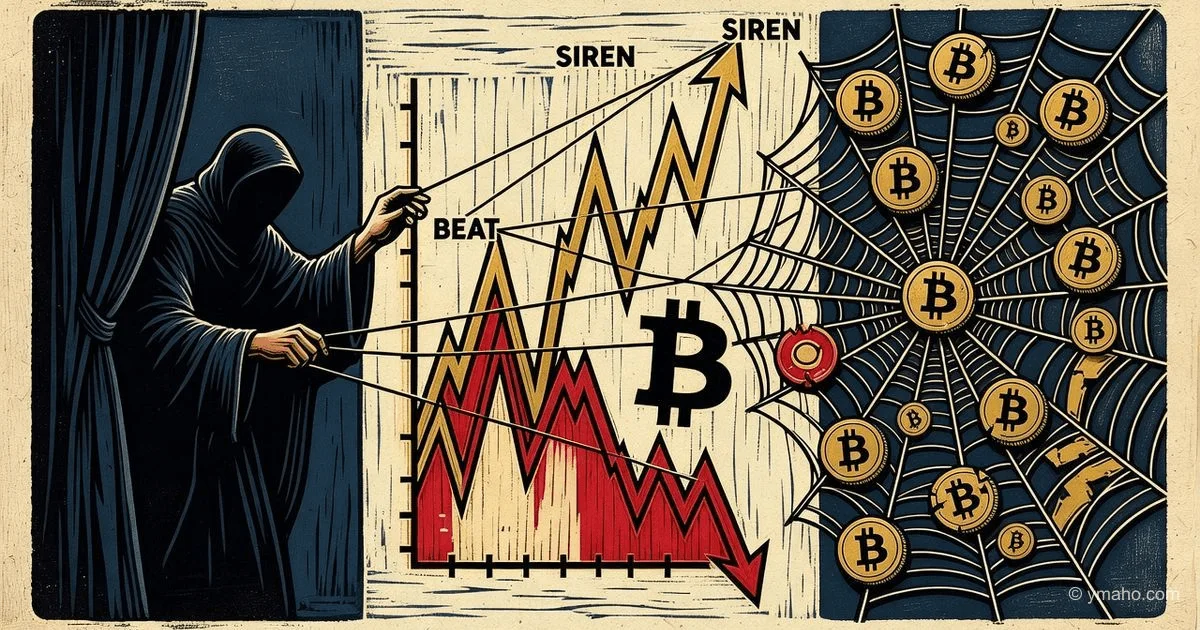
The tokens BEAT and SIREN, linked to Web3 projects on the BNB Chain blockchain, showed the best performance among the top 100 cryptocurrencies, gaining 78% and 33% respectively.
The Illusion of an Ecosystem Explosion: How the Market Confused Short Squeezes with Fundamentals
While the world of crypto finance held its breath awaiting the SEC's decision on ETFs and watched Bitcoin fall below $60,000, something on the periphery caught speculators' attention. Tokens BEAT and SIREN, associated with the BNB Chain ecosystem, posted double-digit gains. Media outlets quickly dubbed them the "center of attention," hinting at a revival of altcoin season.
Behind the facade of an explosive rally lies the banal but harsh reality of low-liquidity markets. What we are witnessing is not "attention" to fundamental projects. It is a classic hunt for short position stop-losses, backed by savvy PR and inflated marketing budgets. Over 80% of SIREN's supply, by various estimates, is hidden in a single cluster of wallets, while BEAT trades with an RSI above 90, which historically precedes a sharp correction. Let's break down this mechanics.
[The Gist]: What's Really Happening
Officially: projects on BNB Chain are showing sustainable growth driven by real economics (AI, Music-to-Earn). Unofficially: we are seeing a standard scheme to pump low-cap assets in order to offload token bags from early investors to retail traders.
Let's start with Audiera (BEAT). This is an AI music and rhythm game platform that actually generates revenue. Last week, the company reported $2.87 million in revenue and burned 770,000 BEAT. Sounds like fundamentals, right? But it's a drop in the ocean. BEAT's market cap soared to $1.24 billion. For a company earning less than $3 million per week, the P/S (Price-to-Sales) multiple is an astronomical 80-100x. That's a tech giant valuation, not a gaming startup.
SIREN is an even murkier story. The project positions itself as an "AI Agent-driven on-chain think tank," but in essence, it's a classic memecoin with AI narrative elements. Its main achievement is getting into Binance Alpha support programs and receiving $200,000 in liquidity. However, the key risk that press releases keep quiet about is token concentration. Various on-chain analysts estimate that a single wallet cluster holds between 50% and 88% of the circulating supply.
In March 2026, SIREN already made a similar rally from $0.94 to $3.60, then crashed 93% in a week when "big players" took profits. Now history is repeating itself exactly. The only difference is the scenery.
Timeline and Context
Why did the rally happen this particular week, when Bitcoin was falling and altcoins, including BNB itself, were trading sideways? It's important to look not at the chart but at the calendar of marketing activities.
June 5, 2026 (Friday). SIREN breaks the technical resistance level of $0.8044 amid a general market decline. Trading volumes surge. No fundamental product news, but rumors of an upcoming listing spread in the market.
June 7, 2026 (Sunday). Audiera (BEAT) publishes weekly revenue and token burn data. This triggers FOMO. Traders see "real economics" and start buying, closing their short positions.
June 8, 2026 (Monday). Pumping continues. BEAT shows 40% daily growth, with its weekly gain reaching 283%. SIREN adds another 49.7% in a day.
June 9, 2026 (Tuesday, expected). Gate.io holds an AMA with the Audiera team. This is a standard tactic: pump the price before the event to create an illusion of success, then at the meeting try to hold the audience's attention without providing concrete development details.
This timeline is a pump & dump roadmap. First, a technical breakout on low liquidity (SIREN, June 5). Then, news coverage (BEAT, June 7). Finally, media hype through exchange AMAs (June 9). By Wednesday, when the noise dies down, someone will definitely place a massive sell order.
Who Wins and Who Loses
Winners: early investors and "whales." Participants who entered SIREN at $0.2-0.3 have seen 300-400% returns in a few days. They don't care what happens to the project in a month. They have "free" tokens and are already placing limit sell orders on the order book.
Winner: Gate.io exchange. BEAT brought $48 million in spot market volume from a single pair. In a declining market with falling overall activity, such a spike in fee income is manna from heaven.
Winner: BNB Chain. While Ethereum struggles with high gas fees and waning interest in L2s, BNB gets "media hits." This brings developer attention back to the Binance blockchain, even if the top growth projects are high-risk memecoins.
Losers: retail traders. Most buyers at the peak of $3.90 (BEAT) or $1.30 (SIREN) will again be left with losses. SIREN already lost 93% of its value in March. Those who held it after the pump have yet to recoup their losses. The current rally is an opportunity to break even for those caught in the March trap.
Loser: BNB Chain's reputation among institutions. When large funds look at an ecosystem, they seek stability and real liquidity. If the growth flagships are memecoins and speculative gaming tokens with high-risk holder structures, it scares away serious capital. Venture funds are pulling money out of similar ecosystems dominated by "insider" trading.
What the Media Isn't Saying
Non-obvious insight #1: BEAT's scarcity is an artificial scenario. Yes, the project burns tokens. But 770,000 burned tokens is nothing compared to the emission planned for the coming years. BEAT's total maximum supply is 1 billion tokens. Currently, about 288 million are in circulation. The remaining 712 million tokens are held by the team and investors and will be unlocked over the next 2-3 years. By burning 12 million tokens, they create artificial scarcity that masks future dilution of hundreds of millions of coins.
Insight #2: SIREN is an experiment in crowd psychology. SIREN doesn't need a product. It needs listings. In 2025, it passed Binance Alpha and received support. That was enough to pump the price to $3.60. After the March crash, the project was delisted from HashKey. That didn't stop speculators. Now, with the token at $1.29, traders buy it not because they believe in AI agents, but because they hope for a repeat of the March rally. It's a game of Russian roulette.
Insight #3 (most important): liquidity is flowing into low-cap coins because the mainstream is dead. The explosive growth of BEAT and SIREN is not a sign of a healthy market. It's a sign of unhealthy diversification. Large institutional players (BlackRock, Fidelity) are not buying BEAT. They are pulling money out of Bitcoin, which is stagnating. Speculative capital is looking for any opportunity for 2-3x gains. When Bitcoin breaks out of its consolidation to the upside, all liquidity from BEAT and SIREN will flow back into BTC and ETH, leaving current holders high and dry. Such pumps are a capital trap in a bearish or neutral market.
Forecast: Next 30 Days and 90 Days
30 days. I expect high volatility followed by a deep correction. BEAT is already in overbought territory (RSI > 90). Historically, after such readings, the token either consolidates for weeks or drops 30-50%. Given that the AMA on Gate.io (June 9) will pass and the news flow will fade, profit-taking is highly likely. BEAT correction target: $1.80-$2.20. SIREN, which is more dependent on "crowd" sentiment, could retrace to $0.60-$0.70.
90 days. By September, if the macroeconomic backdrop doesn't change, both tokens could return to their fundamental values. For BEAT, that's $1.00-$1.50 (support from November-December 2025). For SIREN, below $0.50. The only catalyst that could prevent their fall is a sudden announcement of a real spot listing on Binance (not futures or Alpha). But that probability is low given the risks associated with supply concentration. Without a listing on the top exchange, euphoria will fizzle out in 2-3 weeks.
Editorial Forecast
Asset: Audiera (BEAT). Direction: sharp decline (correction).
In the next 72 hours after the AMA hype subsides, we expect strong selling pressure. The daily RSI is at 91.06, signaling an overheated market. Key levels: resistance $3.96, support $1.92. Confidence level: high. Main risk: if unconfirmed rumors of an upcoming Binance spot listing emerge, it could trigger another short squeeze and test the $5.00 level, but such news is unlikely without prior coordination.
The editorial opinion is not an investment recommendation.
— Editorial Team