Italian Bank Merger: Intesa Sanpaolo Offers €31 Billion for Monte dei Paschi
Italy's largest bank, Intesa Sanpaolo, has made a €30.6 billion offer to buy Banca Monte dei Paschi di Siena, potentially sparking a new wave of deals in Italy's banking sector.
Banking War in Italy: The Hidden Springs of the Century's Deal for Monte dei Paschi
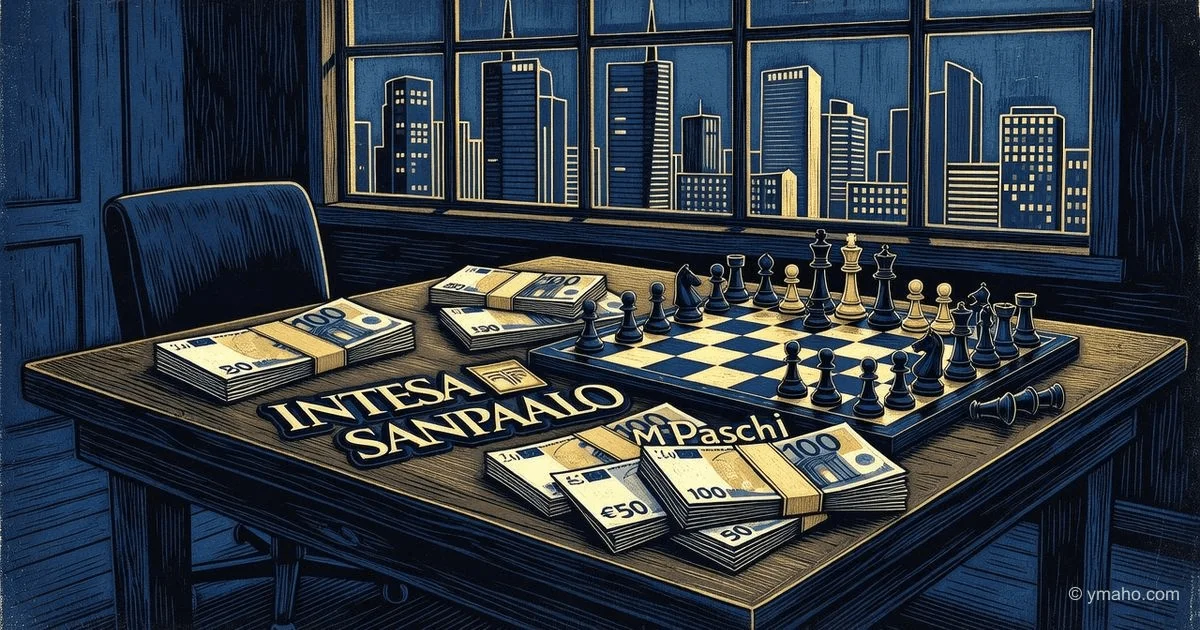
While the world debates Bitcoin at $170,000 and the tech chaos on Nasdaq, real money is being made in the stuffy boardrooms of Roman palaces and Turin skyscrapers. The events of the last 48 hours in the Italian banking sector are not just another merger. They are a multi-layered chess game where stakes are measured in tens of billions of euros, and control over the financial heart of Europe is passing from state hands to private ones.
This is about the hostile takeover of Monte dei Paschi di Siena (MPS) by Intesa Sanpaolo. The official sum is €30.6 billion. The unofficial price is Italy's sovereignty in the insurance business, domestic market hegemony, and a clash of two business philosophies. Most analysts have already dubbed it "just a big deal." I see at least three non-obvious insights that turn this story into a textbook on 21st-century financial geopolitics.
[The Essence]: What Is Really Happening
Intesa Sanpaolo, led by Carlo Messina, one of Europe's oldest and most authoritative banking CEOs, has thrown down the gauntlet. On June 6, 2026, Banco BPM announced its intention to conduct a "merger of equals" with the world's oldest bank. The deal seemed a foregone conclusion: Banco BPM and MPS together would become Italy's second-largest bank, overtaking UniCredit.
But within 24 hours, on June 8, Intesa struck. The offer was aggressively hostile: 1.6 Intesa shares plus €1 in cash for each MPS share. That's a 12.5% premium over Friday's closing market price. At first glance, a standard intercept. But the devil is in the details.
Condition one: Intesa pre-arranged with Unipol (the largest shareholder of BPER Banca) to resell the MPS brand and 635 branches. The sale price: €3-3.5 billion. Condition two: Intesa keeps Mediobanca and its stake in Generali. Condition three: this hostile offer triggers the passivity rules — MPS's board is now legally constrained in its maneuvers until December 2026.
What's really happening? This is not an attempt to buy a bank. It's an attempt to buy control of Generali — Italy's largest insurance group — on the cheap. After acquiring Mediobanca, MPS became Generali's largest shareholder. By buying MPS, Intesa gets Generali. And Generali is not just insurance policies. It's an investment portfolio worth hundreds of billions of euros, a lobbying resource, and access to Italians' pension funds.
Timeline and Context
Understanding the timeline is critical here. Forget the boring dates in presentations. Here's the real sequence of strikes.
May 2025. MPS completes its purchase of Mediobanca. This was the first step in transforming the "sick man" of Italian banking (MPS was bailed out with public funds in 2017) into a market consolidator. Everyone laughed. They were wrong.
June 6, 2026 (Sunday). Banco BPM, under pressure from its largest shareholder Credit Agricole, announces the start of merger talks with MPS. "Merger of equals" — nice words behind which lies an attempt by the French to gain control over Italian assets through the back door. Credit Agricole already owns a stake in Banco BPM, and the merger with MPS would give them influence over Generali.
June 8, 2026 (Monday, before market open). Intesa strikes preemptively. This is a planned operation. Messina didn't sleep over the weekend. He had a ready package of documents, a scheme with Unipol, and a plan for a €5.7 billion capital increase to be approved at an extraordinary shareholders' meeting on September 10, 2026.
Context: Eurozone interest rates have risen, bank profitability has normalized, but regulatory pressure on "too big to fail" has eased. The ECB is turning a blind eye to consolidation because European banks need to catch up with American giants in terms of capitalization. This window of opportunity will close when the next crisis hits. Messina is striking now.
Who Wins and Who Loses
Winner: Intesa Sanpaolo. Formally: €1.5 billion in annual cost synergies + €1.4 billion in revenue synergies. Informally: Messina gets Generali, which he unsuccessfully tried to buy in 2017. This is a personal triumph and turns Intesa into the eurozone's second-largest bank after Santander, with a market cap of €126 billion.
Winner: Unipol. The insurance company pays €3-3.5 billion for the "stub" of MPS — 635 branches, the brand, and about 2 million customers. They get a ready-made retail network at half price. Their shares will rise. But most importantly, Unipol becomes the "national champion" in the retail insurance segment, clearing the way for Intesa in corporate insurance schemes.
Loser: Banco BPM and Credit Agricole. Banco BPM lost face by announcing a deal only to be outmaneuvered a day later. Credit Agricole suffers a strategic defeat. The French wanted to gain leverage over Generali through MPS. Now Intesa buys that leverage and doesn't even plan to share it. Credit Agricole will remain a minority shareholder in Banco BPM with no growth prospects in Italy.
Loser: The Italian government. At first glance, Giorgia Meloni's government should be happy — a key asset (Generali) stays under Italian control rather than going to the French. But the problem is different: the state still has a "golden share" (golden power) in several strategic companies. However, in the case of MPS, after the reprivatization in 2023-2024, Rome's influence is limited. Politicians ended up as spectators, not players. This is a dangerous precedent for future deals in energy and defense.
What the Media Isn't Saying
What are Bloomberg and the Financial Times silent about? The hidden cost of the deal for taxpayers. Yes, MPS was bailed out by the state in 2017 for €5.4 billion. But then the state sold it at a loss. Now Intesa buys the bank for €30.6 billion, half of which is "paper" value inflated by shares. The real money in the deal is about €3 billion, which will go to MPS shareholders. But among those shareholders are mostly funds and speculators who bought MPS debt at a fire sale. The state exited the capital earlier. Italian taxpayers financed the bank's recovery, but private investors will reap the profit from its sale. This is a classic case of socializing losses and privatizing profits.
The second non-obvious point is the technical infeasibility of synergies. Intesa claims €1.5 billion in cost cuts. But what will that look like? MPS and Intesa together will close about 1,000 branches. In Italy, where the average bank customer age is approaching 50, this is a social time bomb. Laying off thousands of employees under strict Italian labor laws (Article 18) will cost an amount comparable to the synergies. Messina will likely use an "early retirement buyout scheme," but that will stretch payments over 10 years, and real savings will only start after 2030.
Third insight: Intesa's derivative maneuver. Official documents state that Intesa signed a "derivative hedging contract" on 3.01% of Generali shares. This is a legal euphemism for "we've already locked in the entry price for Generali, even before closing the MPS deal." Messina isn't waiting for 2027. He already owns the economics of Generali through swaps and options. When the deal closes, he'll simply convert the derivatives into physical shares, avoiding market impact. It's brilliant and nearly invisible to an outside observer.
Forecast: Next 30 Days and 90 Days
30 days. Litigation begins. Banco BPM will file a lawsuit in Milan court alleging antitrust violations — a formal pretext, the real goal is to buy time. Credit Agricole, through subsidiaries, will start buying Generali shares on the open market, trying to create a "poison pill." MPS shares will be volatile: up on news of the premium (+10% already), then a correction as retail investors realize their bank will cease to exist as an independent brand.
90 days. September 10 — Intesa's extraordinary meeting. If shareholders approve the €5.7 billion capital increase (and they will, as major holders are institutional), the deal moves to regulatory approval. The ECB and European Commission won't block it — they need European banking giants. However, a risk emerges: if eurosceptics win elections in Germany or France in late 2026, rhetoric in Brussels will change. So Messina is rushing to close the deal by December 2026 — before the political wind shifts.
Key risk: intervention by the Italian Antitrust Authority (AGCM). If they see Intesa becoming a monopoly in life insurance (controlling both Intesa Vita and Generali), they may demand the sale of even more assets than the 635 branches. But Messina has already factored this in — Unipol is ready to buy more.
Editorial Forecast
Asset: Assicurazioni Generali shares (G.MI). Direction: up.
In the next 72 hours, Generali shares will continue to rise after the initial 2.8% jump. Target: €38.5 per share (plus 4-5% from current levels). Confidence level: medium, because the market hasn't fully grasped Intesa's derivative entry mechanism — once this information reaches investors, an additional boost is possible. Main risk: a sudden announcement by Credit Agricole of a counter-offer to Generali minority shareholders, moving the fight to a corporate level and creating price uncertainty.
The editorial opinion is not an investment recommendation.
— Editorial Team