Sporty Aesthetics in Skincare: ASICS Launches Campaign on Post-Workout Beauty
Sportswear brand ASICS has launched the 'Get The Glow' campaign, highlighting the benefits of physical activity for appearance. This confirms the trend of integrating fitness into beauty routines, showing that glowing skin is the result of a healthy lifestyle.
Analytical Review: The Death of 'Applied Beauty'
How ASICS 'Get The Glow' Declares War on the $162 Billion Skincare Industry
Introduction: When Athletes Become Cosmetologists
While beauty giants debate retinol concentrations and the benefits of fermented camellia, Japanese sportswear brand ASICS has struck a blow that could change the rules of the beauty market for years to come. The launch of the 'Get The Glow' campaign on May 12, 2026, is not just a marketing move by a sports retailer. It is a manifesto that challenges the very foundation of the modern beauty industry.
What is truly interesting for an analyst: ASICS is not launching cosmetics. They are not partnering with L'Oreal. They are not creating a skincare line. Instead, the brand tells its audience: 'You spend 22 minutes a day on creams — we'll prove that 15 minutes of running gives better results.' This is not just an advertising campaign. It is a direct attack on a business model that generated $162 billion in global revenue for the skincare industry.
The figures ASICS published in the press release are startling: searches for 'skin glow' increased by 43% year-over-year, and conversations about 'instant glow' on social media jumped by 375%. Consumers desperately want to glow, but are they ready to admit that the best serum is a pair of sneakers?
[The Core]: What's Really Happening
From a marketing strategy perspective, ASICS is committing an act of 'brand cannibalism' toward an entire industry. They are not just promoting sports — they are redefining the concept of 'beauty.' Instead of competing with Nike or Adidas on their turf, ASICS steps onto the territory of Estée Lauder and L'Oreal and says: 'Your products are not needed for what they are bought for.'
Gary Rauscher, Global Head of Marketing at ASICS, put it perfectly: 'Long before the beauty industry started bottling glow, people achieved it naturally — through movement.' This is not just a phrase. It is clearing space for a new category thinking: glow is not a product, it is a state. And it cannot be bought; it can only be achieved.
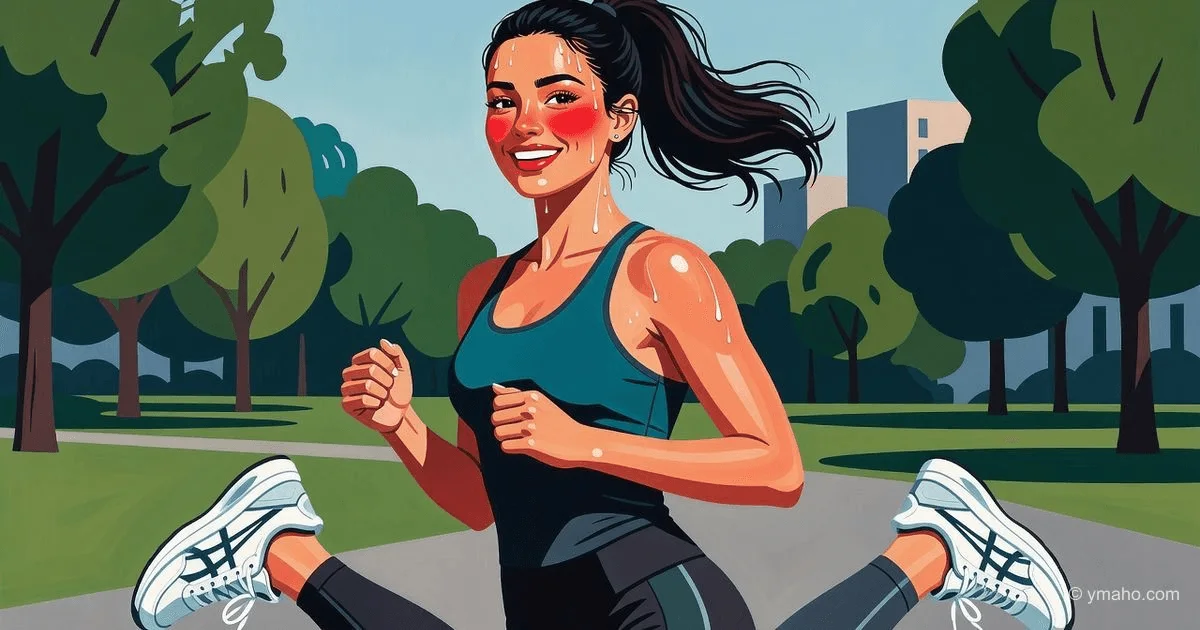
The campaign uses ultra-authentic visual aesthetics: no filters, no makeup, only faces flushed from exertion, disheveled hair, and beads of sweat. In an era when every beauty video on TikTok is filtered to the point of a plastic doll, this looks like a breath of fresh air. But behind this apparent simplicity lies a complex psychological mechanism.
Non-obvious insight (what is not written in press releases): ASICS is not actually competing with beauty brands. They are competing for the mental space of ritual. The modern consumer spends 22 minutes morning and evening applying layers — it's meditation, it's calming, it's a way to feel in control. ASICS offers an alternative ritual: 15 minutes of movement as a way to achieve the same sense of accomplishment and self-care, but with the bonus of endorphins and real physiological changes. This is a brilliant hijacking of the 'self-esteem anchor' from the beauty industry.
Timeline and Context: Why May 2026?
The choice of date — May 12, 2026 — is not accidental. The campaign launches ahead of the summer season, when consumers are traditionally concerned about their appearance before vacations and beach season. But there is also a deeper context.
Here is the timeline that led to this moment:
- 2021-2022: ASICS conducts the Uplifting Minds Study led by Dr. Brendon Stubbs from King's College London. Result: exactly 15 minutes and 9 seconds of physical activity is enough to start improving mental state. This research becomes the scientific basis for the entire future campaign.
- 2025: The skincare market reaches $162 billion. 74% of women follow multi-step routines morning and evening. Consumer fatigue from complex routines peaks.
- January 2026: ASICS analyzes Google trends and notices a 43% increase in searches for glow and a 375% surge in discussions of 'instant glow.' This is the moment the company realizes the market is ripe for an alternative.
- May 12, 2026: Global launch of 'Get The Glow' — the first 'beauty campaign' in ASICS history.
- June 2026: The campaign gains momentum, with initial responses from beauty influencers including Mia Maugé, Mandy Likes, and Hannah London, who post their unfiltered photos under the hashtag #ASICSGetTheGlow.
An important contextual nuance: this campaign launches against the backdrop of a growing trend toward authenticity in fitness marketing. Bodybar Pilates and Club Pilates have already started moving toward real bodies and ages in their advertising campaigns. ASICS simply extends this logic to the beauty territory.
Who Wins and Who Loses
Winners:
- ASICS Corporation: The company gains access to a new audience — women who previously did not consider a sports brand as part of their 'beauty routine.' The campaign expands ASICS's TAM (Total Addressable Market) beyond runners and tennis players toward the mass wellness consumer. At the same time, production costs for the campaign are minimal — no expensive CGI effects, only real faces.
- Budget-conscious consumers: In an environment where the average price of a luxury serum reaches $150–200, ASICS's message that 'glow is accessible to everyone' sounds like economic liberation. For a generation experiencing inflation and shrinking disposable income, 15 minutes of running in the park is a much more affordable path to 'glow' than another bottle costing half a paycheck.
- Mental health charities: ASICS partners with the UK charity Mind, donating funds for each post with the hashtag #ASICSGetTheGlow. This transforms the campaign from purely commercial to socially significant, increasing audience loyalty.
Losers:
- Mass-market brands that profit from 'glow in a jar' (Laneige, Glow Recipe, Drunk Elephant): Their business model is built on the promise that glow can be bought. ASICS has just stated that the best remedy for glow is cardio. For a consumer spending $40 on a hydrating toner with watermelon extract, this could be a trigger to reconsider priorities. If influencers pick up the trend, sales of 'glow products' could drop by 5–10% by the end of 2026.
- Brands that heavily use filters and retouching in advertising: ASICS has just set a new standard of authenticity. Now any beauty campaign where the model has 'perfect skin' will look outdated and dishonest. This will force the industry to revise its visual production standards.
- Traditional fitness brands (Nike, Adidas) that did not make this move: They missed the opportunity to be the first to occupy the mental space of 'beauty through sports.' Now ASICS is perceived as a pioneer in this niche, and the rest as followers.
What the Media Isn't Saying
The official narrative says: 'Glow comes from within, 15 minutes of movement changes everything.' But let's break down three details that are omitted in glossy reprints of the press release.
- ASICS still sells shoes. Behind all the rhetoric about 'free glow' lies a commercial goal: to sell sneakers. Yes, you can get glow for free, but to get it comfortably, you need proper cushioning and arch support. The cheapest ASICS running model costs around $80–100. That's not 'free,' it's just a different way to spend money. The campaign brilliantly masks commerce as a social mission, but ultimately ASICS is a corporation, not a charity.
- 15 minutes is an averaged manipulation. The study ASICS cites shows that exactly 15 minutes and 9 seconds is enough to start improving mental state. But to see visible skin changes, weeks and months of regular activity are needed. The campaign deliberately conflates the mental effect ('you feel better') with the physical ('you look better'). Feeling better after 15 minutes — yes. Looking like a photoshopped Vogue cover after 15 minutes — no. This is a classic bait-and-switch.
- Not all skin glows after sports. For people with rosacea, couperose, or acne, increased blood flow after a workout can lead to redness and inflammation, not the desired 'glow.' The campaign does not account for dermatological differences across skin types. For many, 'post-run glow' is a flushed complexion that an hour later turns into oily shine and enlarged pores. ASICS creates a universal narrative that doesn't work for everyone.
Forecast: The Next 30 Days and 90 Days
Next 30 Days (June – July 2026): Wave of Imitations and Beauty Responses
Within a month, we will see an avalanche of reactions from the beauty industry. The first to respond will be brands that cannot afford to ignore the challenge. L'Oreal will release a study showing that 'skincare + sports give better results than sports alone.' Estée Lauder will launch a campaign with fitness influencers who use their serum before and after a workout — an attempt to join the trend rather than fight it.
Also in the next 30 days, ASICS will expand its pool of ambassadors. Currently, the campaign features Zeynep Sönmez (tennis) and Belinda Bencic. By July, runners, trail runners, and, more importantly, beauty bloggers will start posting their 'post-workout selfies' under the hashtag #ASICSGetTheGlow. The key success metric is not shoe sales, but the number of UGC posts.
Next 90 Days (August – September 2026): Institutionalization of 'Sporty Glow'
By the end of summer, it will become clear whether the campaign has grown into a long-term trend or turned out to be a one-time PR activation. I predict that by September we will see three consequences.
First: the emergence of a new cosmetics segment — 'pre-workout beauty' (products that prepare the skin for exertion and protect it during sweating). Brands will start releasing hydrating sprays with electrolytes for use before running and gels with salicylic acid to prevent breakouts after.
Second: ASICS will launch a collaboration with an actual beauty brand. A logical step would be a partnership with a brand that produces sunscreen (outdoor sports = UV protection). If ASICS strikes a deal with Supergoop! or Coola, it would be an ideal symbiosis: 'movement for glow + protection to preserve results.'
Third: the risk of a 'boomerang effect.' If consumers start massively abandoning skincare in favor of sports but do not see immediate changes (and changes take time), disappointment in both approaches may set in. ASICS will need to manage expectations: 15 minutes of running will not erase wrinkles accumulated over 40 years of life. The campaign risks creating a new form of body anxiety — 'I don't run enough, so I'm not beautiful enough.'
Nevertheless, 'Get The Glow' will remain in marketing textbooks as an example of how a brand from one category can redefine the rules in a completely different one. ASICS did not defeat the beauty industry — but it made it nervous. And in a world where attention is worth $162 billion, making competitors nervous is already a victory.
— Editorial Team